


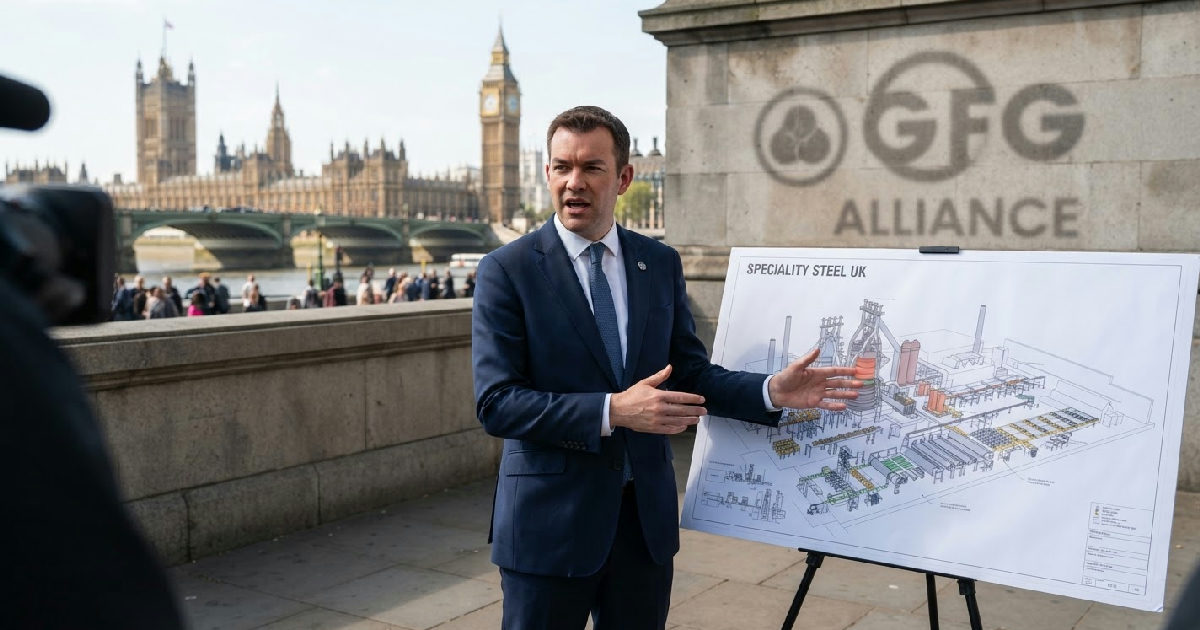
The UK government confirmed its intention for a Speciality Steel UK takeover on Monday, 14 September 2026, to bring the company into public ownership. This move, a Speciality Steel UK takeover, underscores an increasingly interventionist approach to safeguarding domestic steel production, particularly for specialist materials critical to the nation’s engineering and defence sectors.
Business Secretary Jonathan Reynolds is expected to address Parliament on the future of SSUK, a significant producer of specialist and lower-carbon steel. The company, previously part of Sanjeev Gupta’s GFG Alliance, had been maintained by the government since its intervention in 2025, funding the independent court-appointed Official Receiver to maintain site safety and pay staff while a buyer was sought.
Failed Private Rescue Efforts and the Speciality Steel UK Takeover
The decision to pursue nationalisation for SSUK came after a proposed acquisition by Norwegian steel start-up Blastr Green Steel was deemed unviable. Blastr Green Steel had previously been granted preferred bidder status and aimed to establish a lower-carbon steelmaking operation in the UK.
However, reports indicate that the UK government rejected Blastr Green Steel’s bid due to “serious concerns about the proposed financing” and its ability to provide long-term stability. Blastr Green Steel expressed disappointment, stating its offer was “fully-funded – at no cost to the British taxpayer – that is ready to complete within 12 weeks.” This rejection paved the way for the government’s direct intervention.
The Strategic Imperative of UK Steelmaking
This latest move follows the government’s formal nationalisation of British Steel in July 2026, highlighting the continued emphasis on maintaining domestic steelmaking capacity. British Steel was brought into public ownership under the Steel Industry (Nationalisation) Act 2026, passed on 15 July 2026, to protect jobs and critical infrastructure. The government views steel production as a key component of national security and economic resilience.
SSUK presents a challenge, with its production not currently active since the government’s initial intervention in 2025. This contrasts with British Steel, which has remained operational under state control. Nevertheless, SSUK is considered a vital part of the UK’s industrial foundation, supplying specialist steel products to critical sectors. These include aerospace, defence, automotive, and energy.
Its products, such as aircraft landing gear parts, helicopter rotors, missiles, and artillery casings, underline its irreplaceable role in high-value domestic industrial capability. Maintaining this capacity is crucial for supply-chain resilience, reducing reliance on overseas markets, and mitigating geopolitical and price risks for UK manufacturers.
Financial Implications and Government Support
Bringing SSUK into public ownership carries substantial financial implications. The government’s acquisition of SSUK is estimated to cost around £350 million, which is expected to be funded from the remaining portion of the £2.5 billion allocated in Labour’s 2024 manifesto for steel sector support.
The government has already committed significant funding to the broader steel sector through the National Wealth Fund (NWF). Launched in October 2024, the NWF aims to mobilise private investment across strategic sectors, including green steel, with at least £5.8 billion allocated. This includes a £500 million investment for Tata Steel’s Port Talbot site, demonstrating a concerted effort to modernise and decarbonise the industry.
These investments are part of a wider strategy to help the industry transition towards lower-carbon production. Decarbonisation requires considerable investment, making government support critical for older facilities to adapt. The strategy also aims to return domestic steel production to 40-50% of demand from its current 30%.
Broader Pressures on European Steel
The challenges facing SSUK are not isolated; they reflect wider pressures confronting steelmakers across Europe. High energy costs, intense international competition, and the substantial investment needed for decarbonisation are creating a difficult operating environment. These factors impact profitability and long-term sustainability, necessitating strategic interventions.
For UK manufacturers, the stability of domestic steelmaking extends beyond the steel industry itself. Steel serves as a fundamental input for sectors spanning automotive, construction, engineering, defence, and energy. Any reduction in local production capacity could increase dependence on foreign supply chains, exposing manufacturers to heightened price volatility and geopolitical uncertainties.
The government has reinforced the need to bolster domestic industrial capability, consistently identifying steel as a strategically vital sector. Its Steel Strategy, published in March 2026, outlines goals to stabilise the sector and position the UK as a leader in clean steel production.
The Road Ahead for SSUK and UK Steel Strategy
The immediate priority for SSUK centres on securing a sustainable future for its operations and workforce. The nationalisation process is estimated to take between four and six months. Sources indicate a potential restart of production under state control, safeguarding approximately 1,300 jobs across South Yorkshire and the West Midlands.
This intervention will further define the government’s increasingly hands-on approach to the UK’s steel industry. While it protects strategic assets and employment, it also raises questions about the long-term role of the state in supporting critical manufacturing. Union groups, including Unite and Community Union, have welcomed the move, highlighting SSUK’s importance in critical energy infrastructure and advanced manufacturing.
In addition to nationalisation efforts, the government has implemented new trade measures as of 1 July 2026. These measures reduce overall tariff-free quotas on steel imports by 51%, or 60% compared to previous safeguards, and impose a 50% tariff on imports exceeding these levels.
This aims to shield domestic producers from global overcapacity and unfair trading practices, creating a more level playing field for UK steelmakers.
The combination of direct ownership, financial support through the National Wealth Fund, and protective trade policies signals a comprehensive strategy to revitalise the UK’s steel sector. These actions underscore the government’s determination to maintain a robust domestic steel industry, essential for national resilience and the transition to a low-carbon economy. While the path remains complex, securing vital manufacturing assets is a clear priority.
