



Terra Industries’ newly opened drone production facility in Nigeria’s capital city of Abuja may not have received the same kind of attention as a large factory inauguration, but it quietly signifies what is becoming possible on the African continent.
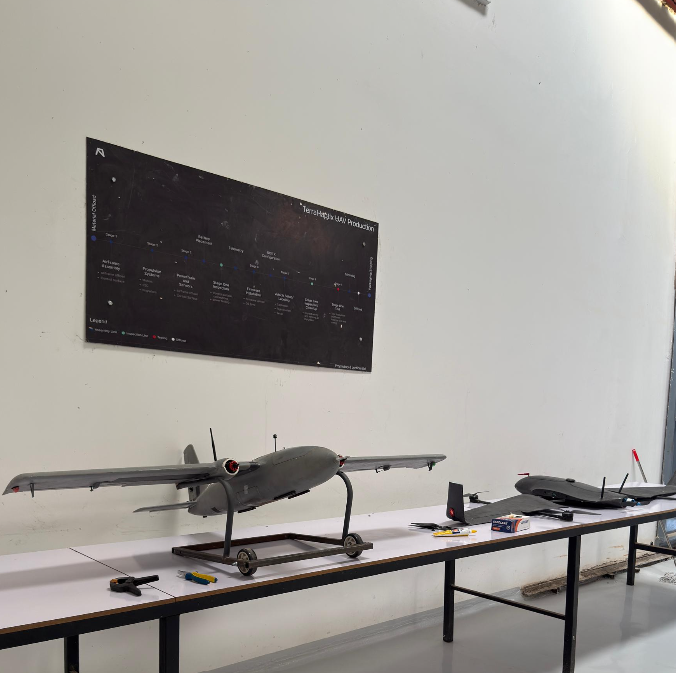
The 15,000-square-foot plant, which was built, outfitted, and operational in under eleven months, takes a full-stack approach to producing autonomous systems.
Design, electronics, software development, assembly, testing, and field support are all housed under one roof, allowing the organization to move quickly and rely less on external partners.
Terra Industries was founded in 2024 by Nathan Nwachuku, 22, and Maxwell Maduka, 24. It creates autonomous defense technology to assist governments and infrastructure operators in monitoring and responding to attacks on land, air, and sea.
Its operations revolve around the Iroko unmanned aerial vehicle, a quadcopter designed for rapid response, perimeter surveillance, and data collection around vital infrastructure.
The Abuja plant can create up to 20 units per day, with approximately 80% of Iroko’s components supplied locally.
How Terra Industries is catching everyone’s attention
The company recently enhanced its position by securing a big massive contract over an Israeli competitor, owing in large part to its supply of hardware-software symbiosis, closely integrated systems developed and constructed together rather than separately.
Terra’s integrated methodology enabled them to collect $11.75 million in seed funding in January 2026, reputedly the largest round of its sort in the region.
Even more striking is the company’s declaration of $11 billion in secured assets, a figure that demonstrates rising investor confidence.
Terra Industries motivation
For years, many African security systems were highly reliant on imported equipment, which became difficult to maintain when proprietary components broke.
Terra is looking to rewrite the narrative with ArtemisOS, a unified, AI-powered operating system that views technology as replaceable rather than locked behind closed designs.
Operators use the same interface to manage an Archer vertical take-off and landing aircraft and a Duma unmanned ground vehicle. In practice, this minimizes operational complexity by allowing a single user to control several systems using a single device.
The Archer itself combines helicopter-style takeoff with the efficiency of fixed-wing flying, eliminating the need for runways and allowing for longer surveillance flights.
Meanwhile, the Iroko has been designed for endurance and scale, with modular components that are durable and suitable for mass manufacturing.
Terra is already aiming for an annual capacity of 10,000 units.
Another standout is the Kallon Sentry Tower, an autonomous surveillance structure designed for situations with unpredictable power supplies.
The tower, which is equipped with solar-harvesting panels and computer-vision technology, can identify threats from up to three kilometers away and notify command centers only when necessary.
The end result is a type of passive security that requires little human intervention while being vigilant.
