


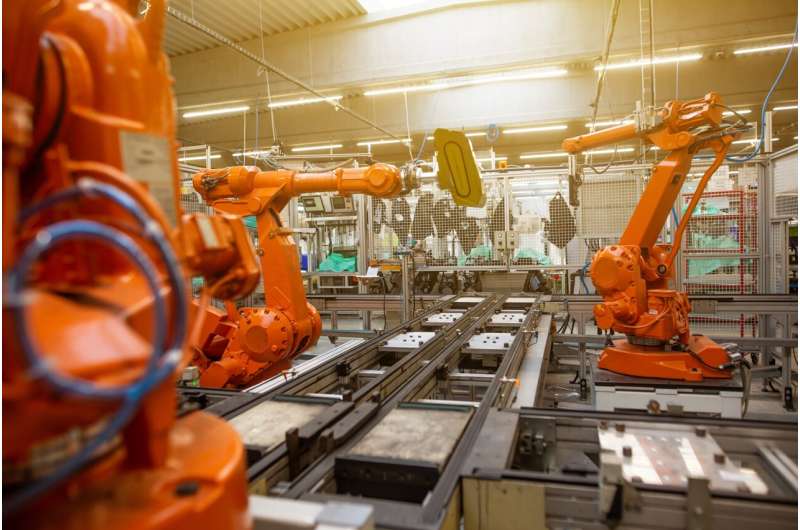
Recently, something happened in Egypt that might actually change the rhythm of factories across North Africa. It wasn’t a flashy tech gala or a billionaire’s vanity project. It was the launch of Raedbots; the country’s first real attempt at building industrial robots on home soil.
For years, if you walked into a high-end factory in Cairo or Alexandria, the “staff” on the assembly line looked like a map of the global supply chain: robotic arms from Germany, sensors from Japan, and software from China. On paper, these machines are world-class. In reality? They’re often a nightmare to maintain in the local climate.
The founders of Raedbots, Mohamed Ibrahim and Hamza El-Sahiti, didn’t start this company just to be “the first”. They started it because they were tired of watching production lines grind to a halt over a single broken sensor that had to be shipped from halfway across the world.
There’s a specific kind of stress that comes with a power fluctuation or a dust storm in North Africa. A machine designed for a sterile, climate-controlled lab in Munich doesn’t always handle the gritty reality of an Egyptian industrial zone very well.
Ibrahim and El-Sahiti saw this gap and realized that Egypt didn’t just need robots; it needed robots that actually “spoke” the local environment.
Raedbots isn’t trying to build a humanoid butler or an AI that writes poetry. Their initial focus is intentionally unglamorous: material handling, packaging, and palletizing. This is the heavy, repetitive lifting that human workers hate and that imported robots often over-complicate.
The strategy here is smart. By mastering the “boring” stuff first (like moving boxes and basic assembly) Raedbots can prove they are reliable before moving into more complex “cobots” (robots that work side-by-side with humans). It’s about building trust in a market that, for decades, has been told that “foreign” always means “better.”
See also: The policy shift redefining African cashew production
The launch comes at a time when Egypt is desperate to stop being just a consumer of high-tech gear. Every time a factory buys a Japanese robot, the high-skilled maintenance and software jobs essentially stay in Japan.
By building these systems in-house, Ibrahim’s team is creating a local ecosystem for engineers and technicians who would otherwise have to move abroad to find work.
It’s a massive gamble, of course. Convincing a factory owner to choose a homegrown brand over an established name like Fanuc or Kuka is an uphill battle. They’ll need more than just patriotism; they’ll need to prove their tech is tougher, faster to repair, and cheaper in the long run.
Raedbots is proud to be a member of NVIDIA Inception, making it one of the first Physical AI and robotics startups in the Middle East to join this prestigious global initiative, as reported by Wamda.
Raedbots is a small step, but it’s a determined one. It joins a growing list of African-led STEM projects (from fintech in Lagos to solar tech in Nairobi) that are moving away from the “import-everything” model.
It’s a signal to the rest of the world that the region is no longer content with just being a market for the future. They want to be the ones building it.
