


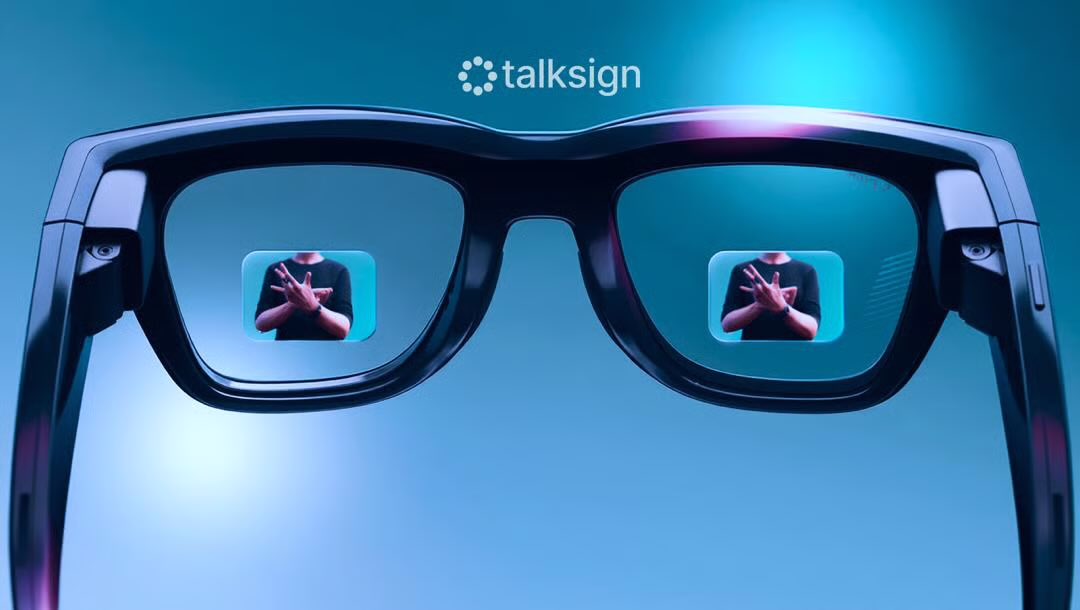
Nigeria’s assistive technology landscape may be entering a new phase with the emergence of a groundbreaking real-time sign language translation system built by the Nigerian and UK-based AI company, Talksign.
In a country where millions of individuals have hearing impairments and accessibility tools are limited, Talksign-1, an AI-driven translation tool, could be a turning point for inclusive technology in Nigeria.
Talksign-1, developed by Nigerian-founded AI business Talksign, is a real-time sign language translation model that uses a regular webcam to turn sign language into speech and text, as well as spoken or typed words back into sign language video.
The engineering behind the idea Talksign-1
The system’s principal sensor input is a normal RGB webcam, which captures hand trajectories, facial expressions, and upper-body motion.
These inputs go through a computer vision pipeline, which extracts skeletal keypoints and motion vectors before putting them into a trained recognition model.
The output is subsequently converted to text or speech via natural language processing and synthesis tools.
The reverse method, which converts speech or text into sign output, uses pre-designed sign animations or video sequences.
What makes Talksign-1 particularly notable in a Nigerian and broader African context is its emphasis on real-time inference and minimal hardware requirements.
The system reportedly operates with sub-100 millisecond latency
Technically, sign language recognition is far more sophisticated than speech recognition. It is more than just gesture detection.

Practicality of Talksign-1
Sign languages use grammar, facial expressions, spatial location, and temporal sequencing. Subtle changes in hand position or facial muscle activity might cause meaning to vary.
The greater significance of Talksign-1 stems from what it says about Nigeria’s developing technical capacity.
Historically, the country’s tech ecosystem has been heavily focused on financial and digital services. Deep-tech innovation, particularly AI systems based on computer vision and multimodal modeling, has been rather rare.
Talksign-1 signals a transition to more complicated engineering domains. Creating such a system necessitates multidisciplinary knowledge in machine learning, embedded optimization, user interface design, and accessibility requirements.
It also places Nigeria in worldwide discussions about inclusive AI design, rather than merely commercial automation.
