


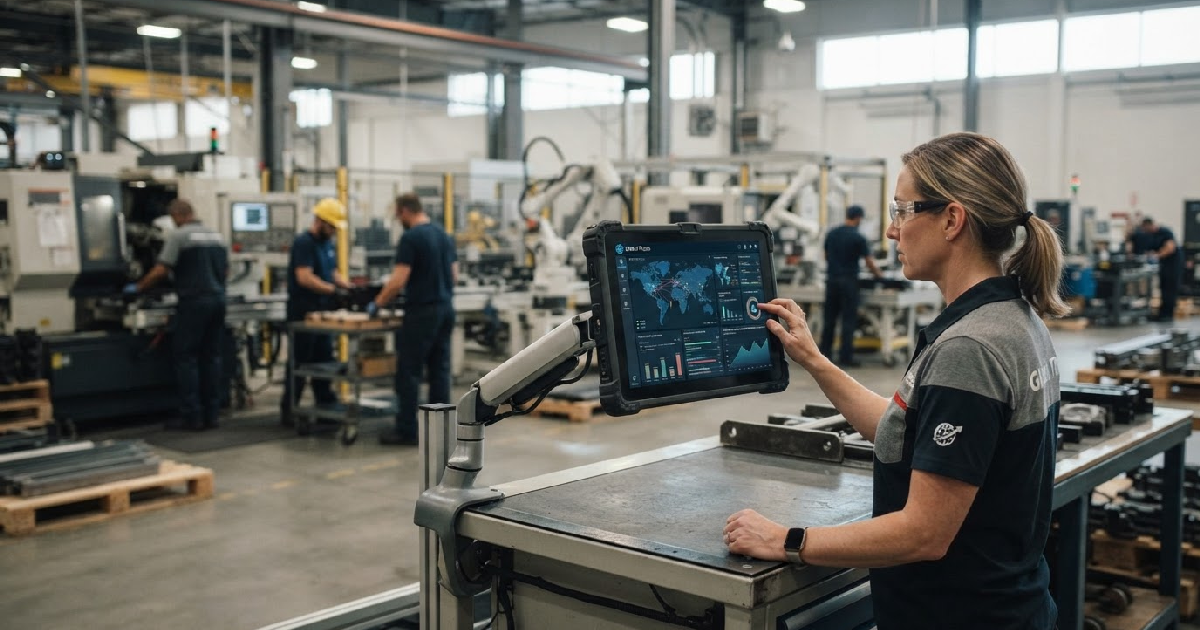
Manufacturers are integrating AI-enabled supply chains into their operations, a critical move as global volatility continues to expose weaknesses in traditional models, helping manufacturers turn resilient.
By mid-2026, artificial intelligence is no longer a concept confined to executive discussions; it’s becoming a key driver of global trade and economic activity. Companies are actively reshaping their practices, with 75% reporting changes to their supply chains based on lessons learned from the recent past.
Building resilience with AI in supply chain management
The past decade unequivocally demonstrated the fragility of manufacturing supply chains optimised solely for cost. Events like the COVID-19 pandemic, geopolitical instability, labour strikes, and climate-related incidents underscored how traditional “just-in-time” delivery models could prove brittle under pressure.
This inability to quickly adjust supply to meet changing demand highlighted the urgent need for AI. Manufacturers need systems capable of absorbing shocks and ensuring continuity, making the pivot from mere efficiency to inherent resilience a core business objective.
AI’s role in enhancing visibility and automation
AI provides real-time insights, automation, and predictive tools that overcome traditional supply chain limitations. It significantly enhances visibility by delivering current data, enabling faster and smarter decisions.
This technology also strengthens internal operations, which leads to reduced downtime and improved operational resilience across the board. AI can automate up to 80% of manual tasks in supply chain management, freeing up human capital for more complex strategic work.
Quantifiable benefits of AI adoption
The returns from integrating AI into supply chain management are tangible and significant. Early adopters have reported substantial improvements, showcasing the technology’s direct impact on operational metrics.
These companies reduced logistics costs by 15%, improved inventory levels by 35%, and enhanced service levels by 65%. A 2022 McKinsey survey also confirmed that AI offers the highest cost savings within supply chain management.
Operational efficiency and risk reduction
AI dramatically improves supply chain management efficiency by 40% through advanced data processing, trend prediction, and automated task execution. Businesses leveraging AI in their operations have seen up to a 50% reduction in forecasting errors, alongside a 65% decrease in lost sales.
Companies with AI-mature supply chains are notably more profitable, being 23% ahead of their peers. Furthermore, AI adoption has reduced fulfilment costs by an average of 23% for organisations that have implemented it at scale.
Keevlar research shows that businesses adopting AI or automation across their sourcing operations are 3.7 times less likely to suffer during periods of volatility. AI tools can also reduce excess inventory carrying costs by up to 15%, a crucial factor in optimising capital expenditure.
Advanced AI applications and predictive capabilities
The true power of AI in modern manufacturing lies in its advanced predictive and simulation capabilities. It allows organisations to move beyond reactive measures to proactive risk management and strategic planning.
This foresight is particularly valuable for navigating the unpredictable nature of today’s global supply networks. Such tools transform how companies prepare for and respond to potential disruptions.
Simulating scenarios and orchestrating responses
AI-driven simulations and digital twins allow organisations to stress-test various supply chain scenarios, preparing for disruptions before they occur. Predictive risk management models offer insights into probable events such as extreme weather, geopolitical risks, and transportation delays.
Generative AI, for example, simulates thousands of “what-if” scenarios, optimising safety stock levels and identifying single-source risks across global supply networks. This helps to pinpoint potential vulnerabilities and develop robust contingency plans.
Agentic AI takes this a step further, coordinating actions across multiple functions, systems, and stakeholders, effectively moving beyond mere automation to sophisticated orchestration. It enables automated re-routing and decision-making based on live conditions, providing proactive intelligence to overcome visibility and resilience gaps.
AI can detect and react to anomalous patterns in real-time by tracking indicators, helping firms respond to crises and strengthen supply chains before they are severely strained. PepsiCo used AI and digital twin technology to identify 90% of potential issues in plant operations, which allowed them to optimise configurations and boost capacity.
Penske Logistics expects 30-40% productivity gains from its deployment of a new AI platform from Augment. These systems continually recommend changes based on factors like seasonality and macroeconomic trends, ensuring dynamic and adaptive supply chain management. Only 21% of supply chain leaders currently have true end-to-end visibility, underscoring the potential for AI to bridge this critical gap.
The broader impact of AI in industrial operations
AI’s influence extends beyond core supply chain mechanics, touching various aspects of industrial operations and consumer perception. Its integration signals a shift towards more intelligent and responsive manufacturing environments.
This widespread adoption highlights AI’s foundational role in the future of industrial productivity. It’s becoming an indispensable tool for businesses seeking a competitive advantage.
AI’s reach across manufacturing applications
A significant 41% of manufacturers now use AI for supply chain optimisation. Computer vision is particularly prevalent, with 63% of companies using it for quality control and inspection, making it the most widely adopted specific AI manufacturing application.
The global AI in supply chain market, valued at $9.94 billion in 2025, is projected to reach $236.42 billion by 2035, growing at a 37.3% CAGR. Another estimate places the market at $192.51 billion by 2034. The supply chain management AI market alone is valued at $40.4 billion in 2025, with projections to reach $101.8 billion by 2033 at a 10% CAGR.
Interestingly, 70% of consumers would be more willing to buy from a brand if they knew it used AI to manage its supply chain, showing a growing public appreciation for its benefits. The intersection of physical automation hardware with AI-driven decision-making, where precision components meet on-demand manufacturing capacity, defines the leading edge of advanced manufacturing solutions.
African industry: opportunities in AI adoption
The global push towards AI-enabled, resilient supply chains presents a significant strategic opportunity for African manufacturing. While often navigating complex logistical and infrastructure challenges, many African nations can bypass older, less efficient systems by adopting these advanced technologies from the outset.
Investment in smart factories and AI-driven supply networks could attract foreign direct investment and bolster local production capabilities. It could also integrate African economies more effectively into global trade. Prioritising localised production and intelligent sourcing within the continent would build resilience against external shocks, fostering regional economic stability.
This approach would not only enhance operational efficiencies but also create new high-skilled jobs and drive innovation. Ultimately, it would strengthen Africa’s position in the global industrial landscape. The ability to model and respond to local market conditions with AI offers a powerful competitive advantage for growing industries across the continent.
