


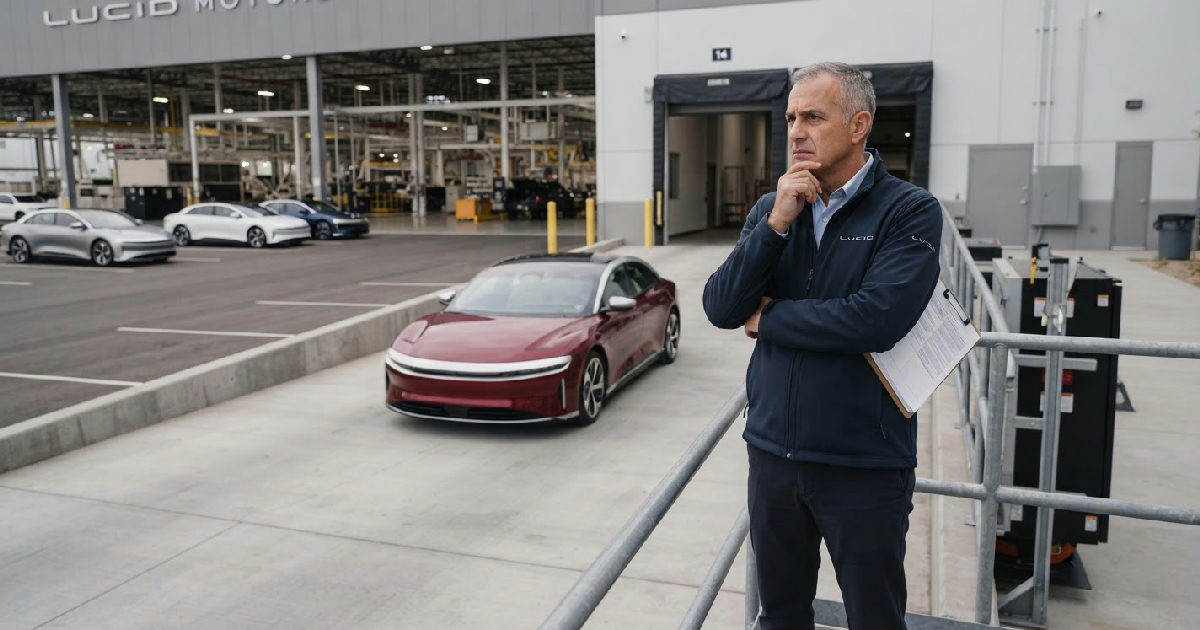
Lucid Motors produced 2,954 electric vehicles in the third quarter of 2026, its lowest quarterly production total since the first quarter of 2025. The figure was 24.1% lower than the same period a year earlier, as the company reduced production to align output with demand and lower inventory.
The company also reported 3,806 deliveries, down 6.7% year on year. The lower production level comes as Lucid seeks to reduce inventory and improve its financial position.
Lucid Reduces Production to Manage Inventory
The production reduction follows several quarters in which Lucid produced more vehicles than it delivered. Lucid had produced more vehicles than it delivered in five of the previous six quarters, contributing to higher inventory.
CEO Silvio Napoli has launched what the company describes as a “simplify the company” effort. As part of the effort, Lucid reduced operations at its Arizona manufacturing facility from two shifts to one in June 2026.
The company also announced plans affecting about 1,500 employees as part of a broader effort to reduce costs and improve cash flow by $1.4 billion in 2026.
Notably, Q3 2026 marked the first time since Q3 2025 that Lucid’s deliveries surpassed its production, with 3,806 vehicles delivered against 2,954 built. The difference between deliveries and production reduced the number of vehicles added to inventory during the quarter.
Lucid’s Production Challenge Reflects a Competitive EV Market
Lucid’s current production levels are well below the volumes projected when the company went public in 2021. When Lucid went public through a merger with a special purpose acquisition company in 2021, its forecasts included deliveries of up to 90,000 vehicles in 2024.
Lucid’s actual deliveries have remained well below that projection.
The company has notably struggled to attract buyers for its initial luxury offerings, the Lucid Air and the newer Gravity SUV, which saw production begin just prior to the first quarter of 2025.
This challenge is amplified by a broader cooling in demand for high-priced EVs, as consumers become more price-sensitive and traditional automakers expand their electric lineups.
The wider automotive industry is experiencing a complex period, with some sectors showing resilience. Automakers continue to adjust production and product strategies as demand and technology develop.
Napoli Outlines Changes to Lucid’s Operations
During Lucid’s second-quarter earnings call in August, CEO Silvio Napoli discussed the company’s performance and operational challenges. He acknowledged that despite bringing what he described as “leading innovations and outstanding products to the market,” Lucid had “disappointed on several fronts, and for far too long.”
Napoli pinpointed several critical areas of failure, including inconsistent execution, missed commitments, and launching products prematurely. He also cited underinvestment in service, slow responses to quality issues, and internal complexity hindering decision-making as key contributors to the company’s inability to gain significant market traction. Napoli’s comments were accompanied by measures aimed at reducing costs, simplifying operations and improving execution.
Lucid Delays Cosmos Launch as It Revises Product Strategy
Part of Lucid’s strategic recalibration includes delaying the launch of its third EV model, the Cosmos. The Cosmos is expected to be positioned below Lucid’s current luxury models, with reports putting its target starting price below $50,000.
However, Napoli has cautioned against rushing the Cosmos to market, stating that the company “will not repeat the mistakes of the past by bringing a product to market before it is ready.” The comments indicate that Lucid intends to prioritise product readiness before launching the vehicle.
Lucid has set a target of $1.4 billion in cash-flow improvement for 2026. The target comprises approximately $600 million to $800 million from reducing vehicle inventory, $500 million from capital-expenditure optimisation and $200 million from operating-expense savings.
The measures are intended to reduce cash requirements and operating costs while supporting Lucid’s near-term financial position.
Industry Implications and African Outlook
Lucid’s production reduction illustrates the importance of aligning manufacturing capacity with vehicle demand. The company’s experience also highlights the importance of matching product development and manufacturing capacity with market demand. The luxury EV segment, particularly, faces unique challenges in carving out significant market share against established premium brands and a growing array of more affordable electric options.
Lucid’s experience may also be relevant to emerging EV markets, including those developing in Africa, that are considering or embarking on their own EV manufacturing initiatives. For emerging EV manufacturers, production capacity needs to be considered alongside demand forecasts, vehicle pricing and the characteristics of the target market.
Napoli’s emphasis on quality, service and supply-chain management also highlights operational considerations that can apply across manufacturing markets.
As African countries develop electric-mobility strategies, market demand, vehicle affordability and manufacturing capacity will remain relevant considerations. Lucid’s experience illustrates the risks of expanding production ahead of demand and the importance of matching product positioning with target markets. For African manufacturers, the relevance of these lessons will depend on local demand, infrastructure, supply chains and manufacturing economics.
