


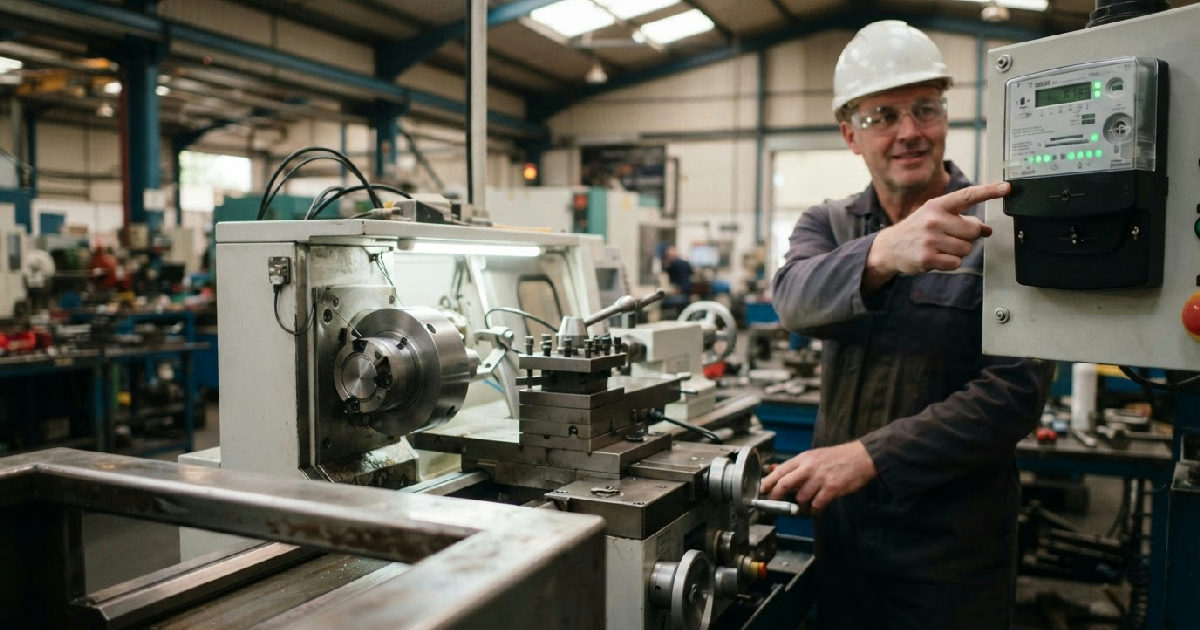
Eligible manufacturers in Great Britain can now apply for the British Industrial Competitiveness Scheme (BICS), which is intended to reduce electricity costs by up to 25%.
The scheme follows government analysis that identifies high industrial electricity costs as a competitiveness challenge for UK manufacturers. BICS aims to reduce electricity costs for eligible manufacturers, potentially freeing funds for other business activities.
Addressing Manufacturing Electricity Costs
UK manufacturers have faced higher electricity costs than many European competitors. In the second half of 2025, large UK businesses reportedly paid about 130% more for electricity than the EU14 median.
The disparity was also evident in 2023, when the UK recorded the highest industrial electricity prices among the 24 countries included in the cited IEA comparison. The comparison found UK industrial electricity prices were nearly 50% higher than those in France and Germany and about four times those in the United States and Canada.
BICS addresses electricity costs by exempting eligible businesses from certain indirect policy costs included in electricity bills. These include the indirect costs of the Renewables Obligation, Feed-in Tariffs and Capacity Market. The government says the scheme is expected to reduce electricity costs by up to £40 per MWh for more than 10,000 manufacturers.
Understanding BICS Eligibility and Application
The scheme covers eligible manufacturing businesses in the Industrial Strategy’s frontier industries and foundational manufacturing industries, subject to the relevant electricity-intensity thresholds. To qualify, companies must meet the scheme’s eligibility requirements, including requirements relating to their sector, products and electricity use.
Applicants must be registered with Companies House, operate in an eligible sector identified by Standard Industrial Classification (SIC) codes, manufacture eligible products identified by Harmonised System (HS) codes, and meet the relevant electricity-use requirements. They must also manufacture eligible products in Great Britain and meet the scheme’s minimum electricity-use requirements. The government provides an online checker for an initial indication of eligibility, though the full application determines final qualification.
Manufacturers must prepare the required evidence before submitting an application because applications cannot be amended after submission. Required evidence includes Companies House information, electricity meter details for each site and six consecutive months of electricity evidence from within the previous 12 months. Applicants must also provide evidence of the products they manufacture and other information required by the application guidance.
Applications require a GOV.UK One Login for Business, with some applicants required to complete identity verification. While one application can cover multiple manufacturing sites under a single legal entity, only one application is permitted per legal entity each year. A single application can cover multiple manufacturing sites operated by the same legal entity.
Key Details of the British Industrial Competitiveness Scheme
- Scheme Name: British Industrial Competitiveness Scheme (BICS)
- Purpose: To reduce electricity costs for eligible manufacturing businesses by up to 25%.
- Application Window (Current Round):
- Opening Date: 1 October 2026
- Closing Date: 30 November 2026 at 11:59 PM
- Eligibility Decisions Confirmed: January 2027 (specifically by 8 January 2027 per thenationalenergyhub.co.uk)
- Renewables Obligation (RO) and Feed-in Tariffs (FiT) Exemptions Begin: April 2027
- Capacity Market (CM) Exemption Begins: October 2027
- One-off Backdated Payment: Expected in 2027 for first-round applicants, covering support from April 2026 onwards.
- Scheme Review: 2030 (first period runs to 2035).
- Criterion 1: Business must be registered with Companies House.
- Criterion 2: Business must operate in an eligible sector, identified by Standard Industrial Classification (SIC) and Harmonised System (HS) codes.
- Criterion 3: Business must manufacture eligible products in Great Britain.
- Criterion 4: Business must meet the scheme’s minimum electricity usage requirements.
Industry Response and Broader Economic Impact
Minister for Reindustrialisation Blair McDougall said the scheme could support more than 10,000 manufacturers, with electricity costs reduced by up to £40 per megawatt hour. The scheme also includes an additional payment reflecting support that eligible businesses would have received from April 2026.
BICS adds to existing government support for energy-intensive industries. For energy-intensive manufacturers, the scheme provides another mechanism for reducing electricity costs.
However, some energy-intensive industries have argued that BICS does not address their main energy-cost pressures. INEOS announced in September that it would mothball its three acetyls plants at Saltend in Hull, citing European gas prices that it said were 12 times higher than US prices. The company also argued that BICS’s focus on electricity costs does not fully address the position of industries that rely heavily on gas.
This highlights a key challenge for some energy-intensive sectors, where gas rather than electricity drives the majority of operational expenditure. INEOS called for further measures, including lower carbon-related costs, greater domestic energy supply and measures to address imports. INEOS argued that such measures would help address its concerns about energy costs.
Ceramics Industry Concerns About BICS Eligibility
Rob Flello, CEO of Ceramics UK, raised concerns about the eligibility criteria for some manufacturers. He said producers of some concrete or stone products qualify while certain clay-brick and tile manufacturers do not, arguing that this could affect competition between manufacturers.
Flello also argued that refractories should be eligible and called for greater transparency in the decision-making process. With applications closing on 30 November, Ceramics UK has called for greater clarity on eligibility. The organisation has also referred to the government’s earlier commitment to a dedicated ceramics support scheme.
BICS and the UK’s Industrial Strategy
BICS forms part of the government’s wider Modern Industrial Strategy. The wider strategy includes measures intended to support manufacturing investment, industrial capacity and employment.
Blair McDougall is Parliamentary Under-Secretary of State (Minister for Reindustrialisation), with responsibilities jointly covering the Department for Business, Innovation, Science and Trade and the Department for Energy Security and Net Zero. His responsibilities include industrial strategy implementation, advanced manufacturing, energy, steel and other industrial policy areas.
Industry bodies including the Confederation of British Industry (CBI) and Make UK have welcomed aspects of the scheme while calling for further action on industrial energy costs. CBI Chief Executive Rain Newton-Smith described the scheme as significant but said it was “not ‘job done’” on industrial energy costs.
Make UK CEO Stephen Phipson similarly welcomed the scheme but said it did not provide an “immediate solution” for all manufacturers.
The responses indicate that industry groups see BICS as one element of the wider industrial competitiveness debate. Industry competitiveness also involves factors such as skills, infrastructure and investment conditions.
BICS provides near-term electricity-cost support, while the wider industrial strategy covers other issues affecting manufacturing competitiveness. For eligible manufacturers, the scheme provides a mechanism for reducing electricity costs, with applications open until 30 November 2026.
