


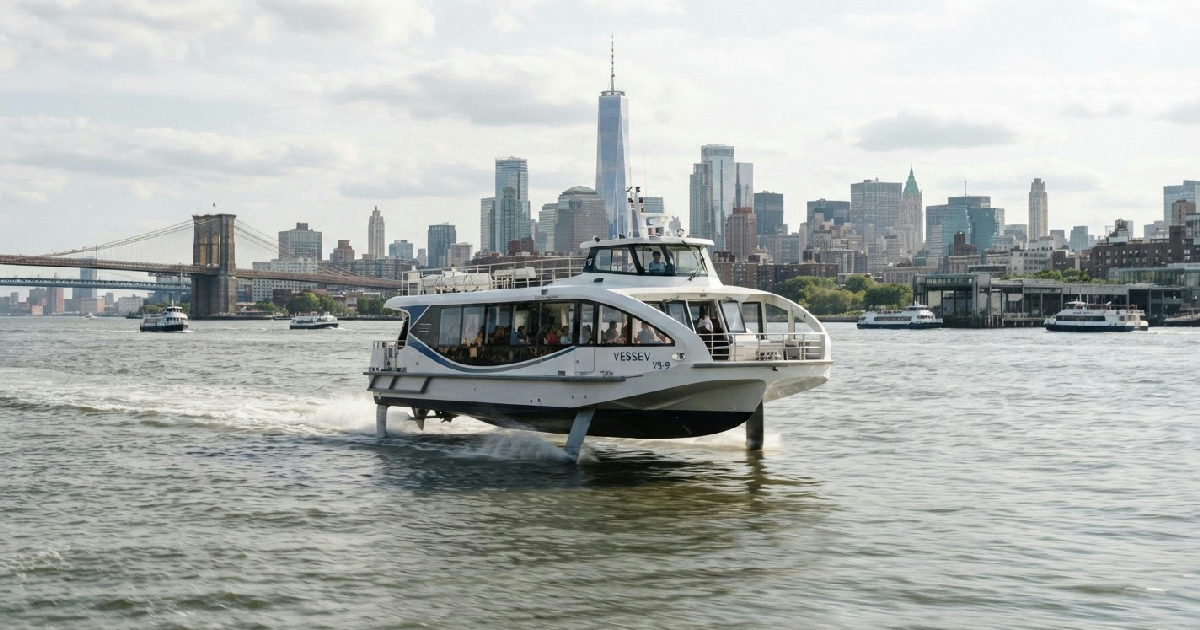
Vessev is developing the VS-9 electric hydrofoil ferry for urban water transport.
The company secured $19 million in Series A funding in August, which it plans to use to support production and market expansion. The funding will support Vessev’s development of high-speed, low-wake water transport. The VS-9 was demonstrated in New York City, where its hydrofoil system allowed the vessel to lift its hull above the water while travelling.
How the Vessev VS-9’s Hydrofoil Design Works
The VS-9 uses hydrofoil technology, a marine design approach that has been developed for more than a century. By lifting much of the hull clear of the water, hydrofoils can reduce hydrodynamic drag at operating speed. This reduction in drag can be particularly relevant to electric boats because lower energy consumption can extend operating range.
The VS-9 has a catamaran-style hull, with two underwater foils providing lift during operation. The foils generate hydrodynamic lift, raising the main hull above the water as the vessel reaches foiling speed. Computer-controlled underwater control surfaces adjust continuously to help maintain the vessel’s stability as it accelerates.
The front foil provides approximately 80% of the vessel’s lift, according to Vessev. The rear foil provides the remaining lift and incorporates the vessel’s electric propulsion system, according to the company. The arrangement is designed to support the transition from displacement operation to foiling mode. Vessev has compared the resulting ride to that of a sports car.
Conventional boats of a similar size can experience increased pitching and impacts with the water as speed rises, depending on hull design and sea conditions. Once the vessel reaches foiling speed, the hydrofoil system lifts the hull clear of the water, reducing contact between the hull and the water surface.. The reduced hull contact can also reduce wake, which may help limit shoreline disturbance and erosion in some waterways.
Vessev’s Approach to Manufacturing and Component Sourcing
Vessev co-founder and CEO Eric Laakmann outlined the company’s approach to manufacturing its electric propulsion system. Vessev designs and produces the VS-9’s electric motors in-house, which the company says helps it control costs and integrate engineering expertise during development. The approach allows Vessev to optimise the powertrain specifically for the hydrofoil application.
The company does not manufacture its own batteries, instead sourcing them from external suppliers. Laakmann said battery technology is sufficiently standardised for Vessev to source battery systems from external suppliers. The company retains development of components such as the motor and control systems while sourcing other components externally.
Operational Context and Market Potential
The VS-9 is designed to carry a full passenger load over a range of up to 40 nautical miles, equivalent to approximately 46 miles or 74 kilometres. This range makes it suitable for numerous short-to-medium distance urban and inter-island routes.
The vessel can also use electric-vehicle charging infrastructure, according to Vessev.
However, hydrofoils are not universally applicable. Their performance depends on water conditions that allow the vessel to maintain foiling operation. For the VS-9, the relevant clearance is approximately 2.5 feet (0.75 metres), according to the company. Larger waves can bring the hull into contact with the water, potentially affecting ride quality and efficiency. This limits the vessel’s suitability for some open-water conditions.
These characteristics can make hydrofoils suitable for some lakes, rivers and sheltered bays. Such waterways can have high passenger-transport demand, while the VS-9’s electric propulsion produces no direct operational emissions. Its low wake could help reduce shoreline disturbance in waterways where vessel-generated wake contributes to erosion.
Vessev is initially targeting transit operations and plans to integrate its vessels into existing urban public-transport networks. Laakmann has said the VS-9 could complement public transport in cities such as New York by providing passenger services between areas including Brooklyn and Queens.
Expanding Horizons and Future Industrial Impact
Beyond public transit, Vessev is also exploring other promising markets for the VS-9. The hotel and tourism sectors are among the other markets being considered, including passenger transport for guests. Public demonstrations have also generated interest in potential private-use applications, according to the company.
The initial VS-9 remains a prototype, while Vessev plans to move towards production. Co-founder Max Olson established the company in Auckland, New Zealand, although the company’s founding year should be stated consistently based on its official records.
Vessev has also discussed the possibility of offering electric hydrofoil kits that could allow other boatbuilders to incorporate its technology into their own vessels. If introduced, such kits could allow Vessev’s technology to be used in a wider range of vessel designs.
Vessev’s development of an electric hydrofoil is part of wider efforts to apply electric propulsion and lightweight marine technologies to passenger transport. Vessev’s in-house motor development gives the company greater control over the propulsion system and its integration with the hydrofoil design, according to the company. Keeping development of the motor and control systems in-house also allows Vessev to retain control over the associated technology and intellectual property.
