


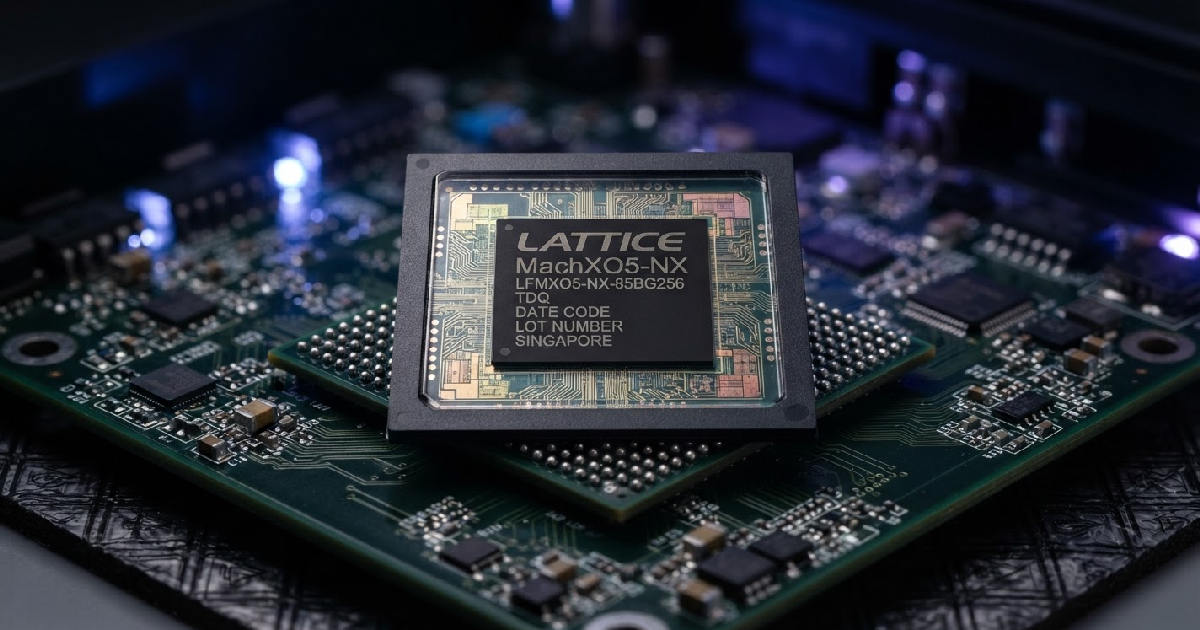
Lattice Semiconductor’s MachXO5-NX TDQ FPGA family has earned a Gold award in the “First-to-Market Innovation” category at the 2026 Globee Awards for Technology.
This achievement addresses critical needs for both encryption key establishment and digital signature requirements, as mandated by evolving quantum-security standards. It underscores the semiconductor firm’s ongoing commitment to developing secure, low-power programmable solutions for an increasingly interconnected industrial landscape.
Lattice FPGA leads the charge in quantum-resistant solutions
The Lattice MachXO5-NX TDQ FPGA stands out for its robust security features, purpose-built to tackle the formidable challenge of quantum computing threats. It represents a significant step in hardware-rooted security, integrating post-quantum cryptography (PQC) directly into its design.
Mamta Gupta, Associate Vice President, Strategic Business Development, Datacenter & Security, at Lattice Semiconductor, emphasised the growing imperative for such technologies. She stated that with the "increased urgency to adopt quantum-resistant solutions, both crypto-agility and hardware-rooted security are becoming more important than ever."
The Globee Awards for Technology specifically acknowledge achievements in innovation, digital transformation, and cybersecurity. They aim to recognise measurable organisational progress across diverse industries and markets worldwide, making this Gold award a strong endorsement of Lattice’s strategic direction.
broader recognition for security and artificial intelligence
This recent accolade is not an isolated event for Lattice Semiconductor; it builds on a series of awards received in 2026, all from the Globee Awards portfolio. On 8 April 2026, the same MachXO5-NX TDQ FPGA family secured a Gold Award in the "Best New Security Solution" category at the Globee Cybersecurity Awards.
This earlier award specifically cited the FPGA as the industry’s first to deliver CNSA 2.0–compliant post-quantum cryptography, crypto agility, and a hardware Root of Trust. Eric Sivertson, Vice President of Security Business, Lattice Semiconductor, highlighted the foundational role of security in the company’s operations.
Mr Sivertson explained, "From post-quantum cryptography to a hardware Root of Trust, our solutions are designed to help customers protect their systems today while preparing for tomorrow." The company’s Lattice Sentry solution stack also received an award for "Embedded Security," and its Cyber Resiliency Program was recognised for "Thought Leadership in Strengthening Cyber Resiliency".
Beyond security, Lattice has also made significant strides in artificial intelligence. On 14 May 2026, the company’s Lattice sensAI solution stack won in the "AI-Powered Quality Control & Defect Detection" category at the Globee Awards for Artificial Intelligence.
Raemin Wang, Vice President of Segment Marketing at Lattice Semiconductor, noted that customers building industrial inspection systems require "consistent, real-time performance within strict power and thermal constraints." The Lattice sensAI delivers low-power, deterministic edge AI to meet these precise needs across industrial, automotive, and consumer systems.
consistent innovation through the years
The consistent recognition from the Globee Awards extends beyond 2026, indicating a sustained pattern of innovation at Lattice Semiconductor. In 2025, the company itself was named the 'Most Innovative Company of the Year' in the Hardware category at the 20th Annual Globee Awards for Technology.
This award, announced on 31 July 2025, also from Hillsboro, Oregon, underscored Lattice’s leadership in providing flexible FPGA solutions. These solutions have set new benchmarks for power efficiency, performance, and broader market impact.
Esam Elashmawi, Chief Strategy and Marketing Officer at Lattice Semiconductor, previously stated the company’s commitment to "bringing breakthrough innovation to our customers and the world that shapes a better future." He noted that the recognition validated their work in delivering customer-centric, scalable, and secure solutions for various applications, from far-edge AI to telecommunications infrastructure and autonomous driving.
securing industrial operations against emerging threats
The implications of Lattice Semiconductor’s work, particularly its secure Lattice FPGA offerings, are substantial for manufacturing and critical infrastructure. As industrial control systems become increasingly interconnected, the attack surface expands, making hardware-rooted security imperative.
Quantum computing, while still developing, poses a long-term threat to current cryptographic standards. Implementing CNSA 2.0-compliant post-quantum cryptography today protects sensitive industrial data and operational integrity from future decryption capabilities.
protecting critical infrastructure at the edge
FPGAs play a crucial role in securing endpoints and critical control points in factories, energy grids, and transportation networks. The ability to perform secure boot, establish trusted communication, and authenticate devices at the hardware level prevents unauthorised access and tampering.
This on-device security becomes vital in scenarios where constant cloud connectivity might be unreliable or introduce latency. Ensuring that industrial assets operate with integrity, even at the network edge, is a key challenge for operational technology professionals.
enhancing quality and efficiency with edge AI
The Lattice sensAI solution stack, recognised for its AI-Powered Quality Control & Defect Detection, offers another layer of operational improvement. Deploying AI at the edge, directly on the device, means real-time analysis without the need to send data to a central cloud.
For manufacturers, this translates to immediate detection of anomalies on production lines, proactive maintenance of machinery, and enhanced product quality control. It provides deterministic performance that is critical in environments where seconds can impact output and safety.
the strategic importance of cyber resilience
The collective recognition of Lattice Semiconductor’s security offerings highlights the strategic importance of cyber resilience in industrial and technological development. Governments and industries globally are pushing for more robust security frameworks to protect national infrastructure and economic stability.
CNSA 2.0, developed by the National Security Agency (NSA) in the United States, represents a significant update to cryptographic standards designed to withstand quantum attacks. Its adoption in commercial hardware like the Lattice MachXO5-NX TDQ FPGA ensures that foundational security elements are quantum-resistant from the outset.
building a foundation for future security standards
By delivering products compliant with emerging standards like CNSA 2.0, Lattice helps industries future-proof their critical systems. This proactive approach mitigates the risk of costly and disruptive security breaches as new computing paradigms emerge.
It also fosters greater trust in the digital supply chain, which is essential for global manufacturing operations and cross-border data exchange. Manufacturers rely on secure communication and verified components, making these FPGA innovations particularly relevant.
lattice’s position in the semiconductor market
Lattice Semiconductor, established in 1983 and traded on Nasdaq as LSCC, has carved out a niche as a leader in low-power programmable solutions. Its focus on small, efficient FPGAs differentiates it from larger competitors, allowing it to address specific market needs in edge computing, IoT, and embedded vision.
The company’s consistent innovation, as evidenced by these Globee Awards, solidifies its position as a key enabler of advanced industrial applications. These FPGAs provide the flexible, high-performance computing required for tasks ranging from sensor fusion to real-time control, all while maintaining strict power budgets.
outlook for industrial adoption
The continued advancement in secure and AI-enabled FPGA technology bodes well for industrial professionals seeking to upgrade their operational technology. Integrating quantum-resistant security and efficient edge AI into industrial systems is no longer a luxury but a necessity for maintaining competitive advantage and operational continuity.
Manufacturers in Africa, like their global counterparts, stand to benefit significantly from these developments. As industrialisation progresses across the continent, the adoption of secure, intelligent, and flexible hardware solutions will be crucial for building resilient and efficient production capabilities, safeguarding investments against both current and future cyber threats.
