


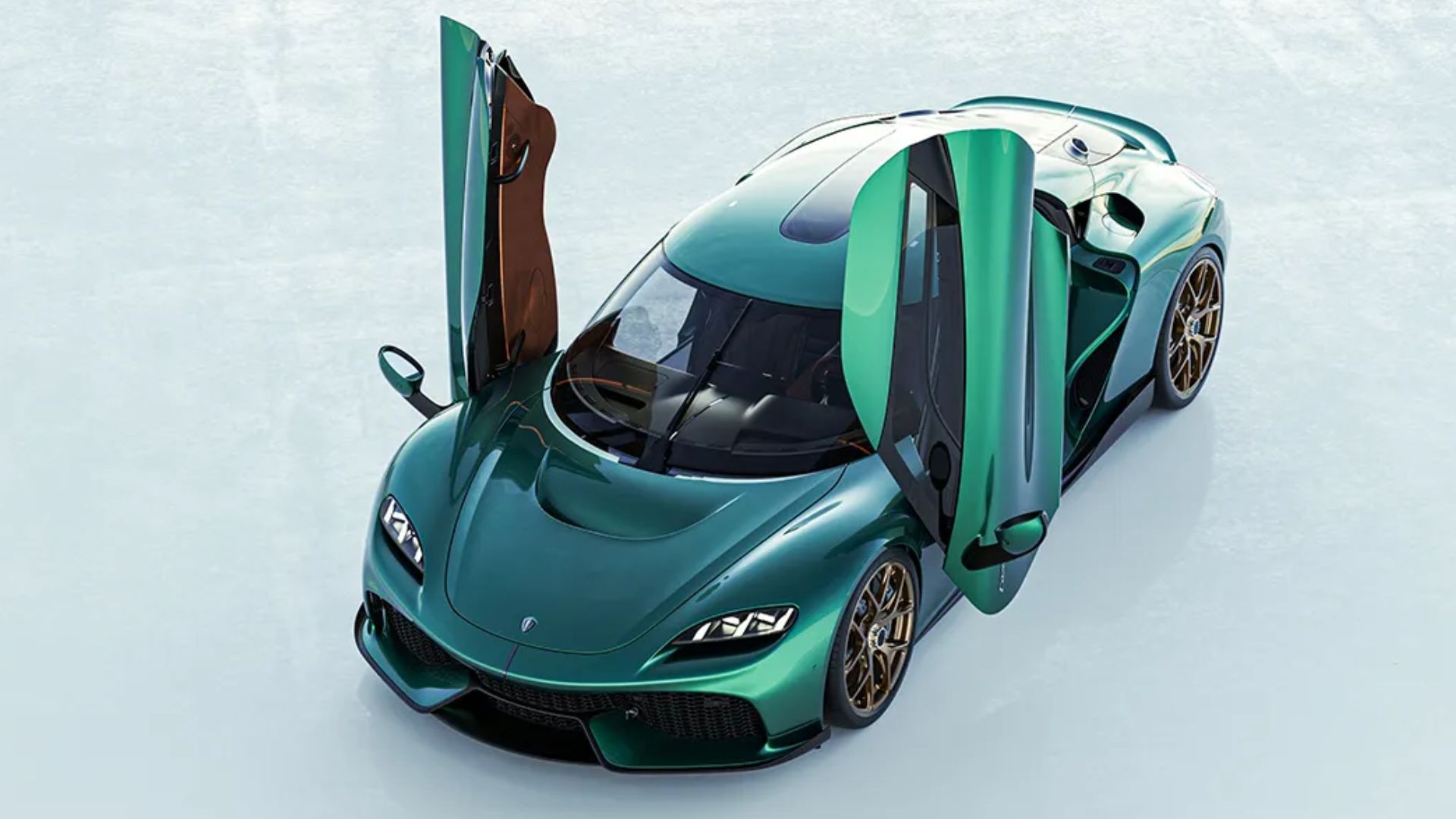
Swedish hypercar maker Koenigsegg has officially started production of the Gemera, its most powerful and most practical hypercar yet. With a staggering 2,300 horsepower and a unique four-seat layout, the Gemera represents a major leap in hybrid performance engineering, blending extreme power with everyday usability in a way that was once considered impossible.
The Gemera is a plug-in hybrid hypercar powered by a combination of a compact 2.0-litre twin-turbocharged three-cylinder petrol engine and three electric motors. Together, they deliver 2,300 horsepower and massive torque, allowing the car to accelerate from 0 to 100 km/h in under 2 seconds and reach a top speed well above 400 km/h.
Despite its supercar performance, the Gemera can also run on electricity alone for short distances and features all-wheel drive with advanced torque vectoring for better handling.
Design approach
What makes the Gemera special is its design philosophy. While most hypercars are strict two-seaters built purely for track performance, the Gemera offers four seats and a more spacious cabin, making it suitable for both thrilling drives and longer journeys with passengers.
Koenigsegg calls it the “world’s first megacar with four seats,” aiming to create a hypercar that can actually be used as a grand tourer rather than just a weekend track toy.
The production line launch, announced this week with new images and details, marks the end of years of development and testing. Each Gemera is hand-built in Koenigsegg’s small factory in Ängelholm, Sweden, where only a limited number will be produced. This exclusivity, combined with cutting-edge hybrid technology, positions the car as one of the most advanced and desirable hypercars of 2026.
For car enthusiasts and the wider world, the Gemera shows how far hybrid technology has come. It proves that extreme performance and reasonable efficiency can coexist; the car can deliver supercar acceleration while still offering electric-only driving and lower emissions than traditional pure-combustion hypercars.
As governments and cities around the world push for cleaner transportation, cars like the Gemera demonstrate that high-performance vehicles don’t have to be left behind in the shift toward electrification.
The arrival of the Gemera on the production line also highlights Sweden’s continued strength in high-end automotive engineering and innovation. From Volvo’s safety leadership to Koenigsegg’s boundary-pushing designs, Swedish companies continue to influence global automotive trends.
While the exact price has not been publicly confirmed, hypercars in this category typically cost several million dollars, making the Gemera an exclusive machine for a small group of collectors and enthusiasts. Deliveries are expected to begin later in 2026.
This is more than just another fast car. It’s a statement that hybrid performance engineering has reached a new level, where raw power, advanced technology, and usable design can finally come together in one extraordinary vehicle.
