


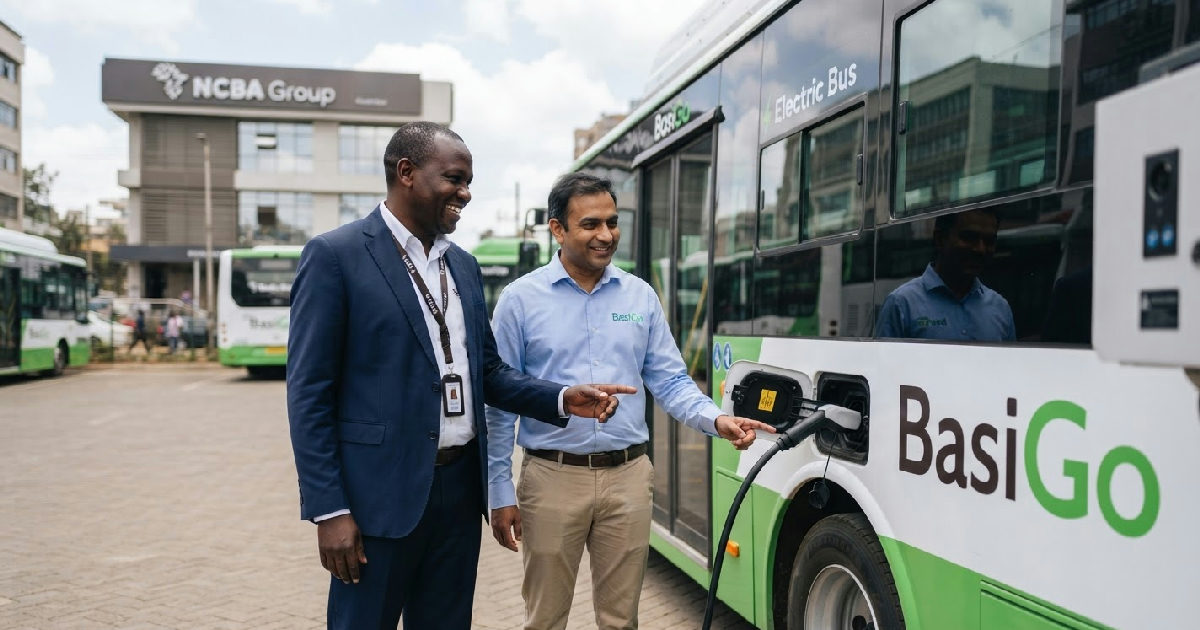
NCBA Group and BasiGo will provide financing for 1,000 electric vehicles, accelerating Kenya’s transition to clean public transport.
Key figures including Robert Marete, Deputy Director & HOD, NCBA Leasing LLP, and Jit Bhattacharya, CEO & Co-Founder of BasiGo, unveiled the deal. This collaboration aims to unlock the next level of scale for electric buses and vans in Kenya, addressing the high upfront cost barrier for PSV operators.
Expanding Kenya EV financing and access to electric public transport
The partnership provides tailored financing options for various PSV entities. Established PSV SACCOs and companies can now access financing for up to 90% of an electric vehicle’s value. This reduces the initial capital outlay, making the switch from conventional diesel vehicles more feasible.
Individual SACCO members also benefit, becoming eligible for financing covering up to 80% of an electric vehicle’s value. Both financing options come with a discounted processing fee of 1.5%, further easing the financial burden on operators looking to upgrade their fleets.
Repayment terms vary depending on the applicant. Established PSV SACCOs and companies receive a repayment period of up to 60 months. This extended timeline offers greater financial flexibility for larger fleet conversions.
Individual SACCO members, meanwhile, have a repayment period of up to 48 months. These structured terms are crucial for integrating new technologies into a capital-intensive sector like public transport.
NCBA Group’s Commitment to E-mobility
NCBA Group’s involvement highlights its strategic focus on sustainable mobility. The financial conglomerate has already allocated a KES 2 billion e-mobility financing facility. More than KES 0.8 billion of this has been deployed into electric vehicle assets within Kenya.
This substantial investment underscores NCBA’s position as a leader in asset finance. It demonstrates a clear institutional belief in the long-term viability and growth of Kenya’s electric vehicle market. The group is actively shaping the financial infrastructure needed for this transition.
Lennox Mugambi, Group Director, Asset Finance and Business Solutions at NCBA Group, articulated this vision. “The transition to electric mobility is not simply about putting more electric vehicles on the road,” he stated. “It is about creating the financing and infrastructure needed to make them commercially viable.”
BasiGo’s Pay-As-You-Drive Model Scales Up
A cornerstone of this partnership is the expansion of BasiGo’s innovative “Pay-As-You-Drive” (PAYD) model. This service package significantly de-risks EV adoption for operators. It tackles concerns about battery life, maintenance, and charging infrastructure head-on.
For BasiGo’s 25-seater K6 electric bus, the daily subscription fee stands at Ksh. 20 per kilometre. This fee covers critical elements like battery leasing, comprehensive maintenance, and access to charging services. It transforms a significant capital expenditure into a manageable operational cost.
The larger 36-seater E9 Kubwa electric bus operates with a mileage-based subscription of Ksh 40 per kilometre. This covers similar services, ensuring operators can predict and manage their running costs effectively. The PAYD model offers free charging at BasiGo Depots and nightly inspections.
Moreover, the PAYD package includes free maintenance at 15,000-kilometre intervals and roadside assistance. Operators also benefit from bus monitoring and analytics, plus a 90% uptime guarantee per month. This comprehensive support ensures operational continuity and efficiency.
Engineering and Operational Benefits for PSV Operators
Adopting electric vehicles through this scheme brings concrete engineering and operational advantages. PSV operators typically face high fuel costs and complex maintenance schedules for diesel engines. Electric powertrains offer a simpler, more efficient alternative.
The K6 electric bus boasts a 250-kilometre range on a four-hour charge, suitable for urban routes. The E9 Kubwa, designed for longer distances, achieves 400 kilometres on a single two-hour charge. These specifications meet the demanding daily operational requirements of public transport.
Reduced moving parts in electric buses lead to lower maintenance complexity and fewer breakdowns. This directly translates to increased vehicle uptime and reduced operational costs over the vehicle’s lifespan. It’s a shift from reactive repairs to proactive management.
The integrated charging and maintenance infrastructure provided by BasiGo further optimises fleet management. Operators gain access to reliable support, allowing them to focus on service delivery rather than complex vehicle upkeep. Many industrial operations prioritise efficiency with data upgrades, a principle BasiGo applies to its fleet.
Kenya’s Ambitious Electric Vehicle Targets
This partnership aligns directly with Kenya’s national electric mobility goals. The government aims for electric vehicles to constitute 5% of all registered vehicles by 2030. This is a significant leap from the current figure, which stands at less than 1% of Kenya’s 4.4 million registered vehicles.
The National Electric Mobility Policy, launched in February 2026, provides a robust framework. It focuses on accelerating EV adoption, expanding charging infrastructure, and creating green jobs. This policy demonstrates a clear governmental push to decarbonise the transport sector.
Kenya has also implemented various incentives to spur EV growth. These include zero Value Added Tax (VAT) on electric buses, bicycles, motorcycles, and lithium-ion batteries. Such fiscal measures reduce the purchase price, making EVs more competitive.
Furthermore, the government has reduced excise duties on selected EVs and exempted EV parts from VAT and excise duties since July 2026. President William Ruto announced tax exemptions for the first 100,000 imported EVs. These incentives are crucial for market penetration.
BasiGo’s Manufacturing and Market Footprint
BasiGo, founded in 2021 by Jit Bhattacharya and Jonathan Green, has rapidly established itself in the East African market. The company initially imported fully or partially assembled electric buses. But since 2023, it partners with Associated Vehicle Assemblers for local assembly in Kenya.
This local assembly component is vital for developing a domestic EV manufacturing ecosystem. It generates local jobs and fosters technical skills within Kenya’s industrial sector. Many advanced industrial robotic solutions increasingly underpin such assembly lines.
By May 2026, BasiGo had already deployed 134 buses across Kenya and Rwanda. These buses collectively covered over 9 million kilometres and transported more than 12 million passengers. This operational track record provides confidence in the reliability of their electric fleet.
The company offers several models, including the BYD K6, the 36-seater E9 Kubwa, the 54-passenger KL-9, and the Ma3e electric van. This diverse product portfolio caters to various segments of the PSV market, enhancing flexibility for operators.
Implications for Kenya’s Industrial Future
This financing deal signifies more than just an increase in electric buses; it represents a tangible step in Kenya’s industrial evolution. Local assembly of these vehicles, coupled with a growing demand, can drive investment in related manufacturing capabilities. This includes components, charging infrastructure, and specialised maintenance services.
The large-scale adoption of electric PSVs could also reduce Kenya’s reliance on imported fossil fuels. This improves national energy security and reduces trade deficits. It channels capital towards domestic energy solutions, such as large-scale power generation projects, which are essential for a robust EV charging network.
Furthermore, the initiative could position Kenya as a regional leader in electric mobility solutions. Demonstrating a successful model for financing and deploying EVs on a mass scale could inspire similar transitions across other African nations. It establishes a blueprint for sustainable urban transport.
Ultimately, the partnership between NCBA Group and BasiGo showcases how financial innovation and engineering solutions can converge to meet environmental and economic objectives. It marks a critical juncture for Kenya’s transport sector, moving it firmly towards a greener, more self-sufficient industrial future.
