


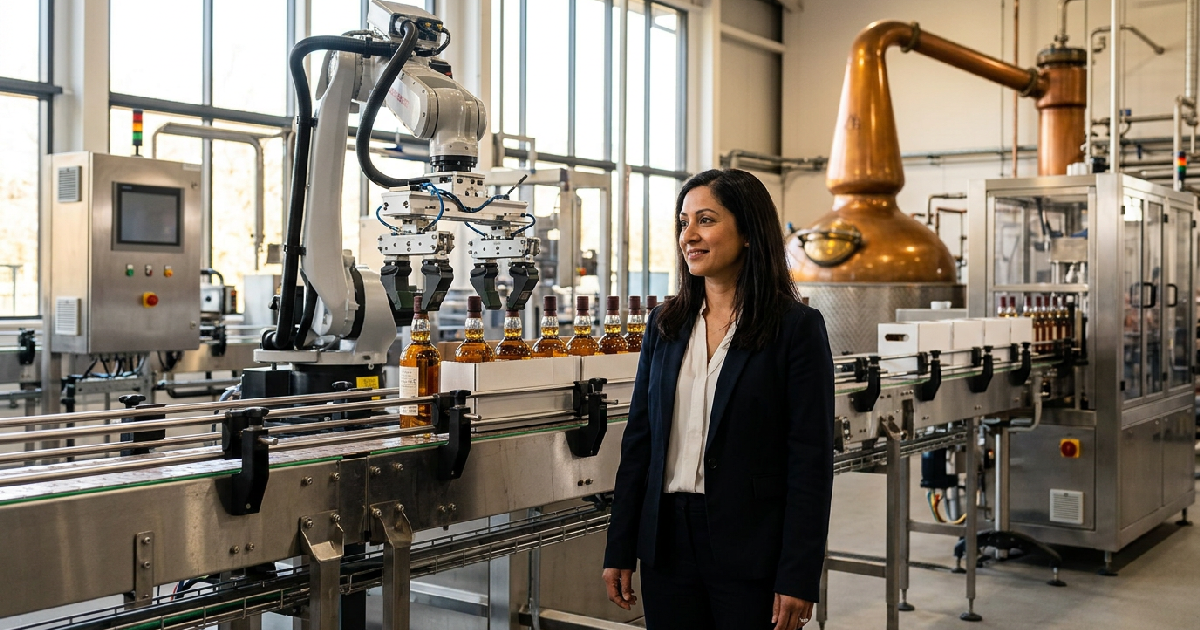
Sarah Badesha, Head of Engineering at Chivas Brothers, is overseeing a significant technological shift at the Kilmalid flagship bottling plant in Dumbarton, integrating high-speed automation while preserving centuries-old distillation traditions. The facility, which serves as a global supply chain node for owner Pernod Ricard, produces approximately 20 million nine-litre cases of Scotch whisky annually. This volume necessitates high-performance production lines, yet the company maintains that the fundamental maturation processes remain unchanged since the business was founded.
The engineering focus at the West Dunbartonshire site centers on ‘Project Optimus,’ a major investment program transforming the Leven and Clyde bottling halls. By deploying digital inspection, data capture, and automation, the plant aims to meet global demand with greater efficiency. However, Badesha is clear that technology is a tool for problem-solving rather than an end in itself. While the bottling environment has evolved significantly since the plant opened in 1982, the liquid inside the bottles is still produced using methods that have remained largely static for generations.
Chivas Brothers Kilmalid engineering for high-speed production
Project Optimus has introduced a hypnotic spectacle of sound and colour to the Clyde bottling hall, where bottles of Glenlivet and other core spirits pass through high-speed lines with meticulous precision. The engineering challenge involves balancing this massive throughput with the delicate nature of the product. Digital camera inspection now monitors fill levels and packaging integrity in real-time, allowing operators to capture data that identifies specific pain points and reduces downtime.
This data-driven approach is a recent shift for the whisky industry, which has historically been a late adopter of digital tools. By using performance tracking, the engineering team can now drive continuous improvement on lines that were previously managed through more manual oversight. To support this scale, the site even segregates heavy goods vehicle (HGV) traffic from pedestrians to maintain safety standards that Badesha says often exceed legislative requirements.
com/manufacturing-execution-system-strategic-lever-engineering-shift/”>manufacturers pivot to Manufacturing Execution Systems to gain plant agility.
Bespoke robotics for premium packaging
For more complex packaging requirements, Chivas Brothers avoided off-the-shelf solutions that might damage delicate premium products. Instead, the company collaborated with a Scottish robotics firm to develop bespoke machinery. These robots handle intricate gift boxes and secondary packaging with a level of finesse that standard industrial equipment often lacks.
This investment in local engineering expertise ensures that even as the facility scales, the final product retains its high-end finish. The use of custom robotics highlights the growing intersection between automated efficiency and artisanal quality. As the collaborative robot market expands, bespoke engineering solutions are becoming essential for heritage brands that cannot rely on generic automation templates.
Maintaining the artisanal core of Scotch distillation
Despite the high-tech updates in the bottling hall, the core processes of distillation and maturation remain untouched by major automation. The “water of life”—from the Gaelic *uisce*—is still a product of patience and heat dynamics. Badesha emphasizes that the company is not aiming to change the craft of whisky production, only the environment in which the spirit is packaged and prepared for the consumer.
This dual-track strategy is most evident in the brand’s highest-tier offerings. For ultra-premium ranges that sell for hundreds of thousands of pounds and are regarded as pieces of art, Chivas Brothers continues to use hand-finishing techniques. The company has made a conscious decision that these products will never be automated, as their value is tied to the human craft involved in their final presentation.
Workforce evolution and the ‘black book’ challenge
The transition from the manual operations of 1982 to a PLC-driven environment has fundamentally altered the role of the distillery engineer. Modern roles at Kilmalid require significant programming skills alongside traditional mechanical knowledge. To manage this, Chivas Brothers utilizes a dedicated training department to upskill its workforce, moving away from purely manual labour toward technical system management.
One of the primary hurdles in this transformation is knowledge transfer. Many veteran engineers at the site have more than 30 years of experience, often keeping vital operational insights in a “little black book” in their back pocket. The engineering team is now working to standardise and document these processes to ensure that this organic wisdom is not lost as a new generation of talent joins the inclusive and diverse workforce.
com/african-iot-sector-growth-industrial-impact/”>African IoT sector and other emerging markets looking to scale industrial productivity.
Sustainability and the net-zero engineering roadmap
Beyond speed and efficiency, the engineering strategy at Kilmalid is increasingly defined by environmental targets. Chivas Brothers has pledged more than £60 million to achieve carbon-neutral facilities by the end of 2026. This includes the integration of enhanced heat recovery technology in distillation, a move that significantly cuts energy consumption without altering the spirit’s flavour profile.
Future developments at the site include further expansion and the development of surrounding greenlands. By dismantling the “dusty old man” reputation of the industry, Chivas Brothers is positioning the Kilmalid plant as a modern engineering hub. The focus remains on problem-driven innovation: choosing exactly where to apply the latest technology while knowing exactly where to leave tradition alone.
