


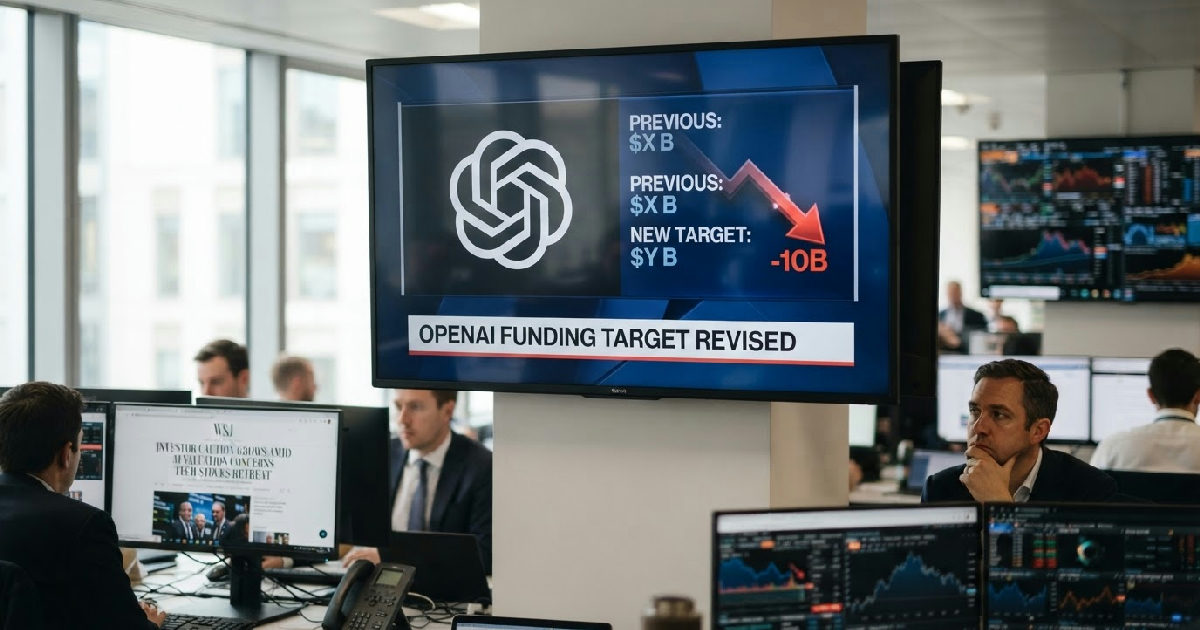
OpenAI has reportedly reduced its target for an upcoming funding round by $10 billion, bringing it down to $20 billion.
The revised target follows a reportedly lukewarm response from some major investors, alongside a downturn in technology stocks, according to The Wall Street Journal. OpenAI has reportedly secured approximately $11 billion in commitments so far.
Shifting investor sentiment affects OpenAI’s fundraising
A group of investors from the United Arab Emirates is expected to lead the round, while an offering to high-net-worth individuals could help bring the total to the $20 billion target.
Investors are becoming increasingly cautious about the substantial infrastructure spending required to develop advanced AI systems. This caution is contributing to a more challenging fundraising environment for companies such as OpenAI. The Nasdaq-100 fell by 3.5% on the Friday the reports emerged, while the broader Nasdaq Composite declined by 2.9%. The latter’s losses brought it to 7.8% below its record high on 6 October.
This market shift reflects a broader investor demand for clearer pathways to profitability from capital-intensive AI operations. Many are questioning whether massive investments in data centres, servers, and other computational resources will yield sufficiently rapid returns to justify previously projected valuations. The initial presentation of this round as a final opportunity before an anticipated IPO may not have resonated as strongly as expected.
OpenAI’s valuation journey and capital needs
OpenAI’s latest fundraising effort comes amid a sharp increase in the company’s reported valuation. Prior to this round, the company had sharply increased its valuation from $852 billion in March 2026, a figure that made it the largest private financing on record. Earlier reports indicated that OpenAI had discussed valuations of approximately $1.2 trillion to $1.4 trillion ahead of the latest fundraising effort.
In 2019, OpenAI established OpenAI LP, a capped-profit entity designed to attract investment while retaining the organisation’s broader mission. The structure enabled OpenAI to attract substantial investment, including a $122 billion funding round announced in March 2026. Major investors and strategic partners, including Microsoft, Amazon, SoftBank and Nvidia, have supported the company’s development.
In October 2025, OpenAI completed a restructuring that placed its for-profit business under OpenAI Group PBC, a Delaware-based public benefit corporation. The restructuring changed the previous capped-profit arrangement and was intended to give OpenAI greater flexibility to raise capital for AI development. These structural changes reflect the immense capital required to develop and deploy cutting-edge AI technologies.
Revenue acceleration meets spending demands
OpenAI’s reported revenue growth comes as the company reassesses its fundraising target. OpenAI’s annualized revenue run rate was reportedly approaching $70 billion in September 2026. Reports in September indicated that OpenAI’s annualised revenue run rate had increased by more than 70% since the beginning of the third quarter, while its enterprise revenue had more than doubled.
OpenAI reportedly generated $5.7 billion in revenue in the first quarter of 2026, followed by $6.7 billion in the second quarter, an increase of approximately 18%. This revenue growth comes alongside substantial expenditure on computing infrastructure and AI development. The company reportedly spent $12.01 billion on computing resources and salaries in the first quarter of 2026.
These figures illustrate the tension facing AI companies: revenue growth must be weighed against the substantial and continuing investment required to develop and operate their systems. OpenAI must therefore convince investors that its revenue growth can eventually support the substantial costs of developing and operating advanced AI systems.
Anthropic’s market presence and IPO challenges
OpenAI’s fundraising difficulties come as its competitor, Anthropic, prepares for a potential public listing. Anthropic has filed for a potential IPO, with a Nasdaq listing under the ticker symbol ANT reportedly targeted for November 2026. Reports have placed its potential valuation at approximately $1.5 trillion or higher. Its S-1 filing also highlights the financial risks associated with expanding computing capacity and securing access to infrastructure.
Anthropic reported revenue of $16.3 billion in the first half of 2026, compared with approximately $1.16 billion in the same period of 2025. However, Anthropic reported a net loss of approximately $80.75 billion for the first half of 2026, compared with $12.97 billion in the same period of 2025. The figures illustrate the substantial financial and infrastructure requirements associated with developing advanced AI systems.
Both OpenAI and Anthropic face the challenge of securing sufficient computing capacity without taking on excessive infrastructure costs. Long-term agreements for electricity and data centre capacity can expose companies to substantial fixed costs. These commitments can make it harder for investors to assess the timing and scale of future returns.
Despite these financial pressures, both companies continue to develop their AI technologies.
The evolving landscape of AI investment
The reported reduction in OpenAI’s funding target highlights growing investor scrutiny of the AI sector. Although investor interest in artificial intelligence remains strong, there is increasing scrutiny of companies’ business models and long-term financial sustainability. Investors are increasingly seeking clearer evidence that companies can achieve profitability and sustain growth despite their substantial capital requirements.
OpenAI reportedly plans to approach family offices and high-net-worth individuals for additional investment as it seeks to reach its revised $20 billion target. The approach could broaden OpenAI’s investor base beyond traditional institutional and venture capital sources. It could also provide access to private investors willing to back high-growth technology companies despite the associated risks.
OpenAI’s potential IPO timeline also remains uncertain. Chief financial officer Sarah Friar reportedly told employees that OpenAI could pursue a listing in 2027, while chief executive Sam Altman said in September 2026 that taking the company public in 2026 would be “ill-advised”. The comments suggest that OpenAI is weighing market conditions and internal readiness before proceeding with a public offering.
Some analysts expect 2027 to be an important year for assessing whether AI companies can generate sufficient revenue to justify their infrastructure investments.
