


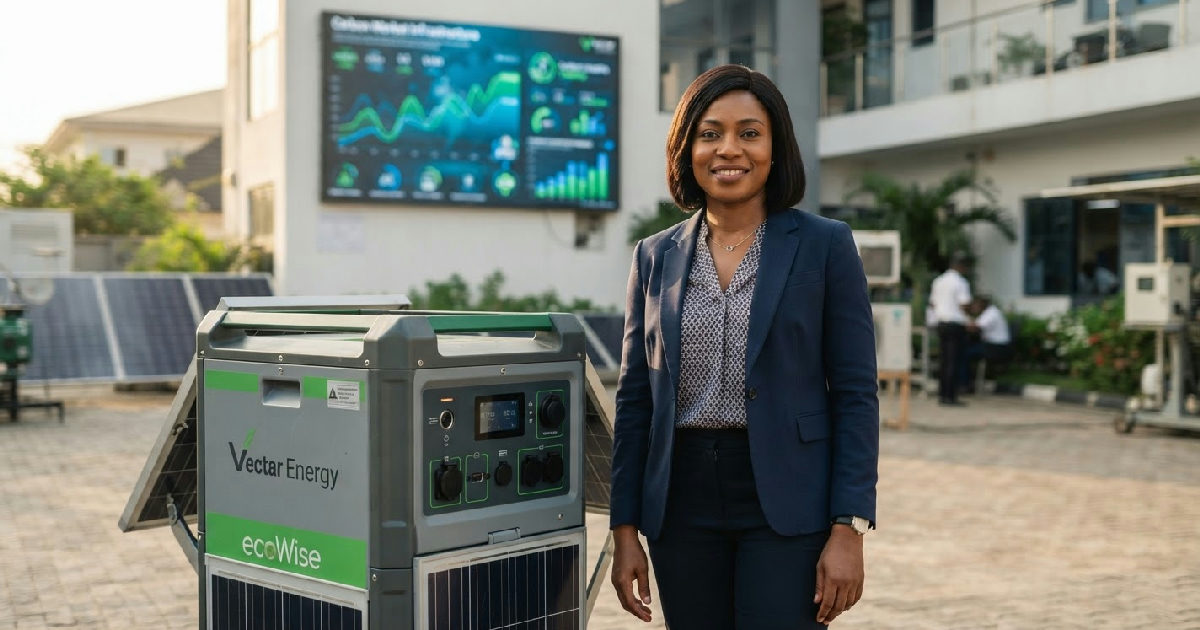
Vectar Energy has shifted its focus from portable solar power products to developing infrastructure for carbon markets.
Vectar Energy founder Deborah Fadeyi was motivated by a personal tragedy. Her experience of carbon monoxide poisoning from generator fumes in 1999 motivated her to explore cleaner energy alternatives.
From personal motivation to product development
In 2025, Biodun Ogunleye, then Lagos State Commissioner for Energy and Mineral Resources, reportedly estimated that carbon monoxide exposure causes 30,000 deaths annually in the state.
Fadeyi began her first venture, YettyFlames, in 2019, focusing on locally assembled solar power systems. Fadeyi began her first venture, YettyFlames, in 2019, focusing on locally assembled solar power systems. Although the systems were rudimentary, they enabled direct engagement with customers and helped the team understand the challenges caused by unreliable electricity supply.
Fadeyi formalised these efforts by establishing Vectar Energy in 2020. The company launched its first product, the Vectar Eco, a portable solar power station designed to replace small petrol generators. The aim was to provide a practical, battery-powered alternative to the small petrol generators commonly known in Nigeria as “I better pass my neighbour” generators.
Translating this ambition into a commercially viable product proved challenging. Developing the hardware required significant capital investment and extensive engineering work to optimise battery configurations, size solar panels and test components. The goal was to design a portable unit capable of powering common household appliances. Fadeyi’s resolve was deeply rooted in her past, driven by the desire to prevent future tragedies.
Scaling challenges and strategic shifts
Vectar Energy changed its approach after the team concluded that local fabrication made its solar units too expensive for many potential customers. To reduce costs, the company moved manufacturing to China and imported semi-assembled units for final assembly in Nigeria. This allowed for more cost-effective production.
By 2023, Vectar was generating revenue from sales of products such as the Vectar Eco and Vectar Eco Mini to customers in Nigeria. These offerings catered to varied power needs and budgets. The products provided portable power for customers seeking alternatives to unreliable grid electricity.
Despite the potential benefits of solar power, the upfront cost remained a major barrier for many customers. Vectar explored partnerships with lenders such as Credit Direct and AltPower to offer instalment payment plans. However, many prospective customers did not meet the lenders’ credit requirements.
Vectar also introduced interest-free instalment plans in Lagos and Abuja, but these did not make the systems affordable for enough of its intended customers. Fadeyi acknowledged that the initiative was not reaching enough customers to have a wider impact.
Embracing carbon markets for affordability
These challenges prompted Vectar to reconsider its business model. In 2024, Vectar began developing SUNWISE while continuing to sell products in its Vectar Eco range. SUNWISE aimed to make portable solar systems more accessible through rent-to-own arrangements, with payments reportedly starting at ₦2,000 per day (approximately US$1.49 at the stated exchange rate). Habeeb Mustapha joined Vectar as chief technology officer in April 2024 and later became a co-founder.
Fadeyi began exploring whether the emissions avoided by solar systems could generate additional revenue to help reduce costs and improve affordability. The central question was whether emissions avoided by replacing petrol- or diesel-powered generators could be translated into carbon credits.
In 2024, Vectar continued developing and selling solar products while laying the groundwork for its climate-finance technology. The company was exploring new models to support clean energy adoption.
ecoWise: a new era of carbon market infrastructure
Vectar identified a potential new revenue stream in monetising the environmental benefits of distributed solar installations, rather than relying solely on equipment sales. Instead of individual installations navigating the carbon market, Fadeyi envisioned an aggregated approach. This conceptual leap led to ecoWise, Vectar’s carbon-market infrastructure platform. The platform was publicly announced around August 1, 2023.
ecoWise aggregates smaller distributed solar projects into portfolios, tracks their electricity generation and estimated avoided emissions, and supports their participation in carbon markets. ecoWise is designed to support project developers with carbon-credit certification processes and the sale of issued credits.
To meet carbon-market requirements and provide credible evidence to buyers, Vectar developed monitoring and assurance processes. This required more than calculating emissions; it also involved developing systems to monitor project performance and document the underlying data. The work involved developing carbon programmes, establishing methodologies and eligibility criteria, drafting agreements with project developers, defining carbon rights and monitoring plans, and implementing safeguards in line with applicable Gold Standard requirements.
Transition and initial impact
By 2025, Vectar was shifting its focus from solar product sales towards climate finance and environmental-market infrastructure. By early 2026, Vectar’s solar product business had served more than 150 customers and generated approximately ₦80 million in cumulative revenue. Fadeyi had increasingly shifted her focus towards the company’s carbon-market activities.
Her focus was now on helping solar developers generate additional revenue through environmental credits linked to the clean electricity they produced.
Technological advancements and market reach
Vectar says it has onboarded distributed solar projects with a combined capacity of 35 megawatt-peak (MWp) across Nigeria. A further portfolio of 50 MWp is being prepared for validation and verification. Fadeyi expects participating solar projects to receive their first carbon-credit payments in January 2027. The model is intended to improve the financial viability of solar installations by generating additional revenue from avoided emissions.
The technology powering ecoWise has seen significant advancements. Vectar is developing ecoWise as a hybrid measurement, reporting and verification (MRV) system that combines digital data collection with physical monitoring. The system combines data from physical Internet of Things (IoT) devices with remote monitoring platforms and application programming interfaces (APIs).
This approach is intended to accommodate the different inverters, monitoring systems and data formats used by distributed solar projects in Nigeria. It could help standardise data collection and produce auditable records across installations.
Fadeyi said the credits could sell for up to US$50 each, depending on market conditions and credit quality. Fadeyi also said Vectar was working with MSCI, a provider of financial data, analytics and research.
In 2026, Vectar entered the International Renewable Energy Certificate (I-REC(E)) market, potentially giving eligible projects another source of revenue. These certificates allow buyers to substantiate claims about their use of renewable electricity.
Future expansion and enduring mission
Vectar Energy’s ambitions extend beyond Nigeria. The company plans to establish operations in Sierra Leone and Madagascar in 2027. In the longer term, Vectar aims to expand its carbon-market infrastructure into other African markets.
Although Vectar has expanded beyond portable solar power stations, its underlying objective remains to make clean energy more affordable and accessible as an alternative to fossil-fuel generators. The shift places financial mechanisms at the centre of Vectar’s approach to expanding access to cleaner energy.
Vectar Energy’s current focus is on developing financial and digital infrastructure to support the adoption of cleaner energy. The business has moved from selling portable solar power systems towards helping distributed solar projects access environmental markets.
