


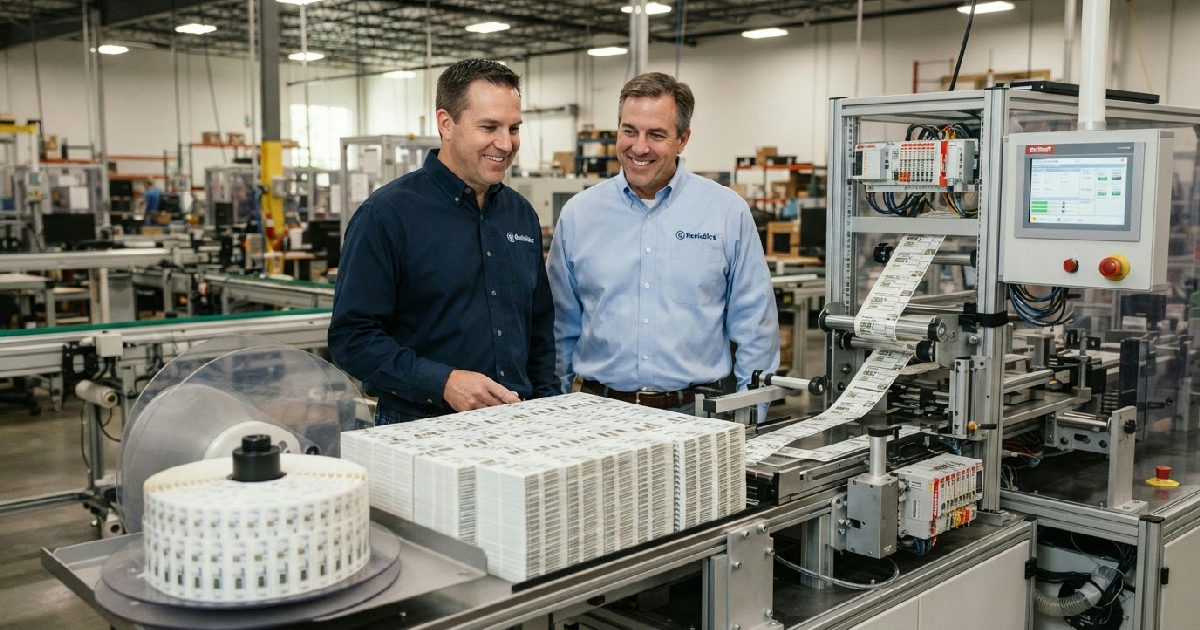
Smart manufacturing label production has surged 150% for London-based Reelables, co-founded by Brian Krejcarek and David Stanton, following a strategic collaboration with German automation specialist Beckhoff.
The company’s innovative labels are designed to replace traditional barcodes, offering continuous location data for packages and assets. Such advancements are critical in an era where approximately 1.7 million packages are reportedly lost or stolen daily, highlighting the limitations of conventional tracking methods that rely on intermittent scans.
From concept to scaled production of smart manufacturing labels
Reelables began with a singular vision from Brian Krejcarek, who, after forgetting a common item, contemplated how to actively track objects. This initial thought, conceived around the company’s founding in 2018, quickly evolved from a business-to-consumer (B2C) idea into a focused business-to-business (B2B) model.
The pivot recognised a substantial opportunity within freight forwarding, logistics, and warehousing sectors, where real-time tracking could fundamentally change operations and reduce significant costs.
David Stanton joined as co-founder and CEO, with Krejcarek taking on the role of CTO. Their ambition was to create a tracking label that was both low-cost and scalable enough to be attached to almost any item.
This approach moved beyond the static data offered by traditional barcodes or QR codes, replacing them with active trackers that consistently broadcast their location, ensuring transparency throughout the supply chain.
The company’s product line now includes various smart label types, such as Bluetooth tracking labels for general asset monitoring across diverse industries. These are particularly valuable in high-value logistics where delays incur significant costs. Reelables also produces temperature-sensitive labels, accurate to within 0.5 degrees Celsius, specifically for cold-chain applications like seafood logistics. This precision helps maintain product integrity for sensitive goods.
In April 2026, Reelables expanded its offerings further with the launch of its “Anywhere” label, a 2×4-inch global shipment tracker. This new product is approved for air transport and priced from $8 per unit, demonstrating the company’s commitment to broad market accessibility. The classification of these labels as standard packaging, rather than e-waste, also streamlines customs processes and disposal.
Engineering the smart label advantage
A core differentiator for Reelables lies in its unique engineering approach: it is the only manufacturer producing labels with an integrated printed battery. Oliver Boswall-Perks, who joined Reelables as Mechatronics Engineer in 2019 and was central to developing its manufacturing capabilities, highlights the practical benefits of this innovation.
These labels are classified as packaging, simplifying customs declarations and allowing them to integrate into standard waste streams, supporting customer sustainability objectives.
The technology behind these smart manufacturing labels involves a reel-to-reel, thin-film manufacturing process that creates intricate wireless circuits. This method integrates a coated zinc battery directly onto a low-cost aluminised PET substrate.
This combination enables the production of active wireless devices with communication ranges up to 110 metres for Bluetooth, and kilometres for 5G LPWAN versions. Such an additive manufacturing approach underpins the labels’ thin profile and disposable nature, a significant departure from bulkier traditional tracking devices.
Before the collaboration with Beckhoff, Reelables’ production setup relied on manual processes and non-industrial hardware. The team was producing thousands of labels during a ten-hour shift. This early stage, common for start-ups with a compelling proof of concept, meant production struggled to keep pace with escalating demand. The critical juncture arrived when the product’s market traction clearly outstripped the company’s capacity to deliver at scale.
Precision Automation: The Beckhoff Partnership
Reelables recognised the need for a fundamental shift in its production strategy to transition from a promising proof of concept to a high-volume manufacturer. Oliver Boswall-Perks, drawing on previous experience, initiated contact with Bradley McEwan, Business Development Manager at Beckhoff UK. Beckhoff, known for its PC-based control technology, assessed Reelables’ existing setup and future ambitions during a pivotal meeting at the London site.
The resulting automation solution is built on a fully integrated Beckhoff TwinCAT and EtherCAT platform, incorporating a comprehensive suite of hardware and software. This includes industrial PCs (IPCs), precision drives, real-time vision systems for quality control, and human-machine-interface (HMI) touchscreens.
Reelables also became an early adopter of TwinCAT Vision and Motion integration, with their system running on Beckhoff’s Software Platform Toolkit (SPT) Framework—the first deployment of its kind in the UK. This modular architecture supports easy expansion and future machine integration.
Beckhoff’s involvement extended beyond hardware supply; its engineering services proved crucial. Beckhoff product engineer Chris Knight led the programming effort, working on-site for months with the Reelables team. Knight’s deep expertise accelerated the development of machine code, logic, and sequencing. This mentorship allowed the Reelables team, a small unit of ten individuals, to quickly master the intricate new system.
The TwinCAT Vision system now plays a critical role in quality control, capturing high-resolution images of each smart manufacturing label as it moves through the line. It precisely calculates rotational and positional offsets, checks for defects, and ensures glue is dispensed with micron-level accuracy.
Crucially, the system identifies and skips labels that would fail further downstream, significantly reducing waste. This automated vision system replaced human inspection, leading to faster, more consistent quality and directly contributing to the 150% increase in output, enabling the production of tens of thousands of labels per shift.
Scaling for the Future of Logistics
Reelables is not stopping at its current production increase. The company is actively building a comprehensive digital record for every label, capturing data at multiple checkpoints along the production line. This feeds into an AI-driven analytics system, designed to predict failure risks based on factors like dispensing quality, chip placement, substrate condition, and environmental variables.
This intelligence enables real-time corrective actions, such as skipping chip placement or epoxy application, further reducing waste and improving overall yield.
A next-generation vision system is also underway, deploying multiple cameras across key inspection stations, all managed by a single Beckhoff IPC. This advanced infrastructure supports machine learning models that will soon classify failures as either manufacturing or field-related.
This capability creates a vital feedback loop between production and real-world performance, allowing for continuous improvement and innovation. Digital manufacturing initiatives like these are reshaping how quality is maintained at scale.
The market for smart labels continues its rapid expansion. Valued at $39.1 billion in 2023, it is projected to reach $55.6 billion by 2030, driven by an accelerating need for real-time tracking and supply chain transparency. Reelables is well-positioned within this growth, having secured a $10.4 million Series A funding round on November 17, 2025.
This capital is fueling the expansion of engineering and operations teams, advancing smart label product development, and critically, increasing manufacturing capacity.
To meet the burgeoning demand, Reelables is scaling production with two new compact lines and a high-throughput system, “The Stratus R22M,” engineered to produce tens of thousands of labels per hour.
Three of the four core machines for the Stratus R22M are already built or fully engineered, paving the way for Reelables to achieve its ambitious goal of 100 million labels per year.
This strategic investment underscores the growing importance of advanced manufacturing capabilities in the UK and globally, driving efficiencies that were previously unattainable for complex, integrated products.
