


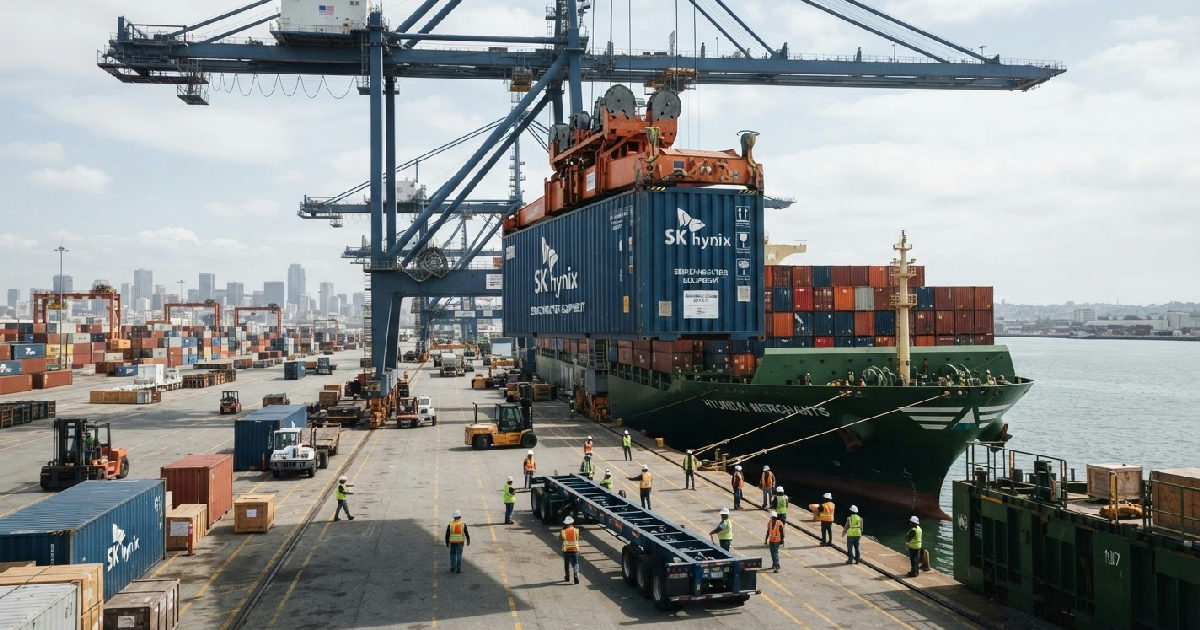
SK Hynix, a major South Korean semiconductor producer, is reportedly negotiating with the U.S. government for approval to export critical SK Hynix chip equipment to its Dalian, China, facility. This approval appears contingent on the company’s commitment to construct a new semiconductor factory within the United States. The intricate discussions underscore the persistent geopolitical pressures shaping global technology supply chains and manufacturing investment decisions.
The reported bargaining involves SK Hynix’s flash memory unit, Solidigm, which is pursuing U.S. authorisation to supply American chip manufacturing tools to its Chinese plant. This manoeuvre aims to navigate Washington’s stringent export controls on advanced chip technology, initially imposed in October 2022 and further tightened in 2023, citing national security concerns.
SK Hynix chip equipment exports and geopolitical tensions
The semiconductor industry finds itself caught between escalating trade and technology disputes, particularly between the United States and China. SK Hynix’s situation exemplifies the tightrope manufacturers must walk to maintain global operations while adhering to national security policies.
For SK Hynix, its Dalian, China, facility is a primary base for NAND flash memory chip production. The ability to install new chipmaking equipment there is essential for maintaining and potentially upgrading its manufacturing capabilities.
The US Export Control Framework
Washington’s sweeping restrictions on advanced chips and chipmaking equipment exports to China began in October 2022. These rules require licenses for companies to send such technology to Chinese entities, significantly impacting the operational freedom of global semiconductor firms.
Further tightening occurred in 2023, amplifying concerns within the industry about supply chain stability. The U.S. has since granted an annual license to Samsung and SK Hynix, allowing them to send chipmaking equipment to their plants in China. This system operates under a more restrictive, review-based process.
The Solidigm Proposition and US Investment
Solidigm, SK Hynix’s flash memory division, is at the heart of these complex negotiations. The unit reportedly intends to build a NAND flash memory chip factory in the United States, with upstate New York emerging as a potential location for the significant investment.
This prospective U.S. factory is part of a broader commitment from SK Hynix to invest $15 billion in the United States over the next decade. This substantial capital injection will target a chip packaging plant and research and development initiatives.
Moreover, Solidigm itself is said to be preparing for a significant financial milestone. The company is reportedly eyeing a U.S. initial public offering (IPO) in 2027, which could raise approximately $10 billion and potentially value the unit at up to $100 billion. Such developments in semiconductor manufacturing highlight a broader trend towards regionalisation of technology production.
Strategic Importance of NAND Flash
NAND flash chips are fundamental components in modern digital infrastructure. They are integral to solid-state storage drives (SSDs), which power everything from personal laptops and smartphones to large-scale artificial intelligence (AI) data centres.
The escalating demand for AI data centres has created a global component shortage, driving up prices across the board. This includes high-speed RAM chips and the very SSDs that rely on NAND flash technology.
Research firm TrendForce anticipates a notable increase in NAND prices, projecting a rise of 15% to 20% during the fourth quarter. This forecast underscores the critical need for stable and expanded NAND production capacity.
US Policy and Industry Incentives
The U.S. government has been actively encouraging foreign chipmakers to establish and expand their manufacturing facilities domestically. This push aligns with strategic goals to bolster national supply chain resilience and technological leadership.
In July, U.S. Commerce officials publicly stated their desire for Samsung and SK Hynix to construct chip plants within the country. They confirmed ongoing discussions with both South Korean giants to facilitate such investments.
The US government’s approach combines restrictive measures with incentives. The aim is to reshape the global semiconductor landscape, bringing more advanced manufacturing capabilities onto American soil.
Transaction-by-Transaction Waivers
A key moment in this evolving policy came on October 11, 2022, when the U.S. government granted a one-year waiver to SK Hynix and Samsung. This allowed them to receive U.S. chip equipment for their China factories without requiring separate, individual licenses.
A senior U.S. official characterised this waiver as a “transaction-by-transaction” review process, indicating a meticulous oversight mechanism. This nuanced approach suggests a balancing act between policy objectives and immediate industry operational needs.
SK Hynix confirmed the waiver on October 11, 2022, stating it had “been granted a license by the U.S. Department of Commerce to receive equipment and other items needed to operate its semiconductor fabrication plants in China.” The company expressed confidence in its discussions with the Department of Commerce, expecting smooth operations without production disruptions.
Factory automation and industrial efficiency remain crucial for such large-scale production.
Implications for Global Supply Chains and Technology
These negotiations between SK Hynix and the U.S. government illustrate the profound impact of national industrial policies on the global semiconductor sector. The outcome will likely influence how other major chip manufacturers structure their operations and investments worldwide.
The conditional nature of SK Hynix’s proposed U.S. factory highlights a trend where market access and operational permissions are increasingly tied to strategic geopolitical objectives. This shift could lead to a more regionalised, rather than purely globalised, chip manufacturing ecosystem.
For industries reliant on advanced semiconductors, these developments signal potential shifts in supply chain dynamics. Companies may need to adapt to a landscape where political considerations weigh as heavily as economic efficiencies in sourcing critical components. The emphasis on domestic production also creates opportunities for new technological advancements and innovation in the U.S.
While the immediate focus remains on U.S.-China dynamics, the precedent set by these negotiations could have broader implications. Nations across Africa and other regions seeking to develop their own industrial bases will observe how global manufacturing giants balance competing national interests with commercial imperatives. The pursuit of self-sufficiency in critical technologies is a growing theme globally.
