


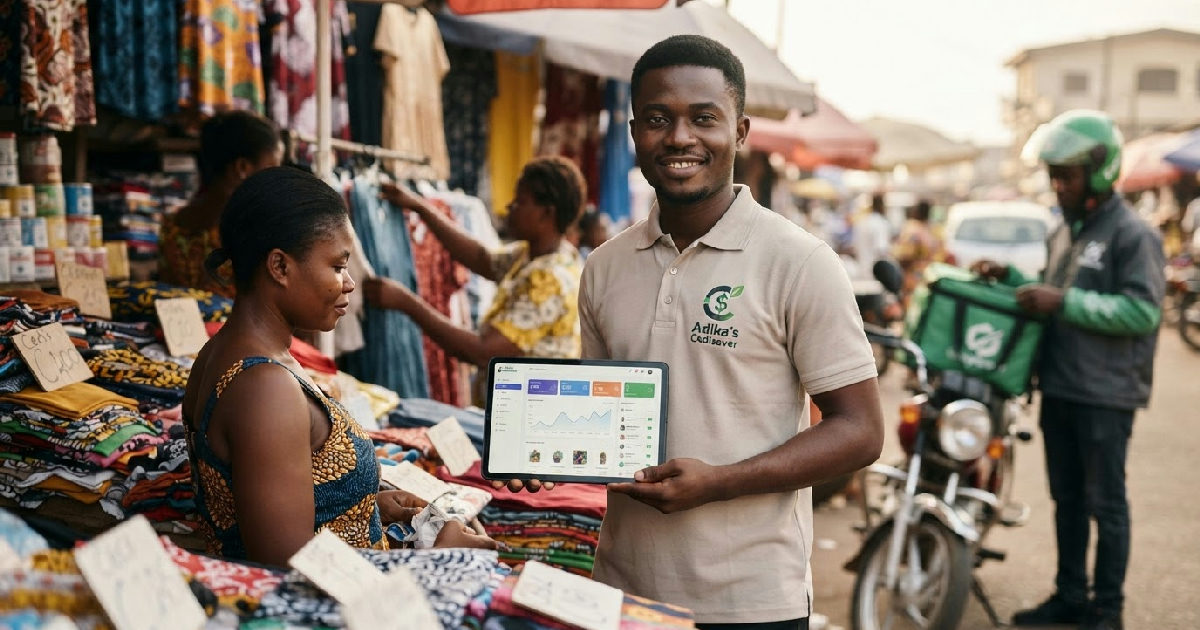
Moriah Adika, a geophysics student at the University of Ghana, has grown his e-commerce platform, Adika’s Cedisaver, to 6,000 monthly active users and 37 informal vendors in just over 1,000 days.
Adika’s journey to building Cedisaver began with a personal need for affordable clothing during his university years, alongside his recognition of a highly fragmented retail sector in Africa. His platform provides a digital marketplace for affordable fashion and offers doorstep delivery to consumers.
From campus thrift to Adika’s Cedisaver digital marketplace
Adika’s initial inspiration for Cedisaver stemmed from the difficulty of finding affordable clothing for university lectures and the high price of popular items such as Birkenstock sandals, which could cost more than $100. This experience, which dates back to his senior high school days at Achimota School, prompted him to explore a digital solution.
Although Adika was studying geophysics at the University of Ghana rather than software development, he began developing the technical skills needed to build the platform. He independently developed his coding skills through YouTube tutorials and used them to build the platform.
Cedisaver officially launched in January 2023, during Adika’s final year of university. The platform’s early development was supported by Adika’s participation in an incubation programme co-hosted by the British Council, Imperial College London and the University of Ghana. The programme did not provide direct equity funding but offered training in startup operations and helped Adika refine Cedisaver’s business model.
His university classmates became Cedisaver’s first customers, providing an initial customer base for its footwear offerings. This early customer base allowed Adika to test the concept and understand customer preferences before allocating a formal marketing budget.
Building the two-sided marketplace
By 2024, Cedisaver faced a common two-sided marketplace challenge: attracting enough buyers to encourage vendors to join while building a sufficient vendor base to offer a wider range of products. Adika’s attention was also divided during his mandatory national service, when he worked as a quality assurance analyst for the National Petroleum Authority and audited fuel facilities across Ghana.
After returning to Cedisaver full time, Adika focused on addressing the platform’s supply-side constraints. The platform initially sourced inventory from large importers and delayed formally onboarding independent merchants because of its limited operating margins. The approach was intended to establish a sufficient customer base before expanding the vendor network.
To resolve this, Cedisaver focused on listing everyday apparel and high-demand items known for rapid turnover. The approach was intended to demonstrate consistent sales to potential suppliers, addressing concerns about joining the platform without evidence of steady orders.
This period led Cedisaver to change its approach to acquiring customers and vendors. Instead of expanding all aspects of the platform simultaneously, the company focused on increasing sales of selected products. This approach helped build confidence among vendors and supported the subsequent expansion of the merchant network.
Proving the marketplace model and its economic impact
By 2025, Cedisaver had established steady consumer demand and began formally onboarding independent merchants. The platform now works with 37 informal market vendors, alongside sellers that already operate catalogues through social media.
The platform now records approximately 6,000 monthly active users and an average order value of GHS 400, equivalent to about US$34. The startup remains entirely bootstrapped and has not raised external funding.
Limited access to capital has influenced Cedisaver’s approach to operations and growth. The team has prioritised maintaining profit margins and developing partnerships with informal merchants rather than seeking immediate external funding. Adika has said that raising capital is not an immediate priority and that he wants to strengthen the company’s operations before seeking investment.
Cedisaver’s current objective is to deepen its inventory selection for Ghanaian consumers. The platform’s current focus is on expanding its inventory for Ghanaian consumers while continuing to develop its marketplace model.
The $100 sandal and the early development of Ghanaian e-commerce
Cedisaver’s development follows earlier efforts to build Ghana’s e-commerce market. An earlier example came in March 2016, when a $100 custom-made leather sandal was sold through the e-commerce platform Shopa. The transaction demonstrated that a Ghanaian-made product could be sold to a customer in an international market through an online platform.
Shopa, founded in 2014 by Gregory Rockson and Daniel Abankwa, was established to help small businesses in Ghana sell their products online. The platform sought to address challenges including limited market access, payment processing and logistics faced by local merchants.
The $100 sandal, crafted by an unnamed Ghanaian artisan, was purchased by a customer in the United States. Rockson, co-founder and CEO of mPharma, later remarked, “The $100 sandal was a pivotal moment for us. It proved that there was a market for Ghanaian products globally and that our platform could facilitate these transactions seamlessly.”
The transaction was followed by further investment and user growth. By the time of its acquisition by mPharma in 2017, Shopa had onboarded 2,000 merchants and raised $100,000 in seed funding from investors including the Meltwater Entrepreneurial School of Technology (MEST).
Ghana’s expanding digital economy and regulatory framework
Ghana’s e-commerce market was projected to generate $1.007 billion in revenue in 2025, with annual growth of 10–15% projected through 2026. The market’s growth has been associated with rising internet and smartphone penetration and the widespread use of mobile devices. This digital infrastructure is critical for commercial scaling across various sectors.
Ghana’s e-commerce regulatory framework includes the Electronic Transactions Act, 2008 (Act 772), which provides a legal framework for electronic transactions and electronic signatures. Other relevant legislation includes the Sale of Goods Act, 1963, and the Data Protection Act, 2012.
In October 2022, the Ministry of Communications and Digitalisation directed e-commerce entities to register on the AfCFTA Hub. This initiative aims to streamline interactions with regulators and facilitate obtaining AfCFTA Numbers for service providers involved in e-commerce operations, fostering a more integrated digital marketplace.
Implications for African small businesses and digital trade
Cedisaver and earlier platforms such as Shopa illustrate the wider digitisation of trade in Africa and its potential to expand market access for informal businesses and small and medium-sized enterprises (SMEs). This shift can allow local artisans and manufacturers to reach wider domestic and international markets without relying entirely on traditional distribution channels.
For African businesses, wider use of e-commerce could improve market access and, in some cases, support more efficient use of resources. E-commerce platforms can allow small-scale manufacturers and artisans to expand their customer base without relying on extensive physical retail infrastructure. This could support local production and, depending on demand and business capacity, contribute to job creation.
Cedisaver’s connection of 37 informal vendors with approximately 6,000 monthly active users illustrates the potential for digital marketplaces to connect informal sellers with larger customer bases. These platforms can connect fragmented sellers and consumers through a shared digital marketplace. The model also illustrates how an e-commerce business can develop without external funding, although its broader applicability to industrial development would require further evidence.
Such developments could contribute to wider digital adoption in commerce and improve connections between small businesses and consumers. They illustrate how digital marketplaces can expand market access for independent producers and small businesses. Efforts such as these may contribute to wider digital adoption and market access for African businesses.
