


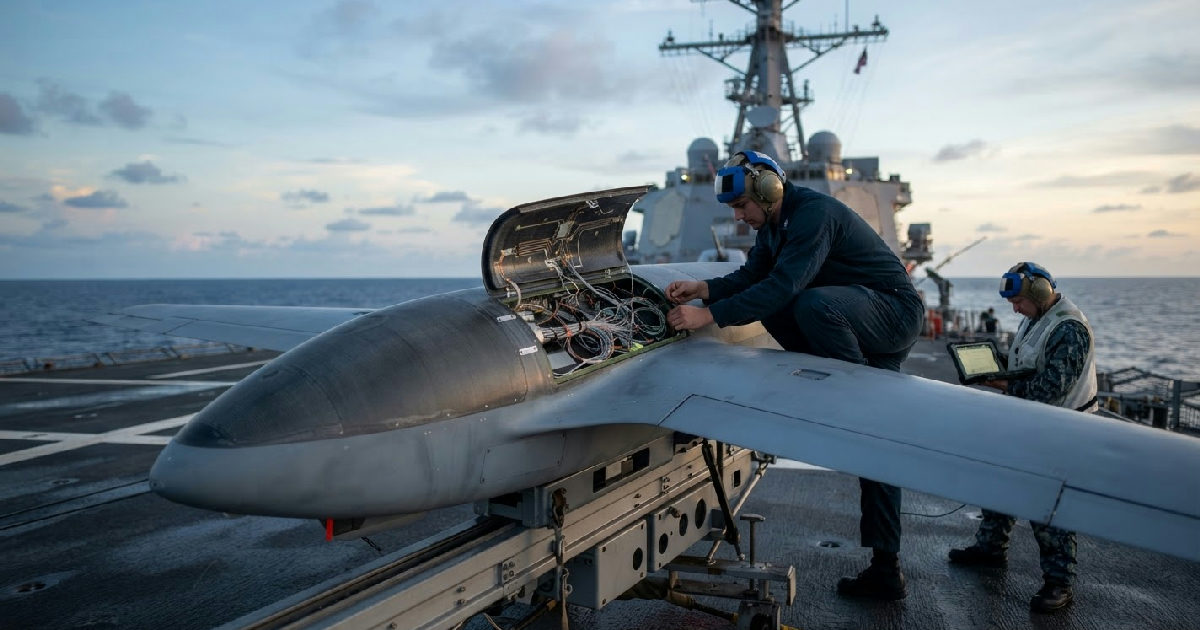
The U.S. Navy is advancing embedded power UAV composites through Continuous Composites Phase II funding to enhance UAV capabilities. S. Navy is advancing embedded-power unmanned aerial vehicle composites through Continuous Composites Phase II funding. This initiative aims to enhance the capabilities and performance of UAVs by integrating power systems directly into their structural components, leveraging innovative composite materials.
This advancement marks a critical step towards creating more modular, reliable, and easily maintainable UAV platforms. Integrating power distribution directly into structural components could drastically reduce complexity and downtime in demanding operational environments. It aligns with broader Department of Defense objectives to enhance the deployability and maintainability of advanced composite-based systems.
Integrating embedded power UAV composites into structural components
The core of this program lies in CCI’s proprietary Continuous Fiber 3D Printing (CF3D®) technology. This additive manufacturing process allows for the precise embedding of continuous fibre reinforcements with snap-curing thermosetting resins. The goal is to co-print conductive elements directly into structural composites, enabling them to carry both mechanical loads and electrical currents.
During Phase I of the project, CCI successfully demonstrated the feasibility of this concept. The company co-printed conductive elements, including copper wiring and fibre optics, into fibreglass-reinforced composite panels. Crucially, subsequent testing revealed only a limited effect on the mechanical performance of these panels, validating the potential for integrating functional materials into composite laminates without compromising structural integrity.
Phase II will build on these initial successes, focusing on integrating higher-capacity conductive pathways into load-bearing parts. This involves meticulous control over material placement to ensure optimal mechanical performance and robust electrical isolation. The outcome promises structurally integrated power systems that foster more modular UAV designs, a significant benefit for both manufacturing and field operations.
Advancing Continuous Fiber 3D Printing Technology
Continuous Composites has positioned itself at the forefront of additive manufacturing with its CF3D® technology. This process differentiates itself by embedding continuous fibre strands directly into parts as they are printed. The result is components that boast significantly greater strength and stiffness compared to those produced using traditional fibre-filled filament 3D printing methods.
The technology uses a 6-axis robotic system combined with a specialised end effector. This setup simultaneously deposits and impregnates continuous dry fibre with a UV snap-curing resin. This method allows for the creation of moldless, out-of-autoclave composite structures, which can dramatically reduce manufacturing costs and lead times while lessening reliance on expensive hard tooling.
Steve Starner, CEO of Continuous Composites, emphasised the transformative nature of the program. He stated that it “represents a shift from printing structure alone to printing functionality directly into the structure.” This vision of multifunctional components is central to the future of aerospace manufacturing, particularly for unmanned systems that demand lightweight and integrated solutions.
The ongoing development of CF3D® technology continues to push the boundaries of what advanced composite manufacturing can achieve, enabling new levels of design freedom and material performance. For those interested in how automation is redefining industrial processes, examining Caterpillar AI deployment lessons offers valuable parallels.
Strategic Benefits for UAV Operations and Maintenance
The immediate practical benefits of embedding power conductors directly into UAV composite structures are substantial. By removing or significantly reducing conventional wire harnesses, the overall system architecture of UAVs becomes far simpler. This simplification translates directly into fewer points of failure, improved reliability, and reduced weight.
For field maintenance, this innovation holds particular promise. When a damaged part needs replacement, the risk of damaging intricate wires and connectors within traditional harnesses is largely eliminated. This streamlining of the repair process can lead to faster turnaround times and reduced operational downtime for critical defence assets.
The ability to integrate power systems structurally also enables more modular UAV designs. This modularity allows for easier upgrades, customisation, and faster assembly of different mission-specific configurations. Such adaptability is crucial for military applications where operational requirements frequently evolve, demanding flexible and rapidly deployable systems.
The Pivotal Role of Small Business Innovation Research
The SBIR program, often called “America’s Seed Fund,” is a cornerstone of federal funding for small technology companies engaged in research and development. Established in 1982, it provides non-dilutive funding, encouraging small businesses to innovate in areas critical to U.S. government needs. For companies like CCI, SBIR contracts provide essential capital and validation.
The program operates in three distinct phases. Phase I assesses technical merit and feasibility, typically with smaller awards. Phase II, which CCI has now secured, focuses on full-scale research and development and prototype creation. This phase generally involves larger funding allocations and a longer timeline, reflecting the complexity of the development work.
CCI has a notable history of engagement with Department of Defense initiatives. In 2021, the company secured a $750,000 contract to additively manufacture an integrated wing spar and rib configuration. They have also received multi-million-dollar U.S.
Air Force funding to advance high-temperature materials using CF3D technology for aerospace applications, and secured a multi-year contract with the U.S. Army DEVCOM Aviation and Missile Center (AvMC) in June 2026 for missile components. These past successes underscore the U.S.
government’s sustained interest in CCI’s technological capabilities and its potential to deliver on advanced defence requirements.
Looking Ahead: Multifunctional Composites and Industrial Impact
The 30-month R&D period for Phase II will focus on materials development, process validation, and embedded conductor integration at various scales. This will include coupon-level testing and sub-scale structure development. Following this, a one-year option period is planned for a functional system-level demonstration. This demonstration is intended to support the transition of the technology towards operational UAV use, showcasing its readiness for real-world deployment.
This project aligns directly with broader Department of Defense goals to reduce system complexity, improve maintainability, and accelerate the deployment of advanced composite-based platforms.
The push towards multifunctional structures is not limited to defence; it has wider implications for civil aviation, automotive, and even renewable energy sectors, where lightweight, integrated systems can offer significant performance and efficiency gains. The ability to embed functionality directly into structural components is a paradigm shift, moving beyond traditional assembly methods.
Continuous Composites has been expanding its capacity to meet growing demand and research needs. In April 2026, the company moved into a new 17,000-square-foot facility in Coeur d’Alene, Idaho, effectively doubling its manufacturing footprint. This expansion positions CCI to further accelerate its development efforts across aerospace, defence, and other high-performance applications.
The continued investment in such advanced materials and manufacturing processes highlights a global trend towards smarter, more integrated industrial solutions, paralleling the advancements seen in Nvidia’s AI infrastructure development.
The long-term vision for embedded-power UAV composites extends beyond simply replacing wires. It paves the way for entirely new design paradigms, where structures can actively sense, power, and communicate, blurring the lines between form and function.
This could lead to UAVs that are lighter, more robust, and more adaptable than current designs, fundamentally changing how these critical assets are conceived, built, and operated in the coming decades. The implications for advanced manufacturing in Africa and globally are substantial, as these technologies promise to drive efficiency and innovation across various industrial sectors.
