


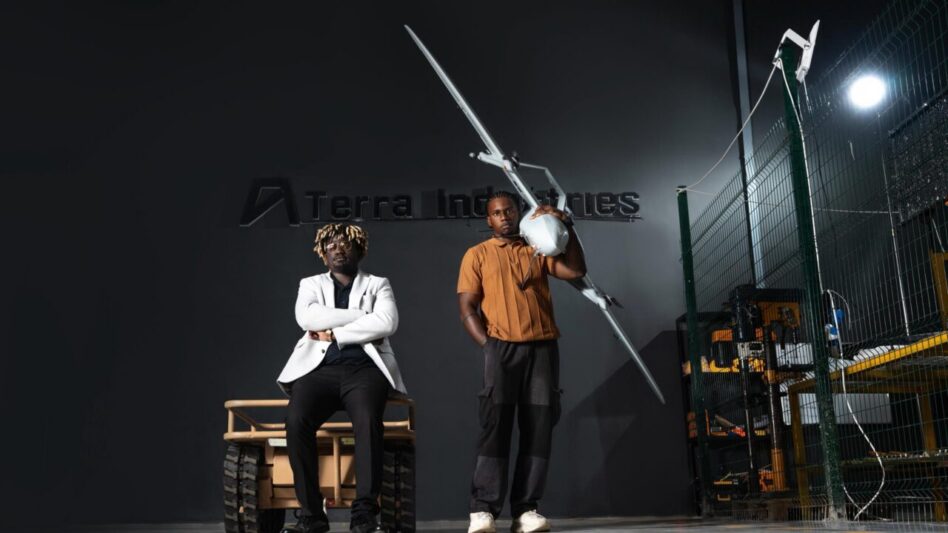
Nigerian defence technology firm Terra Industries closed its seed round at $52 million after securing a final $18 million tranche. The company, founded in 2024 by Nathan Nwachuku and Maxwell Maduka, will use the capital to develop what it says will be Africa’s largest drone factory in Accra, Ghana.
The investment signals significant confidence in the startup’s vision of creating a vertically integrated defence-tech ecosystem built in Africa for Africa. The funding will accelerate the deployment of its autonomous security systems, which are already protecting an estimated $11 billion in critical infrastructure assets across the continent.
Ghana factory to anchor Terra Industries’ production expansion
The centrepiece of Terra’s expansion is the new 34,000-square-foot Pax-2 manufacturing facility in Accra. This plant is more than twice the size of the company’s existing 15,000-square-foot Pax-1 facility in Abuja, Nigeria, marking a major increase in production capacity. Construction is nearing completion, and the company expects the site to become operational in the fourth quarter of 2026.
Once production is fully ramped up in 2028, the Ghana factory is expected to have an annual production capacity of 50,000 autonomous systems. This output is critical to meeting what Terra describes as rising demand from African governments for unmanned and counter-unmanned aerial vehicles. The investment in new manufacturing facilities on the continent is a core part of Terra’s strategy.
This move is about more than simply increasing production volumes. By establishing a major industrial hub in Ghana, Terra is creating a focal point for local engineering and manufacturing talent. The company aims to build a skilled workforce capable of not only assembling but also contributing to the design and innovation of future systems, strengthening Africa’s sovereign industrial base.
Engineering an integrated autonomous system
Terra Industries is not merely manufacturing hardware. The company develops a full-stack suite of interconnected systems designed to provide a unified security solution for land, air, and sea. Its products are controlled by ArtemisOS, a proprietary software platform that acts as the central nervous system for threat detection, mission planning, and autonomous response.
The product portfolio includes a range of specialised drones and sensors. The Archer is a vertical take-off and landing (VTOL) drone with a reported 26-foot wingspan, built for long-range endurance missions. The company cites a range of up to 1,000 kilometres and a flight time of 13 hours, making it suitable for persistent surveillance of large infrastructure assets such as pipelines and border areas.
For active threats, the Kama interceptor drone can reportedly reach speeds of 300 kilometres per hour. It is complemented by the Iroko, a smaller quadcopter for intelligence and surveillance, and the Kallon, a solar-powered sentry tower equipped with sensors and onboard processing. This focus on integrated, automated defence production mirrors a global trend towards creating layered, intelligent security networks.
The role of ArtemisOS
What ties these disparate pieces of hardware together is the ArtemisOS software. It aggregates data from all deployed assets and uses it to create a comprehensive operational picture. This allows for coordinated, autonomous actions. For instance, a Kallon tower could detect a threat and automatically task an Archer drone to investigate while an operator confirms the next step. This integration is Terra’s key technical differentiator.
A strategy for Global South technology sovereignty
While the manufacturing base remains firmly in Africa, Terra’s ambitions are global. The company is actively targeting markets across the Gulf, South America, and South Asia. To facilitate this, Terra is opening its first international office in London, aiming to access institutional defence partners, technology talent, and a mature market ecosystem.
The London office is just the first step. According to the company’s plans, Terra will next establish a presence in San Francisco and Washington, D.C., positioning it to engage with technology investors and key government stakeholders. This expansion comes as spending on security and defence rises in many emerging markets, driven by complex challenges from organised crime to terrorism.
Terra’s founders believe that locally designed and manufactured systems are better suited to address these regional challenges. The company’s strategy of keeping manufacturing and data control within the regions it serves is a powerful proposition for governments seeking greater technology sovereignty.
This approach avoids dependency on foreign powers for critical security infrastructure, a key concern across the Global South. The move into London will also bring it closer to partners of the UK Ministry of Defence.
Investor confidence and commercial traction
The $52 million seed round was a multi-stage effort, beginning with an $11.75 million funding round in early 2026 led by 8VC. This was followed by a significant $22 million bridge round led by Lux Capital, which reportedly valued the company in the nine figures. This final $18 million tranche solidifies its capital base for the next phase of growth.
The latest round saw participation from returning investors, including 8VC, Silent Ventures, Nova Global, Belief Capital, and SV Angel. The returning investors were joined by new backers Norleo Space Investments and angel investor Grant Gordon, indicating a broadening base of support that now includes specialist space and deep-tech financiers.
The investment is a strong vote of confidence in a company founded just two years ago by Nathan Nwachuku and Maxwell Maduka, who were 21 and 23, respectively, when they founded the company.
This investor support is backed by tangible commercial progress. Terra reports that it is on track to record more than $100 million in contract bookings by the end of 2026. The company also projects that it will achieve eight-figure annual revenue this year, a remarkable trajectory for a capital-intensive business in its early stages.
This suggests that its products are not only technologically impressive but also finding a receptive market among national-level customers.
