


Austin-based energy firm Base Power has confirmed a significant financial injection to scale its US home battery production.
This substantial funding round, which now values Base Power at $13 billion, brings its total capital raised to over $2.5 billion. It arrives as the US power grid faces unprecedented demand, driven largely by the proliferation of AI data centres and electric vehicles.
Home battery production expansion fueled by accelerated funding
The latest $1 billion Series D financing round saw contributions from major investors, including Ribbit, Addition, Valor Equity Partners, and JPMorganChase’s Strategic Investment Group. This capital boost follows Base Power’s previous $1 billion Series C round in October 2025, which valued the company at $4 billion.
The rapid increase in investment underscores the urgent need for robust solutions to strengthen national energy infrastructure. Base Power plans to use these new funds to expand its national footprint, accelerate Base Core system installations in homes, and hire additional skilled personnel.
Engineering the Base Core for reliable power
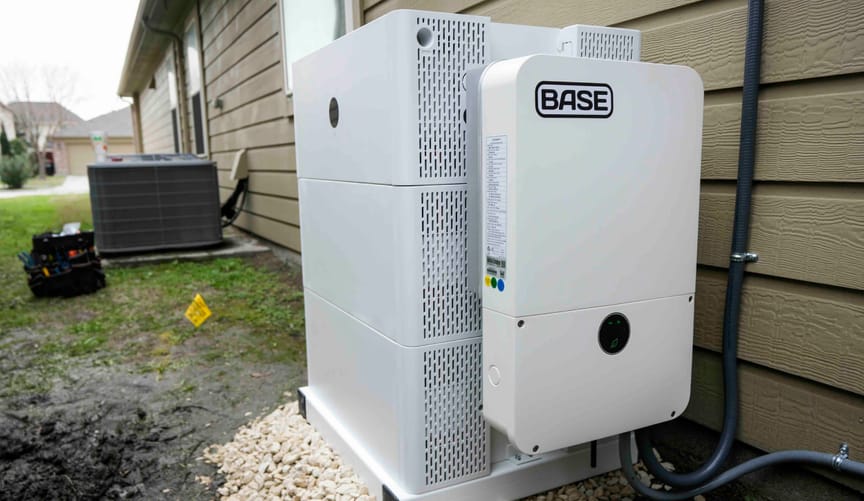
The newly launched Base Core represents a crucial piece of hardware in Base Power’s strategy. Each unit offers a substantial 39.2 kilowatt-hours (kWh) of capacity, making it one of the largest single home batteries on the market. Linking two units provides 78.4 kWh, which can power a home for up to 72 hours during an outage.
Engineered for more than just backup, the Base Core integrates directly into the broader electricity grid from day one. It’s designed to deliver uninterrupted power during blackouts while stabilising the grid when demand spikes. The unit automatically switches over during power failures and withstands extreme weather, tested from -22 to 122°F and submersion-rated to three feet.
Zach Dell, CEO and co-founder of Base Power, explained the product’s dual role. He stated, “We brought together the best hardware and software engineers in the world to build Core – a battery designed to protect American homes while supporting the grid.” Dell emphasised its ease of installation, resilience, and affordability.
Domestic production and strategic investment focus
A core principle of Base Power’s model is its commitment to domestic manufacturing. Base Core batteries are produced at Base Factory 1 in Austin, Texas, with thousands of units reportedly rolling off the production line monthly. This localised production strategy aims to mitigate supply chain disruptions and reduce waiting times for consumers.
Justin Lopas, COO and co-founder, highlighted the importance of this approach for critical infrastructure. He sees the company’s work as rebuilding domestic manufacturing capacity specifically for grid solutions. “The only way to add capacity to the grid is physically deploying hardware, and we need to make that here in the U.S. ourselves,” Lopas remarked.
JPMorganChase’s involvement, through its Strategic Investment Group, signals a broader institutional focus on essential infrastructure. Todd Combs, Head of the Strategic Investment Group, noted their investments aim to strengthen the economy’s underlying infrastructure and advance technologies for growing energy demand. He views distributed energy solutions as vital for security and resilience, akin to transmission lines.
Distributed power addresses grid challenges
The U.S. power system is currently experiencing significant stress. The rapid growth of AI data centres and the widespread adoption of electric vehicles push existing infrastructure to its limits. Traditional solutions, such as constructing new gas plants, are too slow to meet current demand.
Base Power positions its home battery systems as a rapid and efficient solution for this capacity crunch. The company has already deployed over 500 MWh of battery capacity, with utility partnerships accounting for more than 200 MW. This demonstrates how quickly residential batteries can add power to the grid.
These distributed energy resources function as virtual power plants (VPPs). They allow utilities to draw on aggregated residential battery capacity during peak demand or grid instability. This model offers an agile alternative to large-scale, centralised generation, helping to stabilise grids facing voltage fluctuations or sudden surges.
Scaling the business model for future energy infrastructure
Base Power operates a distinct “gentailer” model, combining electricity generation and retail functions, particularly within Texas’s ERCOT market. This approach generates revenue from two main sources: the sale and installation of Base Core battery systems, and payments from utilities for utilising the stored capacity.
Homeowners benefit from outage protection and potential reductions in electricity bills. For utility providers, the immediate access to megawatts of capacity is critical for managing the dynamic demands of the modern grid. The company’s revenue model also includes battery lease fees, retail electricity margins, and wholesale power arbitrage.
Ease of installation further supports this scalable model; a Base Core unit takes under an hour to install, streamlining deployment without needing many specialist electricians. This rapid deployment capability is key to Base Power’s strategy for meeting an escalating need for energy resilience. The company scaled from 1,500 homes to 7,000 homes between July and December 2025.
Base Power’s total capital raised now exceeds $2.5 billion, reflecting strong investor confidence in its technology. The company’s projected 2026 revenue is $70 million, an ambitious target contingent on scaling its Gen 3 in-house battery manufacturing and expanding beyond ERCOT.
The US residential battery market, valued at $4.17 billion in 2025, is forecast to reach $4.90 billion in 2026, with North America holding a significant 38.8% revenue share.
Building resilient infrastructure for Africa’s energy future
Base Power’s trajectory illustrates a fundamental shift in how engineers and policymakers approach energy infrastructure. The traditional paradigm of large, centralised power plants is evolving towards a more distributed, resilient model. Domestically manufactured home batteries, intelligently integrated into the grid, are becoming essential components of this new energy architecture.
The company’s emphasis on manufacturing in Austin not only addresses supply chain concerns but also contributes to job creation and technological independence. This blend of hardware engineering and smart grid integration sets a precedent for meeting future energy challenges.
It offers valuable lessons for countries grappling with similar energy demands and infrastructure deficits, particularly in developing economies seeking to modernise their own energy systems and industrial bases.
As the need for continuous, reliable power grows, driven by AI advancements and widespread electrification, solutions like Base Core become more than just consumer products. They represent foundational engineering achievements that directly impact national economic security and everyday living. Base Power is not just selling batteries; it’s selling a piece of the next-generation power grid, built right in America.
