


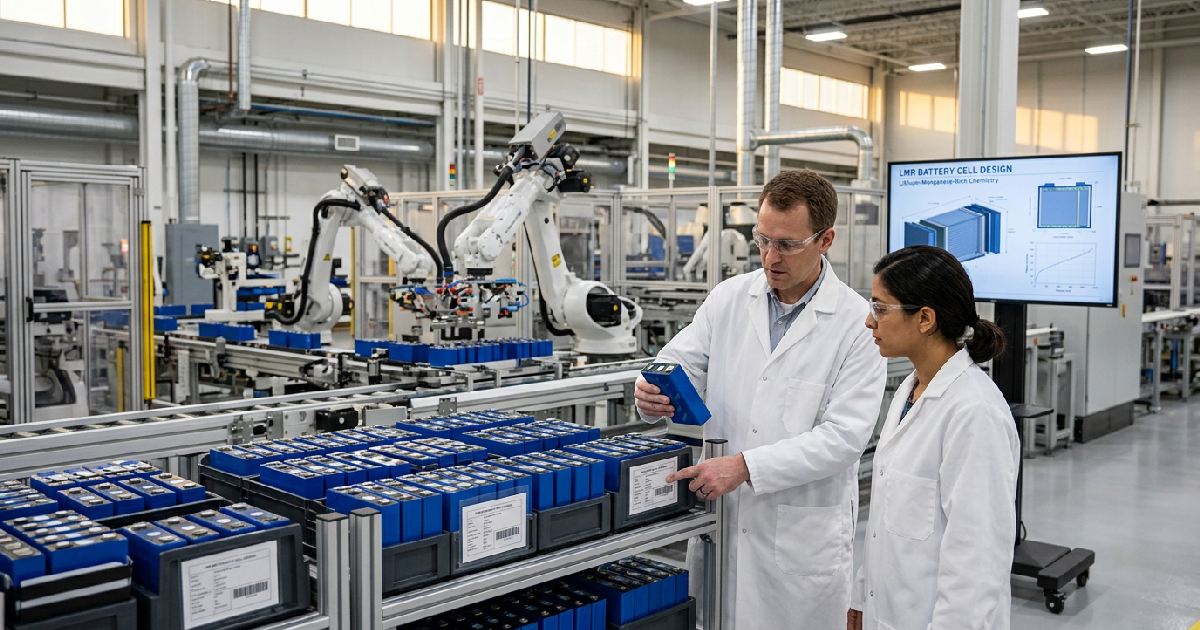
General Motors (GM) launched a $900 million project to establish the Battery Cell Development Center (BCDC) in Warren, Michigan, a facility designed to reduce electric vehicle production costs by nearly 10%.
The 500,000-square-foot facility, also known as the Ancker-Johnson Battery Cell Development Center, will play a central role in validating new cell concepts and accelerating large-scale production. By bridging the gap between experimental laboratory trials and widespread manufacturing, the automaker aims to bring cheaper batteries to market a year ahead of schedule.
The facility is expected to open in early 2027 within the Warren Tech Center area near Detroit. Its first assignment is to advance Lithium-Manganese-Rich (LMR) batteries into production before any other automaker. GM has been researching manganese-rich lithium-ion cells since 2015, prototyping them at the nearby Wallace Battery Cell Innovation Center.
The new BCDC will house development teams focused on ensuring these new chemistries are ready for the factory floors of GM’s massive gigafactories.
Kurt Kelty, vice president of battery and sustainability at GM, has identified LMR technology as the company’s future “bread and butter” product line for mass-market models. This chemistry offers high energy density similar to expensive Nickel-Manganese-Cobalt (NMC) batteries but at a price point competitive with Lithium Iron Phosphate (LFP) solutions.
In applications like the Chevrolet Silverado EV, LMR could preserve a range of over 400 miles while reducing the cost per battery pack by at least $6,000 compared to current designs.
Accelerating the industrial transition from NMC to LMR
The strategic shift toward LMR represents an effort to maintain vehicle performance while slashing manufacturing overheads. While NMC chemistry will remain in GM’s high-end luxury vehicles, LMR is intended to power high-volume segments. This transition is essential for GM as it faces growing competition from Chinese battery titans like CATL and BYD.
The BCDC acts as a keystone in this strategy, helping to reduce development times for new batteries by as much as a year.
Mo Gallegos, head of BCDC at GM, oversees the facility that serves as a pilot line to determine if small-batch breakthroughs are ready for commercial volume. The center’s equipment is nearly identical to that used in full-scale production, which simplifies the handoff to larger plants.
This industrial continuity is vital for avoiding the production bottlenecks that often occur when moving from a research environment to a 2.8 million-square-foot factory like the one in Warren, Ohio.
Stability in production is as critical as the chemistry itself. Just as consistent power delivery is fundamental to national industrial growth, GM’s battery roadmap requires a seamless scale-up of chemical processes. Commercial production of LMR prismatic cells is currently planned for 2028 through Ultium Cells LLC, a joint venture between GM and LG Energy Solution.
Engineering efficiency through the Ultium battery platform
The BCDC is part of a broader industrial ecosystem anchored by the Ultium battery platform. These batteries use large-format pouch cells that can be stacked vertically or horizontally, allowing for flexible vehicle architecture across different models.
A wireless battery management system (wBMS), developed with Analog Devices, further improves efficiency by eliminating up to 90% of the wiring within the battery pack. This innovation reduces the overall volume of the pack by 15%.
The scale of GM’s battery investment is supported by significant financial backing, including a $2.5 billion loan from the Department of Energy awarded in 2022. This funding supports the construction of lithium-ion manufacturing facilities in Ohio, Tennessee, and Michigan. These plants are expected to create over 5,000 operations jobs and significantly reduce petroleum consumption.
For instance, the Ohio facility recently celebrated the production of its 100 millionth battery cell on December 5, 2024.
As the industrial internet of things continues to expand through connected sensors, GM is also incorporating advanced software and AI simulations to manage production risks. The company uses physics-based models to simulate how changes in chemistry or production processes affect cell performance. This “national lab-scale” computing power allows engineers to troubleshoot clearance issues and mixing processes in a virtual environment before physical production begins.
Timeline for commercial LMR deployment
GM is working toward a staggered rollout of its new battery technologies over the next two years. Pre-production of LMR prismatic cells is expected to begin at an LG Energy Solution facility by late 2027. This will be followed by full commercial production in the United States by Ultium Cells in 2028.
Simultaneously, the automaker is expanding into LFP chemistry for its lowest-cost battery solutions, with production lines in Spring Hill, Tennessee, targeted for late 2027.
This multi-chemistry approach allows GM to address different market segments with tailored industrial solutions. By using LMR for mid-range and mass-market vehicles, the company can deliver the best mix of range and affordability. The BCDC’s role in proving these batteries are commercially viable is the final hurdle before they reach consumers in the 2028 model year.
The success of the Warren facility will determine how quickly GM can pivot its production lines to compete globally. With LMR technology, the price gap between electric and combustion vehicles could narrow significantly, driven by innovations in both materials science and manufacturing processes. For engineers and operations professionals, the BCDC represents a shift toward more agile, data-driven industrial production in the automotive sector.
