


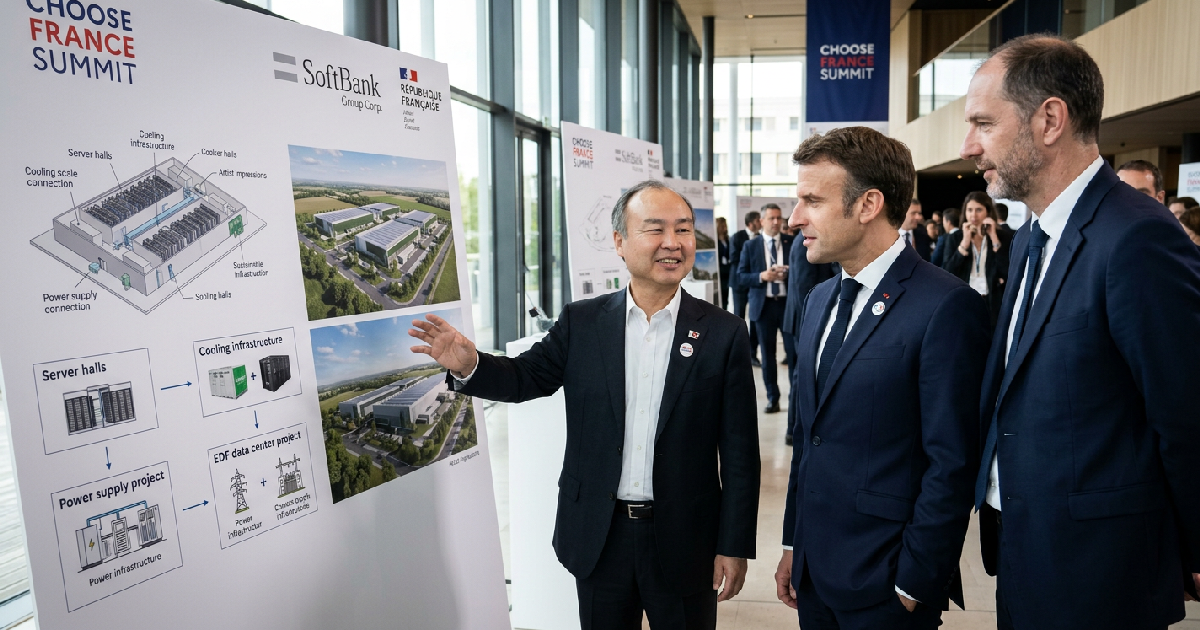
SoftBank Group Corp. 5 billion) to build and operate massive AI data centres across France, a move aimed at establishing the country as Europe’s primary computing hub. The deal, announced on May 30, 2026, during the Choose France summit hosted by President Emmanuel Macron, includes a partnership with state-owned energy giant EDF and Schneider Electric to deliver up to 5 gigawatts (GW) of capacity.
French Minister of Economy Roland Lescure confirmed the investment as a testament to France’s ambition to lead the artificial intelligence value chain.
The first phase of this rollout involves an initial €45 billion (approximately $52 billion) spend to bring 3.1 GW of capacity online by 2031. SoftBank Group Corp. will focus this stage on the Hauts-de-France region, with specific projects already slated for Dunkirk (Loon-Plage), Bosquel, and Bouchain. For industrial professionals, this represents a massive civil engineering and power infrastructure undertaking that leverages France’s status as a reliable energy exporter to meet the voracious power demands of generative AI.
This initiative underscores a growing trend where global firms priorituse regions with stable, high-output energy grids. While some nations struggle with the environmental and pricing impact of massive server farms, France’s industrial ecosystem and reliable grid make it an ideal candidate for SoftBank’s largest AI infrastructure project in Europe. com/africa-digital-payments-infrastructure-reliability/”>African digital payments infrastructure depends on similar underlying stability to scale effectively.
Industrial clusters and the Hauts-de-France regional strategy
The selection of the Hauts-de-France region is strategic, providing a robust industrial ecosystem and a skilled workforce. A significant component of the deal involves a joint venture majority-owned by SoftBank Group Corp., formed with Sesterce, to develop and operate a 1 GW AI data centre campus in Bosquel. This site alone will represent one of the highest concentrations of artificial intelligence computing power on the continent.
Beyond the server racks, SoftBank Group Corp. intends to establish a large-scale industrial production cluster at the Port of Dunkirk. This facility will manufacture data centre components, effectively domesticating the manufacturing supply chain for hardware. By building components where they are deployed, the project reinforces European technological sovereignty and reduces logistical overhead.
Schneider Electric CEO Olivier Blum has positioned his company as a primary technology partner for this cluster. Schneider Electric will provide essential energy technology solutions to keep the planned 5 GW of hardware operational. This collaboration aims to create a blueprint for “sovereign AI,” where hardware production and data processing occur within the same industrial borders.
Repurposing legacy energy infrastructure for modern compute
The involvement of EDF, the French state-owned utility, provides a unique engineering angle. Part of the agreement includes transforming a former power plant site in Bouchain into a high-capacity data centre. Repurposing brownfield industrial sites allows SoftBank to tap into existing high-voltage electrical connections originally built for heavy generation, bypassing many delays associated with new grid commissions.
This approach to infrastructure reliability is critical as more sectors migrate to digital-first industrial models. Just as Ijeoma Eti addresses AI infrastructure faults and security concerns globally, this project highlights the need for controlled, high-standard environments. Converting old power sites into data hubs provides the “plug-and-play” capacity that massive AI models require.
Strategic implications for the European AI value chain
For the engineering and construction sectors, the SoftBank investment signals a decade-long pipeline of work. Building 5 GW of capacity requires sophisticated cooling systems, redundant power backups, and advanced physical security. The project is expected to support the rapid growth of artificial intelligence in Europe, requiring a specialised workforce to maintain the facilities once Phase 1 is live by 2031.
French Minister Roland Lescure noted that the deal creates a “leading destination” for AI, moving France beyond software and into hardware and infrastructure. By hosting compute power, France gains a geographic advantage in low-latency applications, making it a natural home for industrial tech firms. This mirrors broader efforts to strengthen productive capacity, similar to how industrial and engineering stocks rally when major infrastructure projects are greenlit.
While SoftBank previously announced a data centre in Ohio powered by a 9.2 GW natural gas plant, the French strategy relies on the country’s reliable and extensive electrical grid. This allows SoftBank to meet the compute needs of customers like OpenAI—in which it is both an investor and a client—without the same level of utility price volatility seen in other markets. For African markets, France’s model of leveraging state-owned energy assets (EDF) to power high-tech manufacturing offers a compelling blueprint for industrial sovereignty.
