


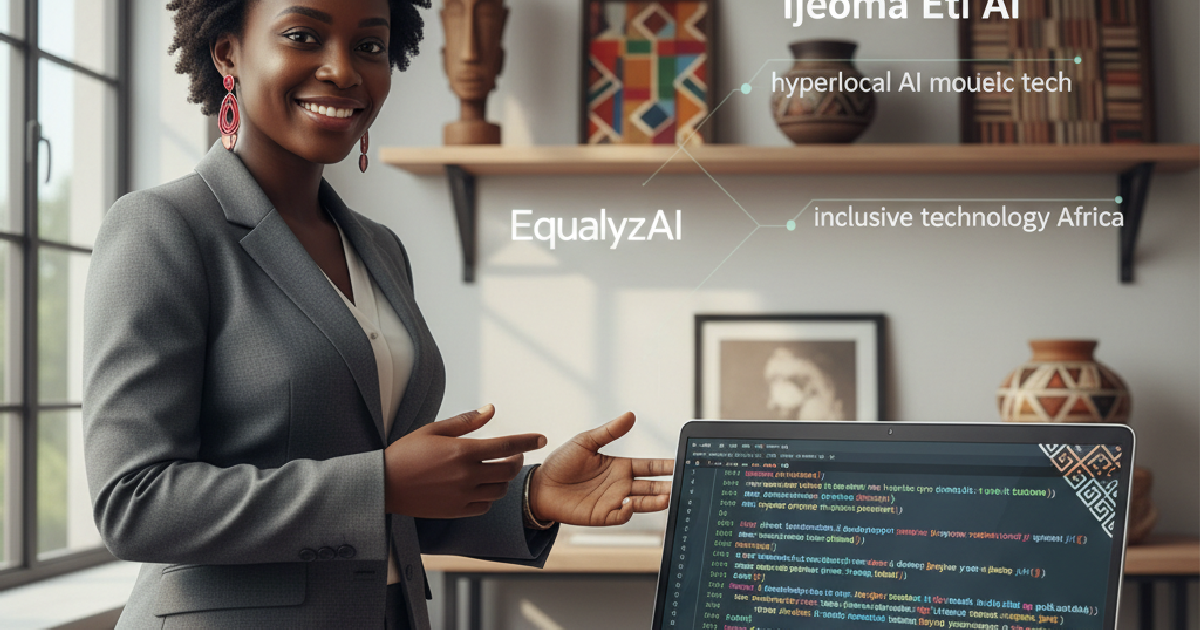
EqualyzAI has launched a specialized artificial intelligence platform designed to address the linguistic exclusion of African languages in the global tech ecosystem. The startup, led by founder Ijeoma Eti, aims to dismantle the barriers that prevent millions of non-English speakers from accessing digital services by developing hyperlocal Large Language Models (LLMs) that prioritize regional dialects and cultural nuances across the continent.
The move comes at a time when major global AI models often struggle with African syntax and context, frequently providing inaccurate translations or failing to understand localized idioms. By focusing on indigenous speech patterns and data privacy, EqualyzAI is positioning itself as a critical bridge between advanced computing and local communities. This development is particularly relevant as Africa digital payments infrastructure continues to evolve, requiring more intuitive and accessible user interfaces for diverse populations.
Most existing AI technologies are trained on massive datasets dominated by Western languages, which creates a “language gap” that alienates a significant portion of the African market. EqualyzAI intends to solve this by building models from the ground up using verified local data, ensuring that the digital transformation is inclusive of those who do not speak English, French, or Portuguese as a first language.
Addressing Linguistic Bias in Global AI Development
The current state of artificial intelligence is heavily skewed toward a handful of dominant global languages. For many African users, this means that voice assistants, chatbots, and translation tools are often ineffective or entirely unavailable in their mother tongues. This disparity doesn’t just affect social interaction; it creates a recursive disadvantage in education, healthcare, and finance.
Ijeoma Eti has previously highlighted that the technical architecture of many systems overlooks the specific needs of diverse populations. Her work with EqualyzAI emphasizes that “inclusive AI” is not just about translation—it is about understanding the structural logic of a language. As the continent scales its technical capabilities, addressing AI infrastructure faults and security concerns remains a top priority for developers seeking to build trust with local users.
The Challenge of Low-Resource Languages
In the world of machine learning, many African languages are classified as “low-resource,” meaning there isn’t enough digitized text available to train standard models effectively. EqualyzAI is tackling this by partnering with local linguists and data collectors to create high-quality datasets. This grassroots approach ensures that the nuances of languages like Yoruba, Zulu, or Amharic are preserved, rather than being flattened by generic algorithms.
The technical hurdles are steep, but the potential impact on accessibility is vast. When a small-scale farmer can interact with a weather-prediction bot in their native dialect, the utility of the technology shifts from a novelty to a necessity. This hyperlocal focus allows the platform to serve sectors that have been traditionally underserved by the Silicon Valley “move fast and break things” philosophy.
Strategic Integration Across the African Tech Sector
EqualyzAI is not operating in a vacuum. The startup is entering an environment where connectivity and digital service delivery are rapidly maturing. From education to heavy industry, the demand for intelligent systems that “speak African” is growing. For instance, the expansion of the African IoT sector through industrial connectivity requires interfaces that local operators can navigate fluently and safely.
By offering an API-first approach, the company allows other businesses to integrate these hyperlocal models into their own applications. This could revolutionize how customer support is handled in the banking sector or how health information is disseminated in rural areas. The goal is to create a ripple effect where local language support becomes a standard feature rather than an afterthought.
| Feature | EqualyzAI Approach | Standard Global AI |
|---|---|---|
| Data Sourcing | Localized, verified regional dialects | Scraped web data (English dominant) |
| Cultural Context | High (Idioms and social nuances) | Low (Literal translations) |
| Access Model | Hyperlocal and API-focused | Generalized cloud platforms |
| Primary Focus | Bridging the linguistic digital divide | Broad-market scalability |
Future Outlook for Localized Computing
The path forward for EqualyzAI involves expanding its language library and strengthening its processing power to handle real-time voice translation. As more Africans come online for the first time, the demand for voice-first interfaces will likely surpass text-based systems, especially in regions with varying literacy rates. The startup’s success will depend on its ability to maintain data integrity while scaling across thousands of distinct languages.
Beyond the immediate utility, this movement represents a shift in digital sovereignty. By building and owning the models that interpret their own languages, African innovators are ensuring that the future of the continent’s AI is shaped by its own people. This isn’t just a technical upgrade; it’s a fundamental reclaiming of the digital narrative.
Frequently Asked Questions
Why is a hyperlocal approach necessary for African AI?
Africa is home to over 2,000 languages, many of which have complex tonal structures and unique cultural contexts. Standard AI models trained on Western data often fail to grasp these nuances, leading to errors or total exclusion of local speakers.
Who is behind the EqualyzAI initiative?
The project is led by Ijeoma Eti, an expert in AI infrastructure and security. The company focuses on building linguistic bridges that allow for more equitable access to technology across the continent.
How will businesses benefit from this technology?
Companies can use EqualyzAI’s models to provide better customer service, more accurate localized marketing, and inclusive user interfaces, helping them reach millions of potential customers who were previously excluded due to language barriers.
