


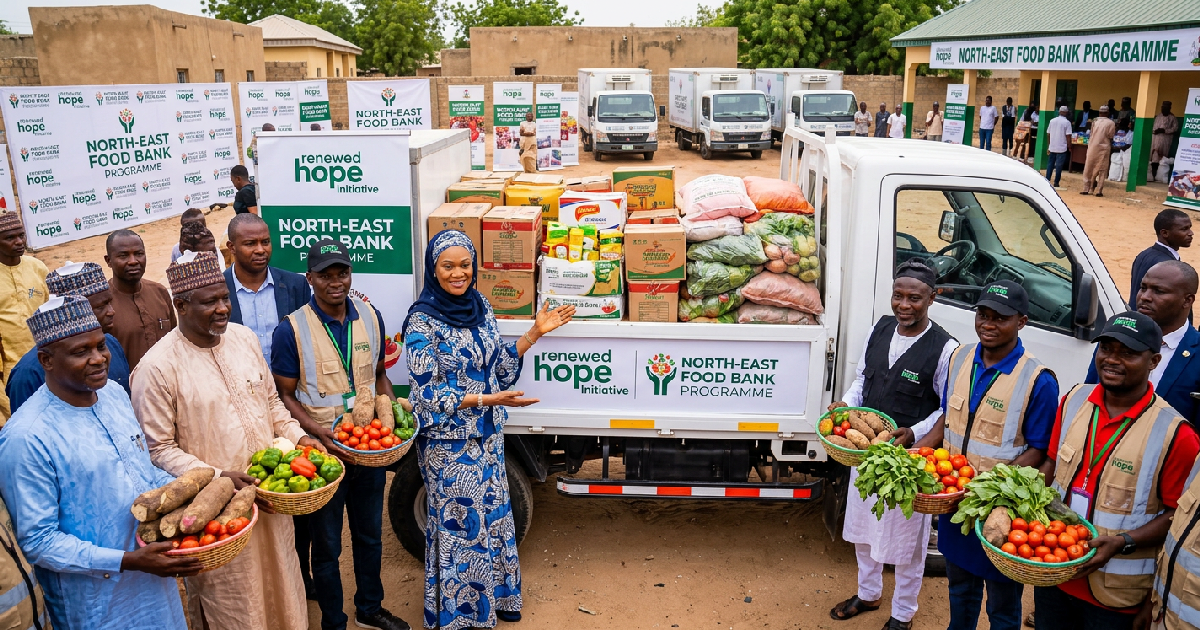
Nigeria’s First Lady, Senator Oluremi Tinubu, has officially flagged off the North-East regional phase of the Renewed Hope Initiative Food Bank program in Borno State. The project is designed to tackle nutritional challenges and offer immediate assistance to vulnerable households across the six states residing within the North-East geopolitical zone. By establishing this coordinated food distribution system, the administration seeks to mitigate the impact of recent economic shifts on the region’s most at-risk populations.
The First Lady’s presence in the regional hub highlights the federal government’s focus on areas that have faced heightened food insecurity due to historical security and environmental hurdles. During the ceremony, she reportedly presented essential supplies to regional representatives, noting that the program fulfills a broader promise of social welfare. The project operates as a central pillar of the Renewed Hope Initiative, which focuses on providing social interventions for women, youth, and children. Success in these large-scale logistics often mirrors the technical precision found when federal authorities upgrade power infrastructure in Ebonyi and Enugu to support regional stability.
Borno State Governor Babagana Zulum hosted the delegation at the Government House alongside several other regional leaders. The rollout comes at a time when the engineering of complex logistics for aid distribution is becoming a primary focus for state-level administrations. While the immediate priority is the delivery of food, local officials indicated that these interventions are intended to complement ongoing efforts to build long-term agricultural resilience.
Engineering Robust Logistics for Regional Relief
The implementation of the Food Bank program aims to build a more resilient social safety net in a region characterized by its challenging terrain and past instability. By centralizing the storage and movement of staples, the initiative attempts to bypass the logistical bottlenecks that frequently slow down aid delivery to rural communities. This regional launch is expected to serve as a blueprint for planned rollouts in other Nigerian zones, marking a shift in how the First Lady’s office manages nationwide social coordination.
Managing the supply chain for this mission involves detailed planning to ensure goods reach the specific local government areas where they are needed most. This focus on industrial-scale connectivity is a growing trend across various sectors. For instance, as the African IoT sector expands through industrial connectivity, there is a clear precedent for using technical systems to monitor and optimize the movement of resources. In the North-East, the effectiveness of the program will likely depend on the reliability of transport networks and the structural integrity of the storage facilities housing the bulk supplies.
Collaborative Distribution Networks
A central part of the strategy involves collaboration between the First Lady and the wives of the various state governors. These local leaders are tasked with supervising the final delivery of items to ensure they reach the intended beneficiaries without diversion. By utilizing these established local networks, the initiative aims to maintain a transparent and data-driven distribution process.
Governor Zulum reported that the timing of the intervention provides a necessary buffer for families during seasonal lean periods when market pressures are highest. The support is expected to help stabilize demand and provide relief to displaced persons and others currently navigating the rising costs of living.
Infrastructure and the Path to Food Security
The deployment of the North-East Food Bank relies on sophisticated supply chain management that goes beyond simple procurement. Transporting thousands of tons of cargo across varied landscapes requires heavy-duty transport solutions and precise mechanical coordination. This emphasis on logistical engineering has become a standard requirement for successful social outreach in geographically diverse regions.
Looking beyond the immediate relief, the administration is focusing on empowering local farmers as a permanent solution to food scarcity. During the event, the First Lady encouraged a shift toward home gardening and small-scale livestock farming. Such moves toward self-reliance are intended to gradually reduce the region’s dependence on emergency federal interventions.
Engineering more efficient irrigation systems and introducing resilient seed varieties remain key objectives for state governments in the North-East. This combination of emergency relief and structural agricultural development is viewed as a necessary path to establishing lasting food security. These efforts can also influence broader economic indicators, often reflected when industrial and engineering stocks respond to improvements in regional stability and infrastructure.
As the program enters its full implementation phase, monitoring teams are expected to provide data on how effectively the food is being distributed. This feedback will help refine the logistics model before it is expanded to the southern regions. For the communities across the North-East, the commencement of this program represents a significant step in federal efforts to sustain regional welfare.
