


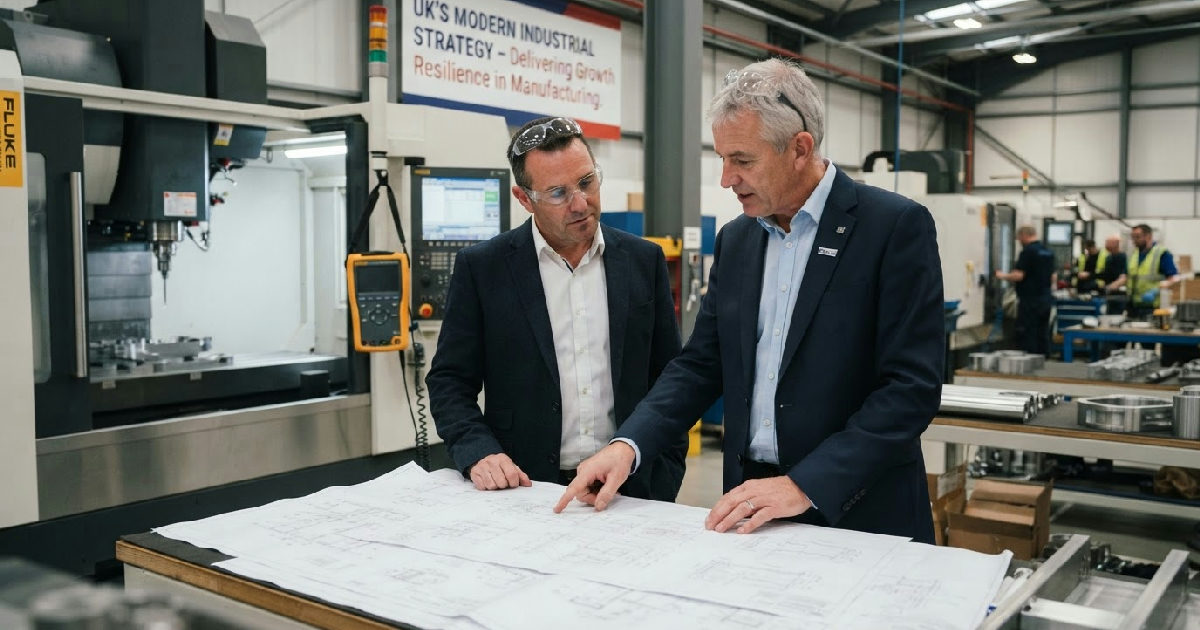
The UK’s Modern Industrial Strategy, launched on June 23, 2025, has reached its critical one-year assessment mark. While the government highlights substantial private sector commitments and investment in key areas, industry leaders and manufacturers are painting a picture of significant delivery shortcomings on the ground, as revealed by an industrial strategy review.
Stephen Phipson CBE, CEO of Make UK, and Paraic O’Lochlainn, VP of eMaint, a Fluke Corporation brand, have both voiced concerns that many businesses are yet to feel the promised benefits, calling into question the strategy’s effectiveness despite its ambitious vision.
Outcomes of the industrial strategy review after one year
Government figures indicate a period of considerable activity under the strategy. More than £380 billion in private sector commitments have been secured for high-growth areas, reportedly supporting over 155,000 new jobs. This signals a strong belief in the UK’s industrial potential from investors.
In addition, the government reports progress on key structural issues for manufacturers. Electricity bills have seen reductions through lower network charges, and efforts are underway to support faster electricity grid connections. Furthermore, £9 billion has been allocated for cutting-edge research and the commercialisation of new technologies.
A nationwide initiative aims to upskill ten million workers in artificial intelligence by 2030, a move designed to address future workforce needs. These statistics present a positive narrative of government engagement and investment in the country’s industrial base.
However, this official optimism contrasts sharply with the experiences of many businesses. The strategy, initially met with some skepticism from the SME community, now faces broader criticism regarding its practical implementation. Manufacturing investments are critical for growth, but their impact must reach the factory floor.
Industry’s call for tangible support
Stephen Phipson CBE of Make UK offers a direct assessment: “One year on from its launch, the Industrial Strategy is falling short on delivery.” He explains that while manufacturers largely back the strategy’s vision and direction, a clear gap persists between policy announcements and their actual business impact. A concerning 55% of manufacturers report seeing no benefit from the strategy so far.
Phipson stresses that the core issue isn’t the strategy’s ambition, but the pace and scale of its execution. Manufacturers are operating in a tougher environment than a year ago, facing persistent high costs and global uncertainty. These pressures force businesses to use capital for survival instead of investing in growth.
Paraic O’Lochlainn of eMaint echoes these sentiments, highlighting how recent geopolitical tensions and supply chain disruptions reinforce the urgency of strengthening domestic manufacturing. He acknowledges the encouraging signs from government reports, such as bill cuts and research funding, but insists that many manufacturers are still waiting for tangible, on-the-ground support.
New Censuswide research, commissioned by Fluke, supports these industry observations. While 61% of UK manufacturers claim to have benefited from the strategy in some capacity, less than a third, just 28%, have actually received direct grant funding. This disparity points to an uneven distribution of support.
Persistent challenges in skills and technology adoption
One of the most pressing issues identified by industry leaders is the pervasive skills gap. Despite government commitments of over £1 billion to train workers for key sectors like manufacturing, the real-world impact has been slow. Fluke’s research reveals that only 32% of manufacturers have hired or trained staff through government-backed programs.
This is particularly problematic given that a significant 90% of manufacturers report skill shortages directly affecting their operations. The disconnect between funding and practical outcomes hinders the rapid upskilling of the existing workforce and the development of future talent pipelines. Addressing this requires a comprehensive approach, integrating education, industry, and government efforts.
Technology adoption presents another hurdle for UK manufacturers striving for global competitiveness. Despite considerable public investment in industrial policy, direct grant funding for manufacturers remains low. The UK appears to trail competing markets when it comes to offering incentives for research and development.
This deficit limits manufacturers’ capacity to invest in the tools and innovations necessary for long-term resilience and growth. If the UK is serious about reshoring production and reindustrialisation, greater support for technological upgrades and innovation will be essential.
The lessons learned here extend beyond the UK. Many developing economies, particularly across Africa, face similar challenges in fostering robust industrial sectors. Strategic UK job creation relies on targeted investment and effective program delivery.
The strategy’s foundation and future direction
The 2025 Modern Industrial Strategy was conceived as a 10-year plan to provide long-term certainty for businesses and investors. It aims to reposition the state as an active partner in economic growth, tackling obstacles such as high energy costs, limited access to finance, insufficient long-term planning, and regulatory burdens.
The strategy targets eight specific high-growth sectors, known as IS-8, including Advanced Manufacturing and Clean Energy Industries.
Key commitments include plans to cut electricity costs by up to 25% for electricity-intensive businesses from 2027 through a new British Industrial Competitiveness Scheme (BICS). Initiatives also focus on reducing grid connection times, crucial for new industrial developments and energy transition projects.
Make UK’s Stephen Phipson is clear on the priorities for the strategy’s second year. The focus must shift from policy design to concrete delivery. Government needs to reduce the cost base for businesses, accelerate capital flow, and ensure reforms translate into real change on the factory floor. Industry supports the strategy’s goals, but its continued backing depends on seeing actual results.
Implications for engineering and industrial growth
For the engineering sector, these findings underscore the urgent need for clear, actionable pathways for government support. Engineers and operations professionals rely on stable policy frameworks and access to funding to drive innovation and productivity. The current perceived gap between strategic ambition and practical delivery creates uncertainty and can stifle investment in critical infrastructure and advanced manufacturing processes.
The emphasis on skills development, particularly in AI, is welcome, but requires faster, more effective implementation to close existing gaps. Engineers need continuous upskilling to adapt to new technologies and processes. Without this, the UK risks falling behind in areas like digital fluency and advanced production techniques.
Moreover, the call for greater incentives for R&D investment directly impacts the ability of engineering firms to develop and implement next-generation solutions. True industrial competitiveness hinges on a supportive environment that encourages continuous technological advancement and allows for the commercialisation of new ideas at scale.
The UK’s capacity for innovation in engineering will largely depend on how effectively these issues are addressed in the coming year.
Lessons for emerging industrial economies
The UK’s experience with its Industrial Strategy offers valuable lessons for economies across Africa and other developing regions currently working to build their own industrial capacity. The clear message is that a well-articulated vision is only the first step; effective delivery mechanisms and tangible support for businesses are paramount.
Governments in these regions often launch ambitious industrialisation plans. However, without addressing fundamental issues such as high energy costs, access to finance, and critical skills shortages, these strategies risk remaining aspirational. Direct grant funding, targeted workforce development programs, and strong incentives for local R&D are crucial to foster genuine industrial growth and resilience.
The experience highlights the need for constant feedback loops between government and industry. Understanding the on-the-ground challenges faced by manufacturers, and adapting policy delivery accordingly, is vital for transforming strategic documents into real economic impact and building competitive industrial bases.
