


The COVID-19 pandemic exposed the vulnerability of Africa’s pharmaceutical needs when global supply chains collapsed, and African nations struggled to secure essential medical supplies, particularly biologics.
According to industry analyses, Africa’s pharmaceutical sector requires an estimated $11 billion in investment by 2030 to achieve meaningful self-sufficiency in a market projected to reach $36.96 billion by 2033.
In November 2025, Nigeria signed a partnership with Brazil’s largest pharmaceutical company, EMS S.A., to establish local drug manufacturing capacity expected to create over 1,200 jobs.
Against this backdrop, South Africa’s Immobazyme has emerged as a pioneer in localizing the production of biologics through precision fermentation technology, positioning the country to manufacture vaccines, therapeutic proteins, and industrial enzymes domestically rather than importing them at high cost.
From University Lab to Commercial Biotech Manufacturing
Immobazyme, a precision fermentation biotech founded at Stellenbosch University in 2019, has successfully raised R24.5 million (approximately $2.9 million) in total funding to scale its biologics manufacturing capabilities.
The most recent round secured $1.3 million, led by the University Technology Fund with backing from Innovus, Stellenbosch University’s technology transfer office.
Founded by three scientists, Dominic Nicholas, Ethan Hunter, and Nicholas Enslin, during their Master’s program, the company addresses a critical gap: Africa’s complete dependence on imported biologics for healthcare, food production, and industrial applications.
Since then, Immobazyme has achieved consistent year-on-year growth, opening a state-of-the-art independent laboratory in 2023 and successfully manufacturing and exporting proteins to global clients by 2024, proving that South African-produced biologics can compete internationally on quality and price.
What makes Immobazyme particularly significant is its focus on biologics, a category including vaccines, monoclonal antibodies, growth factors, and complex proteins that are typically far more expensive to produce than traditional small-molecule drugs and have been manufactured almost exclusively outside Africa.
Precision Fermentation: The Manufacturing Technology
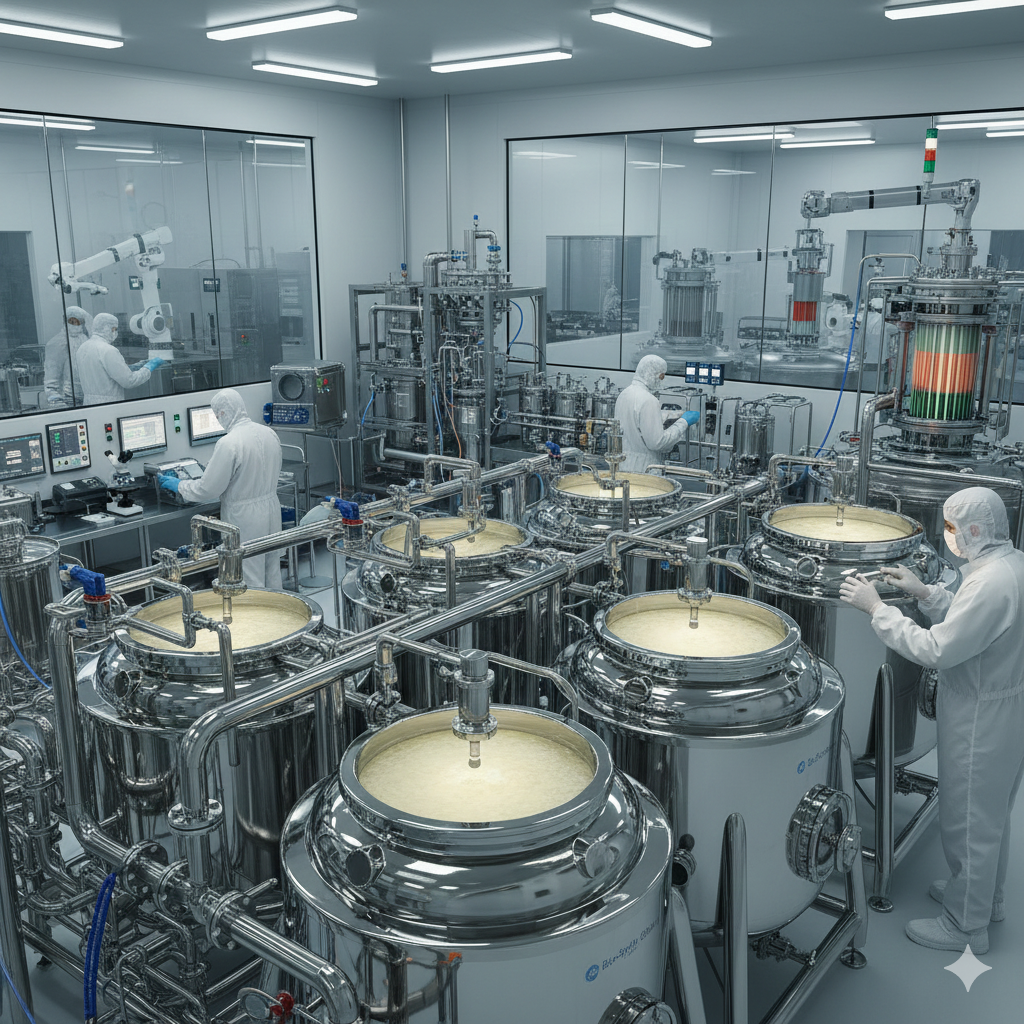
Immobazyme uses precision fermentation technology, a process using microorganisms like yeast or bacteria to produce specific proteins through controlled fermentation, but engineered to create complex biological molecules for medical and industrial use.
The company’s manufacturing portfolio spans multiple sectors.
For the food industry, Immobazyme produces enzymes like dextranase, which breaks down dextran gums that contaminate sugarcane processing, thereby improving production efficiency and reducing costs for manufacturers.
For the emerging cellular agriculture sector, the company manufactures growth factors needed for cell-cultured meat production.
For pharmaceutical applications, Immobazyme is developing therapeutic proteins that could be manufactured locally rather than imported.
The company has also developed PepTrap, a proprietary enzyme immobilization platform that enhances enzyme efficiency and stability in manufacturing processes, a patent-pending technology that provides significant competitive advantage and allows for more cost-effective production at scale.
Scaling Manufacturing Capacity
The recent funding will enable Immobazyme to dramatically expand its biologics manufacturing infrastructure and production capacity.
Over the next 12 months, Immobazyme intends to complete a new 1,800m² manufacturing facility in Cape Town, equipped with advanced fermentation systems, quality control laboratories, and clean rooms that meet international Good Manufacturing Practice (GMP) standards.
This expansion will increase the company’s production volume capabilities significantly, allowing it to move from laboratory-scale batches to commercial-scale manufacturing that can serve both domestic and international markets.
The facility will house multiple fermentation lines capable of producing different biological products simultaneously, creating a versatile manufacturing platform that can respond to various market demands.
The company is also advancing its proprietary therapeutics program, developing new biological medicines that could address health challenges prevalent in African populations.
CEO Dominic Nicholas emphasized the manufacturing focus, “Our platform is already delivering measurable impact in biologics production, and we’re closing in on manufacturing solutions for some of the toughest challenges in biologics scalability and cost-effectiveness.”
Building Africa’s Biologics Manufacturing Ecosystem
Immobazyme’s expansion aligns with the African Union aims to produce 50% of needed vaccines and achieve 55% market share for locally produced medical products by 2040.
However, significant manufacturing challenges remain:
- Most African pharmaceutical facilities operate at just 30-60% capacity compared to over 70% in advanced economies, indicating systemic inefficiencies in production processes.
- Infrastructure gaps, particularly unreliable electricity that disrupts sensitive fermentation processes and poor cold-chain logistics needed for biologics storage and distribution, constrain manufacturing operations.
- Access to specialized equipment, raw materials for fermentation, and trained biotechnologists remains limited compared to established manufacturing hubs in North America, Europe, and Asia.
Despite these challenges, Immobazyme’s manufacturing approach represents a strategic pathway.
As global health challenges evolve, from antimicrobial resistance to climate-related diseases, Africa cannot afford continued reliance on external supply chains for essential medicines, particularly biologics that require specialized storage and rapid deployment during health emergencies.
