


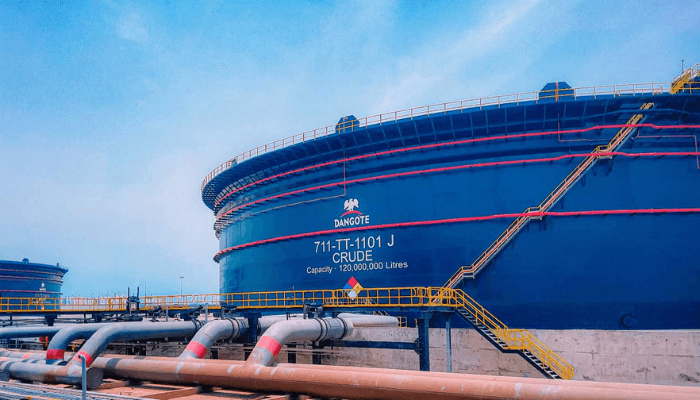
The Dangote Petroleum Refinery has announced a massive production and supply plan aimed at ensuring Nigeria’s gasoline availability over the Christmas season and well into 2026, indicating a dramatic shift in the country’s downstream manufacturing capabilities.
In an official notification to the Nigerian Midstream and Downstream Petroleum Regulatory Authority (NMDPRA), the refinery said that it will produce 1.5 billion litres of Premium Motor Spirit (PMS) between December 2025 and January 2026.
Production is set to increase to 1.7 billion litres per month beginning in February 2026, cementing the refinery’s position as a key driver of Nigeria’s industrial production.
“Our priority is to ensure Nigeria receives the products it needs. This is not driven by profit motives; it is about guaranteeing the availability of essential energy products. It is similar to the transformation we delivered in the cement sector,” Dangote said.
According to Managing Director David Bird, the factory is presently making 40–45 million litres of PMS per day and is positioned to expand that amount to 50 million litres during the high-demand December season.
Bird stated that the refinery is ready to meet NMDPRA inspectors from December 1noting that the firm is completely committed to operational openness on production and inventory levels.
The announcement emphasizes the refinery’s rising importance not just as an energy provider but as one of the continent’s most major industrial production hubs.
During a recent facility tour by the South-South Development Commission (SSDC), Dangote Industries President Aliko Dangote reiterated that the refinery’s core objective is ensuring supply stability, eliminating the recurring production and distribution bottlenecks that have historically constrained domestic manufacturing activity.
The refinery is currently taking on a large-scale expansion plan aimed at increasing processing capacity to 1.4 million barrels per day, which would place the facility among the world’s top refining complexes.
This growth is inextricably linked to the group’s long-term industrial strategy: reducing Africa’s dependency on imported fuels and transforming the continent into a net exporter of refined petroleum products.
More than 100,000 workers are planned to be employed during the refinery and fertilizer plant development stages, demonstrating the project’s scope and importance in Nigeria’s manufacturing environment.
