


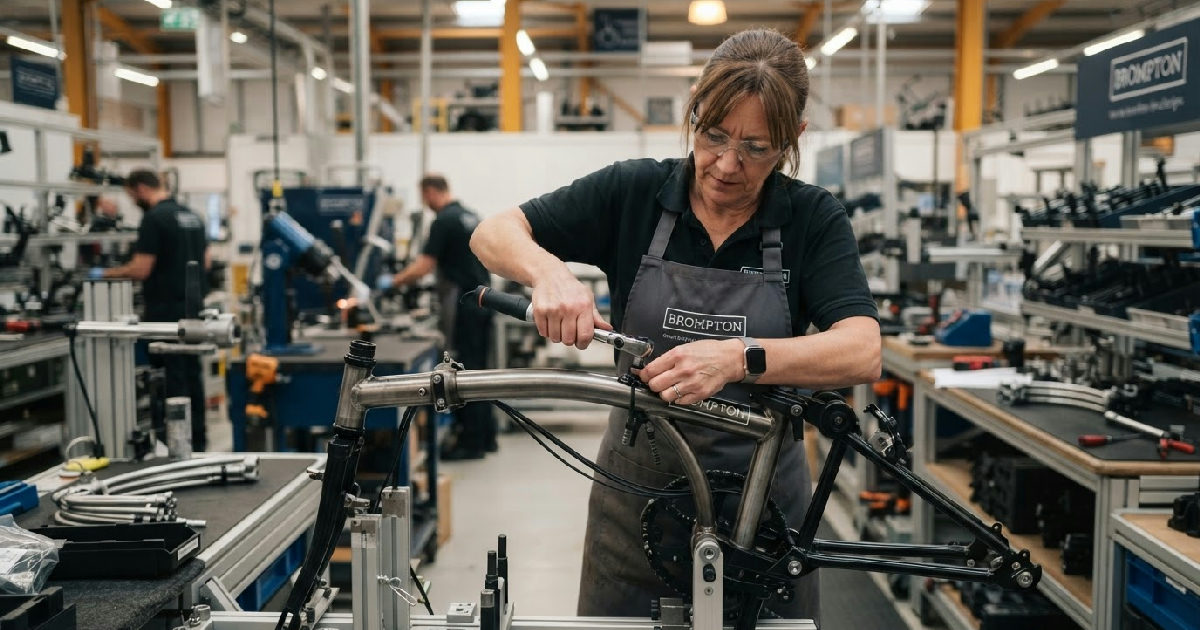
Brompton Bicycle integrates advanced manufacturing technology with traditional craftsmanship and a strong commitment to sustainability in its iconic folding bike production.
Founded in 1975 by Andrew Ritchie, Brompton’s original vision for a compact, efficient urban transport solution has evolved into a global brand. This journey reflects a continuous pursuit of improvement and a deep understanding of urban mobility needs. The company now aims to double its annual production to 140,000 bikes by 2027.
Precision Engineering in Brompton Manufacturing
Brompton’s manufacturing process is meticulously structured, operating across four distinct production lines in its West London factory in Greenford. These lines function Monday to Thursday, from 7:00 am to 4:30 pm, dedicating Fridays to essential factory maintenance. This systematic approach supports a consistent output.
Currently, the factory produces an average of 350 bikes daily, equating to 1,400 bikes each week. During the peak demand of COVID-19, production soared to a record 2,500 units in a single week. This demonstrates the factory’s capacity for rapid scaling when market conditions demand it.
The initial stage involves receiving pre-cut and formed tubing from suppliers. Skilled brazing technicians then meticulously join these components by hand to create the bike frame, a testament to enduring British craftsmanship. Alex Watkins, a Manufacturing Engineer at Brompton Bicycle, highlights this crucial craft, noting its central role in achieving product integrity.
Subsequent stages focus on assembling components, wheels, and gears, a process done entirely in-house due to the product’s specific design requirements. After metalwork receives its colour, all parts are assembled to complete the finished bicycle. This comprehensive on-site assembly ensures precise control over every detail.
Incorporating smart manufacturing technologies
Smart manufacturing technologies have become integral to Brompton’s factory, aiding operations and driving efficiency. The company’s increased demand during COVID-19 acted as a catalyst, prompting a shift from manufacturing hundreds to thousands of bicycles. This necessitated a focus on ergonomics and automated solutions for repetitive tasks.
Brompton has moved into Industry 4.0 by introducing new sensors and developing advanced algorithms. These innovations create sophisticated controls over production, enhancing overall quality and consistency. Alex Watkins confirms these changes have allowed Brompton to deliver a superior product to its customer base.
Looking forward, Brompton plans to implement a digital passport system for each bicycle. This will allow customers to trace the date of production and the origin of materials, enhancing transparency and traceability. Such projects underscore the company’s commitment to ongoing digital transformation.
Further technological advancements include partnerships with ABB Robotics, East Kent College (EKCG), and HSSMI on the “Brom-bot project.” Backed by Made Smarter Innovation, this initiative develops robotic solutions for coating and brazing processes. The automated brazing, for instance, is 30% faster than manual methods, promising improved scalability and reduced lead times.
These robotic innovations also contribute to sustainability by reducing energy consumption and emissions, with an estimated 15-20% reduction in environmental impact. The company also uses modern paint shops with powder coating systems that reuse paint, further minimising waste. Its research and development centre in London employs advanced CNC machining expertise from Geomiq for complex production-line tooling, boosting precision and design capabilities.
Better forecasting and planning
At a time when trading environments are so volatile, manufacturers that build collaboration into their supply chains tend to thrive. Brompton certainly falls into this category, having cultivated long-established relationships with suppliers over the years, many of whom have been partners since day one.
Brompton also supports local businesses, which can present challenges when certain manufacturing moves exclusively to Europe. “However, we work as closely with British suppliers as we can,” Alex said. Standardised planning has been key for Brompton to continue its production.
During COVID-19, the business experienced a significant influx of orders due to the nature of its product, which enabled people to exercise alone and commute without mixing with others. Since then, the business has successfully built upon that growth.
“Even though we were already producing large volumes of bicycles we had to increase our orders from our suppliers to meet that increase in demand. Yet, we wanted to ensure that same level continued after the pandemic.
To help with this we involved other teams such as marketing to perform research, predict trends and gain insights into what our customer base was looking for, as well as what their priorities were when purchasing a new bicycle,” Alex explained.
In the last two years, Brompton has seen a significant shift in its ability to plan, a critical area given general industrial strategy shortcomings.
“When I joined the business five years ago, the production plan could change on an hourly basis, now we have the most amount of models being produced on the shop floor, meaning we can’t be as flexible. Therefore, moving towards better forecasting and planning will allow us to operate more effectively,” Alex said.
e-Motiq System Redefines Electric Folding Bikes
Brompton’s e-Motiq electric bike system exemplifies its technological prowess, engineered with an approach akin to the automotive and aerospace industries. This ensures high standards of quality, reliability, and safety. The system provides smooth, natural assistance, making varied terrains and longer journeys more accessible for riders.
The e-Motiq system intelligently adapts to rider input, offering more accurate range predictions and personalised ride insights. Its intuitive handlebar controller allows riders to switch assistance modes without removing their hands, while a companion Brompton app provides additional data and updates. This integrated design enhances the user experience.
Powering the system is a 345Wh battery, externally placed for easy removal, and capable of offering up to 56 miles of range across three assistance modes. Charging takes five hours for a full charge or four hours to reach 80%.
New Brompton Electric bikes feature a handlebar-mounted display for real-time information on assistance, battery levels, estimated range, and current speed, with the app providing mileage-based service reminders.
The Electric G Line, featuring 20-inch wheels, hydraulic disc brakes, and updated geometry, offers smoother rides across diverse terrains and includes a 9W front light. For those seeking ultimate lightness, the Electric T Line combines the e-Motiq system with a titanium frame and carbon components, representing Brompton’s pinnacle of lightweight folding e-bike design. These advancements highlight the company’s continuous engineering pursuit of performance and portability.
Going green
Brompton’s B-Corp Certification, attained in July 2023, underlines its comprehensive commitment to environmental and social performance. The company had already been implementing many required practices prior to certification, viewing the process as a formalisation of existing values. This certification includes an Impact Business Model for resource conservation through its Brompton Docks bike hire scheme.
The company is targeting Net-Zero by 2050, with ambitions to achieve this milestone sooner. In 2023, Brompton meticulously measured its entire carbon footprint, encompassing Scopes 1, 2, and 3, which totalled 18,187 tCO2e. The company plans to submit its carbon reduction roadmap to the Science Based Targets Initiative for validation in 2024.
A significant portion of its emissions, 62%, stems from product materials, particularly the steel and aluminium supply chain. Brompton calculates each of its bikes uses an average of 6.2 tonnes less carbon to produce than a car, highlighting the inherent environmental benefit of its product.
Operations are also becoming greener, with 95% of global operational energy now sourced from renewable energy and carbon-neutral gas contracts, projected to reach 100% by 2024.
Waste reduction is a core pillar of Brompton’s sustainability efforts. The London factory halved its waste over the past five years, recycling 62% of waste at its Greenford site in 2023.
The powder-coating process reuses paint from one frame to another, and a new water recycling washing system continuously recovers and reuses wash water, significantly reducing both waste and pollution. This dedication to efficient resource management defines its operational practices.
Attracting new talent
Brompton actively invests in its people and specialist skills, recognising that human expertise remains critical alongside technological integration. The company’s strong brand and values aid in attracting new talent. Alex Watkins notes a unique energy on site, where individuals are collaborative and supportive, fostering a positive recruitment environment.
Over the last decade, Brompton has expanded its skill set by drawing influence from diverse sectors such as automotive and aerospace. Collaborating with an aerospace partner for its titanium T Line and a Formula One team for its e-bike development has brought in new expertise. This cross-industry engagement supports skill transfer and innovation within the company.
The company also offers graduate scheme placements annually, providing young people with new ideas and fresh talent. Brompton engages with the local community, recently hosting Year 8 girls who showed keen interest and even proposed future product designs. This proactive approach ensures a pipeline of future engineers and designers.
Preserving specialised manufacturing skills
A cornerstone of Brompton’s craftsmanship is brazing, a specialised skill increasingly rare in the UK. To preserve this expertise, Brompton has established an in-house brazing school. Rather than hiring experienced braziers, the company trains employees from within, typically those with strong manual skills from assembly roles who already understand the brand and its manufacturing standards.
Becoming a skilled brazier is a substantial investment, with training often spanning one to two years. However, it is also one of the highest-paid shop floor roles, providing a strong incentive for individuals to develop this intricate skill. Each master brazer leaves a small signature on the frames, a testament to their individual contribution and the enduring value of hand-built quality.
Keeping up with change
As a business with 51 years of history, Brompton continuously adapts to market changes and emerging trends. A key focus involves understanding customer needs and integrating this feedback directly into operations. Defining clear business goals and implementing a structured plan are crucial for sustained growth, according to Alex Watkins.
This strategic roadmap has been instrumental in the development of new product ranges over the past five years, including the lighter, faster T Line made from titanium. Brompton’s ability to listen to customer demands and execute a clear plan allows it to position itself effectively in the competitive market. This customer-led innovation ensures its products remain relevant and desirable.
Brompton’s commitment to continuous improvement extends to exploring new materials and refining existing designs. The ultimate goal remains building the best possible bicycles while delivering exceptional value to customers. This holistic approach, combining tradition with technology and sustainability, provides a strong model for other manufacturers focused on precision engineering.
Racing Ahead with Technology and Innovation
Looking ahead, Brompton is planning to embrace emerging technologies wherever they can add value, using them to shape its roadmap for the next five years. By gaining a deeper understanding of its customers, the business hopes to improve planning, accelerate innovation and bring new products to market more quickly.
“Alongside the technology, we are focusing on the expertise of our people, encouraging them to share ideas with us to help us grow. This approach resonates with broader manufacturing sector demands for skilled labour and innovation. We are going to continue exploring new materials for our bicycles and improving on our existing designs.
Ultimately, the goal is to build the best bicycles possible while delivering the best value to our customers,” said Alex. Its blend of traditional craft with digital tools, coupled with a strong ethical framework, makes it a compelling example of modern engineering in action.
Brompton’s journey demonstrates how heritage brands can evolve, embracing new technologies and sustainable practices without compromising their core identity.
