


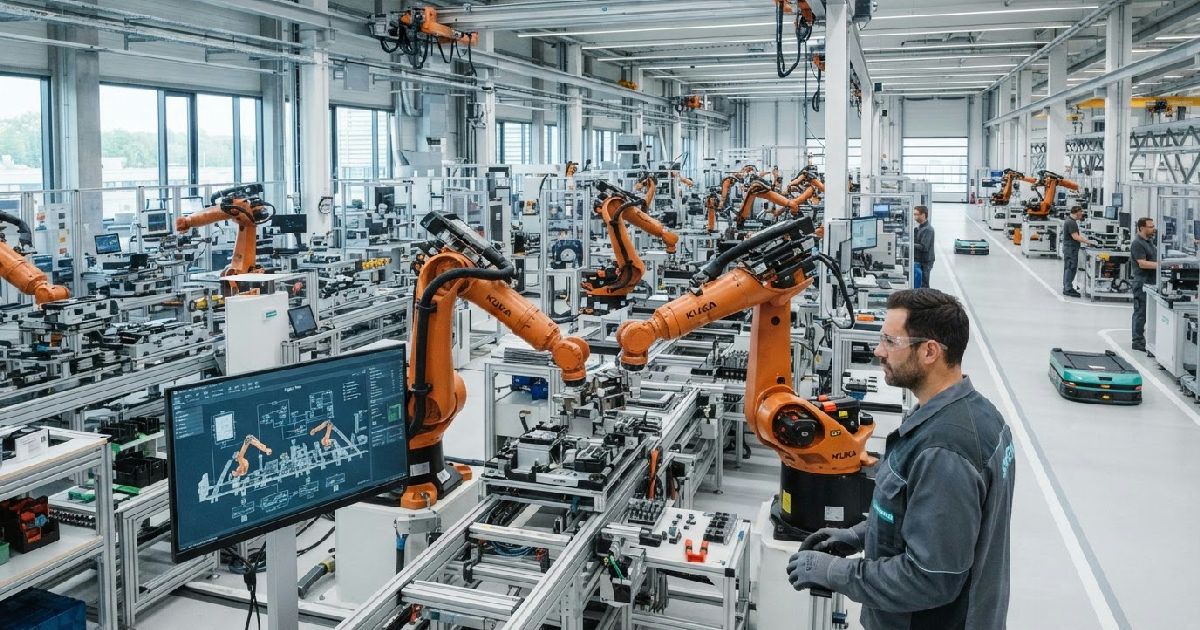
Siemens is channelling €500 million into its Erlangen electronics plant, a major step in its ambitious plan to achieve 80% automation across its German manufacturing operations.
This investment, set to run through 2030, will transform the Erlangen facility into a showcase for AI-powered production. It’s part of a wider €2 billion investment programme Siemens announced in late 2023, aimed at building new factories and innovation hubs in Germany, Singapore, and other key locations.
The technology driving 80% automation
The strategy underscores a fundamental shift in manufacturing, where data and simulation are becoming as critical as the physical assembly line itself.
At the heart of Siemens’ strategy is the fusion of the real and digital worlds. The company is heavily leveraging digital twin technology, creating virtual replicas of its factories to simulate, test, and optimise production processes before a single physical component is changed. This virtual commissioning drastically cuts down on errors and deployment times.
This effort is being supercharged by a collaboration with Nvidia on what they term “physical AI.” By combining Siemens’ digital twin platforms with Nvidia’s simulation capabilities, the company can create highly realistic, physics-based virtual environments.
These digital sandboxes allow them to train AI models and refine robotic operations with a high degree of accuracy, aiming for annual productivity gains between 7% and 9%. The goal is to create factories that are not just automated, but intelligent and self-optimising.
According to Cedrik Neike, a member of the Managing Board of Siemens AG, this is how the company enables its customers to become more competitive and resilient. The firm is also developing its own AI tools, like the Eigen industrial engineering agent, which can autonomously write automation code and configure systems to meet performance goals.
Erlangen and Amberg as showcases for the future
The Erlangen and Amberg plants are central to demonstrating this vision. The Erlangen electronics plant, established in 1971, will become the primary development and manufacturing hub for Siemens’ industrial metaverse applications. The €500 million injection will fund its expansion into a “customer zero” facility, where new automation and digitalisation solutions are tested in a live production environment before being rolled out to customers.
Meanwhile, the Siemens Electronics Works Amberg (EWA) is already a beacon for digital manufacturing. Founded in 1989, the plant boasts a 75% automation level along its value chain and produces around 15 million Simatic products annually. These programmable logic controllers (PLCs) and human-machine interfaces are the brains behind countless automated systems worldwide.
Building on this success, Siemens is investing an additional €200 million to construct a new intelligent factory for its Smart Infrastructure business in Amberg by 2030. This facility will be built from the ground up around AI-based and digitalised processes.
The existing Amberg plant already showcases the power of data, evaluating about 50 million items of process and product information daily to continually refine its operations.
A new organisational structure for an automated age
To fully capitalise on these technological advancements, Siemens is also reorganising its internal structure. Effective from October 1, 2026, the company consolidated its four distinct automation business units—Factory Automation, Motion Control, Process Automation, and Customer Services—into a single, unified organisation simply called “Automation.”
This new unit is led by President Rainer Brehm, who reports directly to Cedrik Neike, the CEO of Siemens’ Digital Industries. The move is designed to break down internal silos and offer customers a more integrated portfolio of hardware, software, and services. It reflects a market that no longer sees automation as a collection of discrete parts but as a holistic system.
This aligns with the vision of Siemens CEO Roland Busch, who aims to transform the company into an AI-powered automation platform. The strategy relies on “industrial AI agents” trained on Siemens’ vast repository of proprietary manufacturing data. Unlike general-purpose AI, these agents are designed to operate within the specific constraints of production, avoiding the “hallucinations” or unpredictable outputs that can plague less specialised models.
Germany’s Industrie 4.0 and the jobs question
Siemens’ high-stakes bet on automation is not happening in a vacuum. It is a cornerstone of Germany’s broader “Industrie 4.0” initiative, a strategic project launched by the government in 2011 to secure the nation’s position as a leading provider of advanced manufacturing solutions. The initiative focuses on integrating cyber-physical systems, the Internet of Things (IoT), and cloud computing into the industrial landscape.
Germany already has one of the highest robot densities in the world, with 429 robots per 10,000 employees in 2023, ranking fourth globally. While this push for automation raises inevitable questions about job displacement, Siemens executives argue it is essential for preserving manufacturing jobs in a high-wage economy.
Cedrik Neike has stated that AI-driven automation boosts productivity, which is the only way to remain competitive without offshoring production. To remain competitive some firms have found they have had to take drastic steps, for example when a company closes its last plant in a country.
Historical data from Germany appears to support this view, suggesting that increased automation has often led to overall job growth in the manufacturing sector, not losses. However, it also drives a clear shift from low-skilled to high-skilled roles and can contribute to wage inequality.
The biggest hurdles German companies face are a shortage of an AI-qualified workforce, cited by 40% of firms, and the high initial investment costs, which can exceed €2.1 million for a mid-sized company. These tools help to modernise physical test workflows and improve efficiency.
Implications for global and African manufacturing
Siemens’ massive investment sends a clear signal about the future of advanced manufacturing. For high-wage countries, hyper-automation is no longer an option but a necessity for survival. The ability to simulate production and deploy AI-driven robotics allows for a level of efficiency and flexibility that manual labour cannot match, enabling onshore production of complex goods.
For industrialising nations, particularly in Africa, this trend presents both a challenge and an opportunity. Competing with an 80%-automated German factory on cost is a losing proposition. The old model of leveraging low-cost labour is becoming less of a competitive advantage. This is especially true as more companies find new ways for human and robotic workers to complete factory logistics tasks together.
The opportunity lies in leapfrogging older technologies. Rather than replicating 20th-century factory models, African manufacturers can adopt digitalisation and automation principles on a smaller, more focused scale. The lessons from Erlangen and Amberg are not necessarily about spending billions, but about embracing data, simulation, and flexible automation to improve quality, reduce waste, and increase productivity.
Adopting these technologies could help African firms climb the value chain and compete on quality and innovation, not just cost.
