


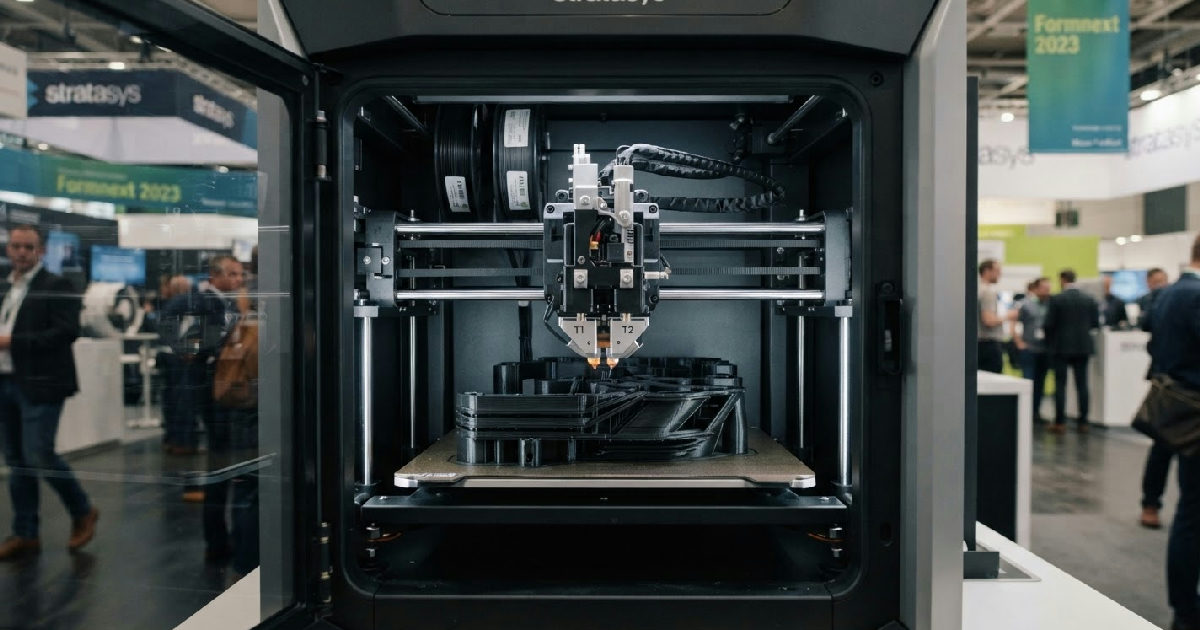
Stratasys has unveiled the F3300, a new fused deposition modelling (FDM) 3D printing system designed specifically for high-volume production. The F3300 was unveiled at Formnext 2023 in Frankfurt, Germany, as part of Stratasys’s strategy to expand the use of additive manufacturing from prototyping into industrial production.
The new system aims to deliver faster print speeds, higher quality parts, and greater reliability for demanding industrial environments. According to Stratasys, the F3300 represents a significant step towards enabling true, scaled production using polymer-based 3D printing, a sentiment echoed by company leadership. The launch reflects a broader industry effort to integrate additive manufacturing into established production workflows.
A closer look at the Stratasys F3300 system
“Additive manufacturing is becoming an essential part of the modern factory floor, giving manufacturers greater flexibility, efficiency, resilience and control over how they produce,” said Dr. Yoav Zeif, CEO of Stratasys, in a statement related to the event. He noted an accelerating shift across industries as customers scale up from individual applications to full production workflows.
The Stratasys F3300 is engineered from the ground up for the rigours of a manufacturing setting. The launch reflects a broader industry effort to integrate additive manufacturing into established production workflows. The printer boasts a substantial build volume of 600 x 600 x 800, making it suitable for producing larger components or batches of smaller parts.
The F3300 features an automatic extruder changer that enables it to switch between extruders, supporting different material or resolution requirements and providing system redundancy. This capability, combined with onboard material dryers and new extruders, is designed to maximise uptime and reduce manual intervention. The system also collects operating data to support process monitoring and help manufacturers assess print consistency and machine performance.
At launch, the F3300 supported ASA, polycarbonate (PC), ULTEM 9085 resin and Nylon 12CF. Each of the four material bays accommodates a 4,100 cc spool, providing a total material capacity of 16,400 cc for longer print runs. The combination of speed, repeatability, and robust materials is intended to provide a cost-effective solution for manufacturers looking to replace or supplement traditional production methods.
F870 makes its European debut for large-format tooling
Alongside the flagship F3300, Stratasys also showcased the European debut of its F870 FDM system. While the F3300 targets end-use part production, the F870 is aimed squarely at the creation of large-format tooling, fixtures, jigs, and other manufacturing aids. These tools are often complex, required in low volumes, and subject to frequent design changes, making them an ideal application for additive manufacturing.
The F870 features a fully heated build chamber measuring 1,000 × 610 × 610 mm, allowing manufacturers to produce large tooling components and manufacturing aids. The system is designed for extended, unattended operation, a crucial feature for busy factory floors.
Stratasys plans to showcase factory-floor applications from Toyota and General Motors, illustrating the use of additive manufacturing for tooling and other production-support tasks.
Producing custom jigs and fixtures in-house can reduce lead times compared with conventional manufacturing methods, depending on part complexity and production requirements. This helps manufacturers improve assembly line efficiency and adapt more quickly to new product introductions. The showcase of proven applications by major industrial players underscores the maturity of FDM technology for these demanding shop-floor roles, where factory logistics tasks with robots are becoming increasingly common.
An ecosystem for the entire manufacturing workflow
Stratasys’s planned Formnext 2026 presentation will extend beyond hardware to cover software, materials and post-processing technologies across its additive manufacturing portfolio. This end-to-end approach is designed to lower the barrier to adoption for manufacturers and ensure repeatable outcomes. A key part of this is the GrabCAD Additive App Suite, software designed to connect and streamline workflows from initial design to final part production.
For specific applications like investment casting, the company demonstrated its Somos ShellCast resin used with the Neo800+ stereolithography (SLA) printer. Stratasys will also present its Somos ShellCast resin and GrabCAD Print Pro ShellGen module for use with the Neo800+ stereolithography printer. The combination is designed to help foundries and aerospace and defence manufacturers produce large, complex master patterns for investment casting without antimony.
Automating post-processing and improving prototypes
Post-processing is often a bottleneck in the 3D printing workflow, requiring significant manual labour. To address this, Stratasys introduced sCure, an automated post-processing system for its Origin P3 DLP platform. The system combines several post-processing stages in one unit, potentially reducing manual handling and helping to improve consistency between parts.
Stratasys has also introduced PolyJet ToughONE Black for its J3 and J5 printer series. The material provides durable, engineering-grade performance with a high-quality black finish, allowing teams to produce functional prototypes that look and feel like the final product much earlier in the development cycle. This allows design teams to assess a product’s appearance and functional characteristics before committing to production tooling.
Advancing qualification for aerospace and defence
For high-stakes industries like aerospace and defence, part qualification is a major hurdle. To simplify this process, Stratasys highlighted recently published qualification data from the National Center for Advanced Materials Performance (NCAMP) for two of its high-performance materials: Antero 800NA and Antero 840CN03.
The published National Center for Advanced Materials Performance (NCAMP) data for Antero 800NA and Antero 840CN03, used with the Stratasys F900 system and its Advanced Industrial Solutions package, provides a shared technical basis to support material and process qualification. Using established material and process data can help manufacturers streamline qualification activities and reduce duplicated testing, although component-level approval requirements still apply.
Standardised qualification methods are important for expanding the use of additive manufacturing in safety-critical applications. It represents a maturation of the technology beyond rapid prototyping and into a trusted manufacturing process for mission-critical hardware. This integration is increasingly seen in highly automated factories across the globe.
