


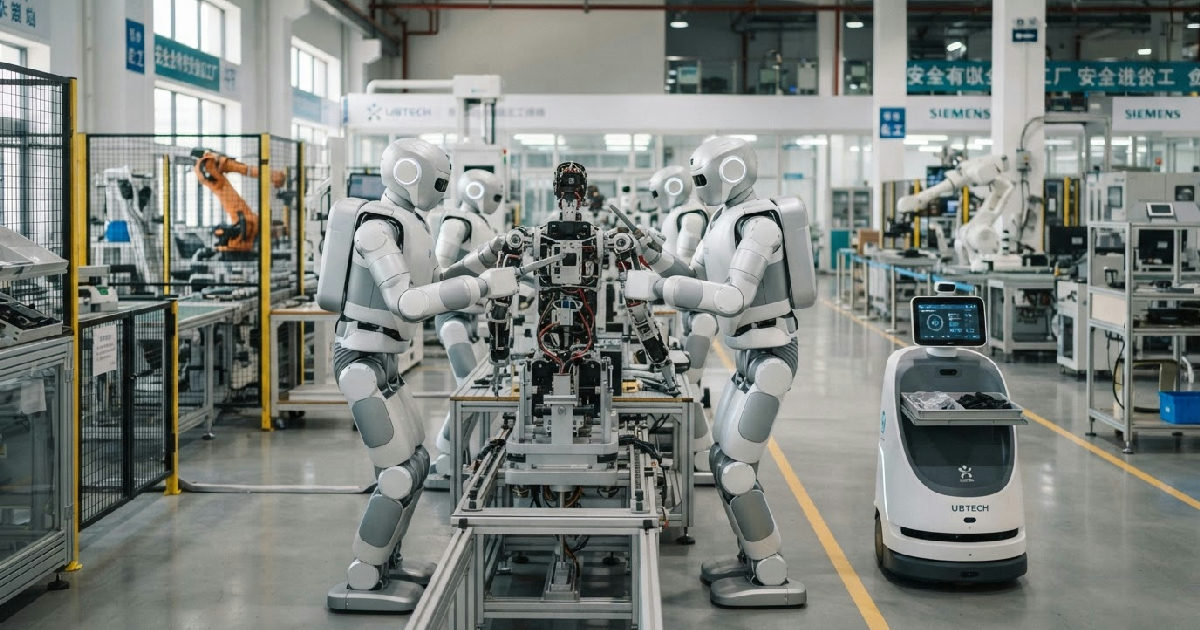
The era of humanoid robots in manufacturing is beginning to take shape.
In China, a new smart factory has begun using humanoid robots to assemble other humanoids. Meanwhile, a major American agricultural equipment manufacturer is preparing to pilot a bipedal robot on its Kansas production lines.
A factory that builds itself with humanoid robots
In a landmark project for industrial automation, a large-scale smart factory in Liuzhou, China, began producing humanoid robots on 17 September 2026, with assistance from other robots.
The facility is a joint effort between Chinese robotics firm UBTech Robotics and the German industrial giant Siemens, with a stated annual production capacity of 10,000 humanoid robots.
The factory leverages AI-driven automation, with UBTech’s Walker S and Cruzr-series robots performing key assembly tasks. These robots are equipped with 3D vision and tactile sensors, allowing them to identify and install small components with high precision.
They work alongside autonomous mobile robots that transport materials, creating a highly integrated production ecosystem with minimal direct human intervention. The entire 14,000-square-metre facility was simulated using a digital twin to optimise workflows and identify bottlenecks before physical deployment.
A similar, smaller-scale initiative was announced by Schaeffler on 20 October 2026, with six humanoid robots assembling joint modules for other robots at its Taicang factory.
Humanoid ‘teammates’ arrive in US agriculture
In the United States, agricultural equipment manufacturer AGCO will pilot humanoid robots in its operations through a programme with Agility Robotics. Announced on 21 October 2026, the trial is scheduled to begin in 2027.
The pilot will deploy Agility Robotics’ Digit humanoid robot at AGCO’s manufacturing plant in Hesston, Kansas. This facility has been building farm machinery for over 55 years and employs more than 1,100 people.
Digit will initially handle repetitive and physically demanding tasks such as sorting parts, stacking components and positioning totes for storage. AGCO, which builds equipment for brands such as Massey Ferguson and Fendt, views humanoid robots as augmenting its workforce rather than replacing it.
The goal is to improve workplace ergonomics while allowing employees to focus on more complex, skill-intensive responsibilities. Thomas Enghof, AGCO’s Director of Manufacturing Technology, stated that humanoid robots ‘unlock automation in complex, human-centric workflows.’
Enghof added that they augment human capabilities by ‘absorbing repetitive, strenuous or hazardous tasks.’ The Digit robot, which stands 5 feet 11 inches tall, uses artificial intelligence to adapt to its surroundings and can be managed through a cloud-based platform.
This pilot represents a key test for integrating advanced robotics into long-established industrial environments. Agility Robotics has previously collaborated with companies such as Toyota, GXO and Schaeffler.
From pilot programmes to broader production realities
These initiatives form part of a broader shift in industrial automation. They are early indicators of a rapidly growing market for autonomous heavy equipment and robotics.
According to Grand View Research, the global humanoid robot market was valued at US$2.4 billion in 2025. The market is projected to reach USD 40.5 billion by 2033, representing a compound annual growth rate of 38.2%.
A growing number of companies are seeking to capture this opportunity. Besides UBTech and Agility Robotics, major players include Tesla with its Optimus robot, Figure AI with Figure 02, and Boston Dynamics with its electric Atlas.
These companies have also reported progress in developing and deploying their humanoid robots. By April 2026, Figure AI reported that it had scaled up production to one robot per hour. Boston Dynamics has also begun deploying its Atlas humanoid at Hyundai’s robotics centre and collaborating with Google DeepMind.
A primary driver of adoption is the need to address labour shortages in manufacturing and logistics. In the U.S. alone, manufacturers could face a shortfall of nearly 1.9 million workers by 2033.
Proponents argue that humanoid robots could help address these gaps. They could take on dull, dirty and dangerous tasks that are difficult to staff, potentially improving productivity and workplace safety.
The broader evolution of global manufacturing also highlights the industry’s increasing reliance on advanced technologies. For instance, the strategic importance of chip equipment exports demonstrates how interconnected industrial supply chains have become.
The significant engineering challenges that remain
Despite the progress and optimistic market forecasts, significant hurdles remain before humanoid robots can achieve mass adoption. Gartner analysts predict that by 2028, fewer than 100 companies will move humanoid robot projects beyond the testing stage.
This phenomenon is often called “pilot purgatory”. Although the technology is advancing rapidly, key areas remain immature and require further development before widespread industrial deployment.
Professor Norbert Krüger of the University of Southern Denmark highlights the gap between compelling video demonstrations and the high level of reliability required on a factory floor. An industrial system must perform reliably across thousands of cycles without requiring constant human intervention.
This is a standard that many humanoid robots cannot yet consistently meet. One of the greatest challenges remains dexterous manipulation, with reliable grasping at industrial speeds still posing a significant technical challenge.
A complex robotic hand developed as part of a major European research project achieved only 50% task reliability after years of development. Such a reliability rate would be insufficient for many production environments.
Safety presents another major concern. Unlike many traditional industrial robotic arms, which often operate within safety enclosures, humanoid robots are designed to work alongside people.
Their reliance on powered joints means that a software malfunction or power failure could cause a robot to fall, potentially posing a risk to nearby workers. Currently, there is no universal humanoid robot safety standard.
The absence of a dedicated, universally applicable framework adds to the complexity of integrating these machines into existing factory environments. Cost also remains a significant barrier to entry for many potential adopters.
The future of physical and agentic AI
Looking ahead, a potential next frontier is the convergence of robotics and advanced artificial intelligence, often referred to as ‘physical AI’. This involves developing robots that can learn, adapt and improve their performance autonomously.
The Italian firm Generative Bionics, for instance, announced plans on 21 October 2026 to build a 5,000-square-metre hub dedicated to training its Gene. 01 robot in simulated industrial environments. The company aims to advance what it describes as ‘European humanoid sovereignty’.
CEO Daniele Pucci described the vision vividly: “We are replicating the world, physically and digitally, to train humanoid robots at scale before they ever enter it.” This involves creating vast ‘data factory’ networks to run thousands of digital-twin scenarios.
Similarly work on agentic AI for CPG supply chains points to a future in which intelligent systems manage complex processes autonomously.
More ambitiously, Unitree Robotics is developing a system called Unitree Rehearsal. Founder Wang Xingxing explained on 23 October 2026 that the system would allow its AI to scan research papers and write new code for its robots.
The code would then be tested in simulation before being deployed in real-world trials. He expects that, by 2028, humanoid robots could complete 80% of tasks assigned through voice commands.
While Wang believes mass adoption in homes and factories could still be a decade away, foundational work on self-improving robotic systems is already under way.
