


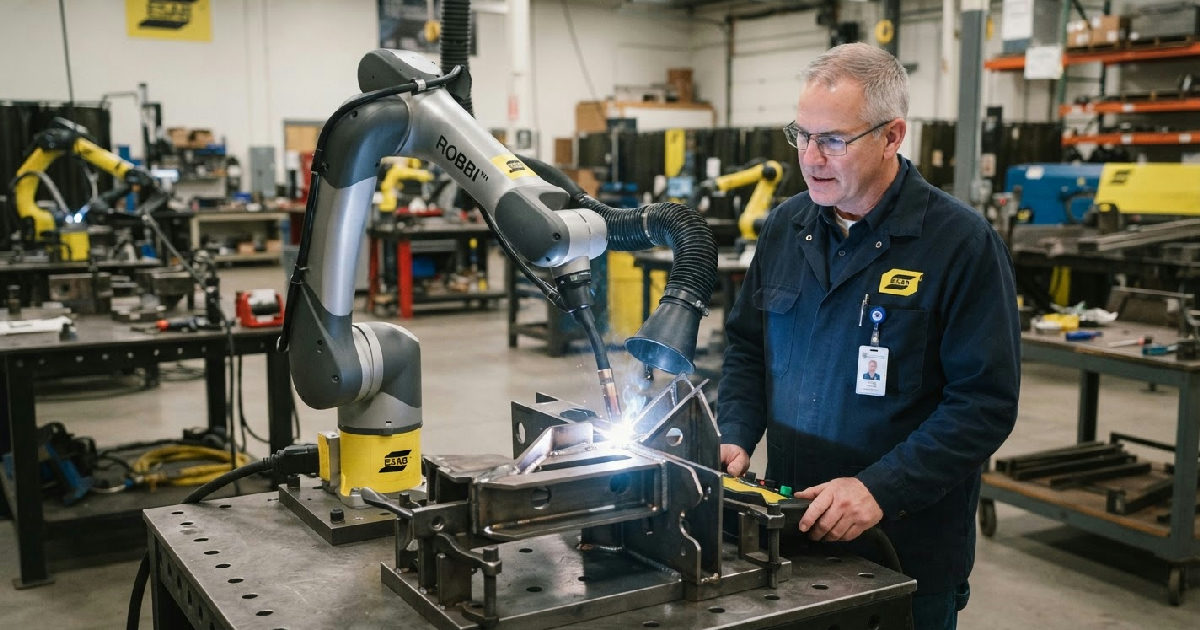
ESAB unveiled its ROBBI AI cobot system on 22 October 2026, marking a significant advancement in automated welding.
This system moves beyond predefined paths and sequences, common in conventional robotic welding, by generating its own weld path and making decisions as the welding progresses. Dan Colvin, Vice President of Advanced Technology Solutions at ESAB, emphasised that this “physical AI” brings intelligence directly into the welding process.
Addressing persistent challenges with AI cobot welding
It empowers the cobot to assess joints, determine optimal approaches, and adapt while welding, reducing reliance on exhaustive manual programming and anticipating every possible variation.
For decades, certain welding applications have resisted full automation due to inherent variabilities. Manufacturers grappling with low-volume, high-mix production often find traditional robotic welding too rigid and costly to program for each unique job. The constant need for precise component fit-up and positioning has limited the widespread adoption of automation in many fabrication shops.
The human element has always been critical in navigating these inconsistencies. Skilled welders can instinctively adjust their torch trajectory, filler-metal feed, and weld pool control in real time. Reproducing this nuanced decision-making with machines has been a primary barrier to more comprehensive automation in the industry.
The complexity of TIG welding automation
TIG welding, known for its high-quality, precise welds, presents a particularly challenging automation problem. This process demands exceptional control over the torch, the filler wire, and the molten weld pool. Even minor deviations in joint geometry or material thickness can significantly impact weld integrity, requiring immediate manual adjustments.
Research examining robotic orbital TIG welding of 304L stainless-steel pipes highlighted these difficulties. Maintaining a stable weld pool during the root pass proved especially arduous as the torch moved around the pipe and the welding position changed. Conventional automation struggles to replicate the continuous micro-adjustments a human welder makes to achieve consistent results.
How physical AI transforms welding operations
ROBBI AI represents a shift in welding automation by integrating AI directly into the physical welding process. Before deployment, the system undergoes a simulation-based learning period. Once operational, it uses its sensing capabilities – cameras and lasers – to evaluate the workpiece, identify the joint, and autonomously determine the best course of action within predefined application parameters.
As welding commences, the system continuously monitors the environment. If a joint gap widens or narrows, for instance, ROBBI AI can dynamically adjust its travel motion, oscillation, or welding parameters to maintain weld quality. This real-time adaptation minimises the risk of defects and ensures consistent output, even with material inconsistencies or imperfect fit-up.
Such advancements are also seen in other industrial sectors, such as autonomous heavy equipment.
Seamless integration and compliance
A key aspect of ESAB’s approach is the local processing of AI data. All AI computing occurs on a computer housed within the customer’s facility, rather than relying on cloud communication. This ensures real-time decision-making and keeps proprietary weld data securely onsite. It also means the system can function without constant internet connectivity, which is vital for many manufacturing environments.
ESAB integrates ROBBI AI with its existing InduSuite software. This integration is crucial for maintaining compliance with established welding procedure specifications (WPS) and qualification requirements. As Dan Colvin explained, this approach “reduces the risk of AI-driven adjustments that could result in welding outside those specifications or with an unapproved procedure,” providing a critical safeguard for quality and regulatory adherence.
Configuration and power source flexibility
The ROBBI AI system is designed for broad compatibility and adaptability to various workshop needs. It can be paired with either a Universal Robots UR10e or UR20e industrial robot arm, offering flexibility based on payload and reach requirements. The UR10e, for example, is a medium-duty cobot with a 12.5 kg payload and 1300 mm reach, while the UR20e offers greater capacity.
To enhance its operational range, the system is available with a seventh-axis configuration, extending its reach and allowing for a larger work envelope. For shops requiring mobility, a wheeled cart option enables the cobot to be moved easily between different workstations. Compatible welding power sources include the ESAB Aristo Edge 500R, the EWM Titan XQ, and the EWM Tetrix XQ.
Powering precision with advanced welding sources
These compatible power sources bring their own set of advantages to the ROBBI AI system. The EWM Titan XQ supports a range of advanced welding processes, including EWM React technology. This can achieve welding speeds up to 100% faster and reduce heat input by 35% compared to conventional short-arc welding, directly contributing to higher productivity and reduced material distortion.
For TIG applications, the EWM Tetrix XQ range provides both DC and AC/DC welding capabilities, with conventional and pulsed operating modes. It can also be combined with EWM’s tigSpeed Drive 45 wire-feeding system. This optional addition supports cold-wire and hot-wire feeding, with hot-wire operation potentially boosting deposition rates by up to 60% compared to traditional manual TIG welding methods.
Impact on manufacturing and skilled labour
The introduction of ROBBI AI arrives at a crucial time for the global manufacturing sector, which faces persistent shortages of skilled welders. This AI cobot welding system offers a viable solution for tasks that are typically labour-intensive and require significant expertise, making automation more accessible for small and medium-sized manufacturers.
By automating the more repetitive or challenging aspects of welding, businesses can reallocate their human welders to more complex, high-value tasks. This not only optimises productivity but also addresses the demographic shift within the skilled trades.
The global AI Robotic Welding Market is projected to reach USD 4.4 billion by 2032, growing at a compound annual growth rate of 12.2% from USD 2.2 billion in 2026, underscoring the demand for such technologies.
Bolstering productivity with intelligent automation
The system’s ability to handle variable joint fit-up and low-volume, high-mix production means manufacturers no longer need to sacrifice automation for flexibility. This is particularly relevant for sectors like pipe fabrication for data centres and other infrastructure projects, where precise and high-quality welds are critical but often performed in dynamic, inconsistent environments.
Other manufacturing sectors are also seeing similar technology boosts, such as major steel plant upgrades.
Moreover, the continuous learning capability of ROBBI AI means it can progressively improve its performance and identify conditions leading to defects. This data-driven feedback loop allows operators to review recorded information and provide input, further refining the AI’s recognition of challenging scenarios. Such intelligent automation enhances quality control and reduces rework, directly impacting the bottom line.
The future of AI in industrial fabrication
ROBBI AI extends the concept of AI beyond mere digital analysis, embedding it directly into the physical act of creation. This signals a broader trend in industrial technology, where machines are becoming increasingly autonomous and adaptive. The aim is to create systems that can mimic, and in some cases surpass, the intuitive decision-making of human operators in challenging physical tasks.
The market for collaborative welding cobots is a rapidly expanding segment, projected to reach USD 5,368.6 million by 2035. This growth is driven by the clear benefits these systems offer, including increased consistency and efficiency. In one study from 2025, cobotic weldments demonstrated 13.5%–37% greater strength across tested parts compared to manual welds, highlighting the tangible quality improvements AI can deliver.
For professionals in manufacturing and engineering across Africa and beyond, technologies like ROBBI AI offer a pathway to enhanced productivity and competitiveness. By embracing adaptive automation, industries can mitigate labour challenges, improve weld quality, and ultimately produce more efficiently.
The ongoing development of AI in fabrication ensures that the role of skilled human operators will evolve, focusing on oversight, process optimisation, and addressing the most complex, bespoke projects.
