


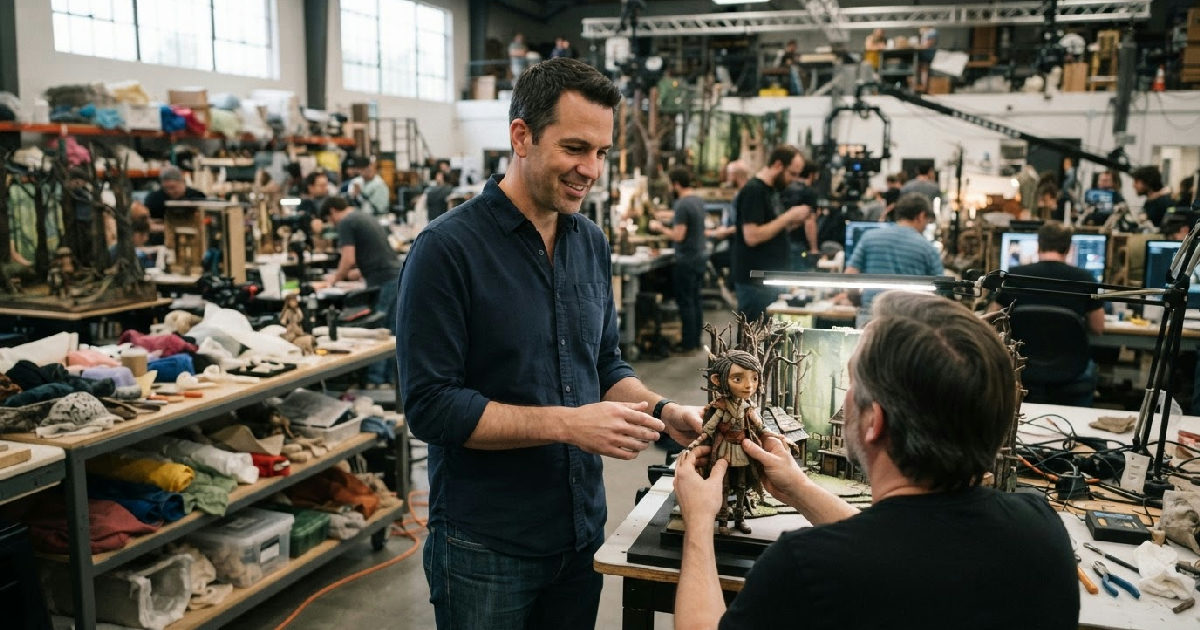
Laika’s sixth feature film, “Wildwood,” premiered on 2026-10-11 at the BFI London Film Festival and debuted in US and UK cinemas on 2026-10-23. The fantasy epic represents the culmination of two decades of painstaking development in stop-motion animation technology and industrial process refinement. Director and CEO Travis Knight has steered the studio towards its most ambitious project yet, pushing the boundaries of practical filmmaking.
This monumental $100 million production, with its record-breaking 131-minute runtime, showcases an unprecedented blend of traditional craftsmanship and advanced industrial techniques. More than 1,000 artists, craftspeople, and technicians at Laika’s Hillsboro, Oregon facility contributed to this effort, transforming artistic vision into tangible, animated reality.
Advancing Physical Realism Through Laika Wildwood Technology
Laika’s approach, described by Chief Marketing and Operations Officer Dave Burke, sees “everything the studio has been developing over the past 20 years” converge in “Wildwood.” This iterative development model, common in advanced manufacturing sectors, highlights how continuous process improvement and material science can be applied to complex creative industries, establishing new benchmarks for industrial film production.
Brad Schiff, Laika’s Head of Animation, underscores the studio’s ethos of blending “old-school craft with modern technology.” This philosophy has driven significant mechanical improvements in puppet design over two decades.
For instance, in Laika’s previous film, Missing Link, the main character incorporated a diaphragm mechanism, enabling animators to mimic breathing subtly through a screw adjustment. This innovation has since become a standard in the studio’s puppet construction.
Beyond internal mechanics, material science plays a crucial role in enhancing character realism. Costume designer Deborah Cook noted the vast “library of techniques” amassed over time, which facilitated the creation of an extensive range of elaborate costumes for “Wildwood.” These designs spanned from contemporary clothing for the film’s Portland sequences to fantastical attire for the forest inhabitants.
The Evolution of Materials Science
Key material advancements for “Wildwood” included the adoption of more flexible fabrics for costumes and a newly engineered, lighter, and more durable silicone for puppets. Oliver Jones, Laika’s Head of Characters and Practical Effects, explained this shift represents a deliberate move away from foam latex.
This traditional material is known for its distinctive odour and tendency to shrink and crumble over time, presenting long-term challenges for preservation.
Rethinking these established materials offers distinct advantages for both durability and creative freedom. The studio’s commitment to exploring new compounds aligns with broader trends in additive manufacturing executive environments, where material innovation drives product performance and longevity. This methodical material development is vital for maintaining the physical integrity of assets used in productions spanning many years.
Precision in Facial Animation
Laika’s dedication to subtle character performance is prominently displayed in its pioneering use of 3D printing for puppet faces. For “Wildwood,” the studio utilised over 142,000 3D printed faces, eclipsing its own Guinness World Record of 106,000 faces from Missing Link.
This translates to an impressive 24 unique faces for every second of footage in some shots, enabling a level of emotional nuance previously thought unachievable in stop-motion animation.
This intricate process requires exceptional precision, ensuring seamless transitions between expressions. Each minute variation in a character’s face can convey deep emotional states, making this technological capability central to the storytelling. The ability to produce such a high volume of bespoke components on demand showcases a significant manufacturing feat within the animation industry.
Industrial Scale and Logistical Mastery
The sheer scale of “Wildwood” demanded an unparalleled level of industrial organisation and logistical precision from the Laika team. The film, which saw 16 years of development and six to seven years of active production, required the construction of 136 practical sets — double the number used for the studio’s earlier work, Kubo and the Two Strings.
These meticulously crafted sets, built within Laika’s Hillsboro facility, form the expansive backdrops for the film’s epic narrative. More than 200 individual puppets, specifically between 231 and 233 handcrafted figures, populate this elaborate world.
This massive roster of characters, combined with complex sequences such as a 12-minute battle involving dozens of soldiers and a chase through a bustling Portland, underscores the intricate planning required for such a large-scale project.
Production Complexity on a Grand Scale
Production Designer Nelson Lowry acknowledged the project’s ambition, noting that while “bigger isn’t always better,” the film’s narrative necessitated this grand scale. The intricate choreography of hundreds of characters across dozens of sets demands a level of operational foresight akin to managing a complex manufacturing assembly line. Every movement and interaction is pre-planned and executed with meticulous precision.
The challenges extend to the dynamic range of scenes, from vast cityscapes to dense magical forests, each requiring unique environmental considerations. This variety pushes the boundaries of set design and construction, demanding adaptable and scalable fabrication techniques. Managing these diverse elements effectively is key to maintaining production schedules and quality standards.
Advanced Tracking and Inventory Management
Managing hundreds of puppets, thousands of facial expressions, and numerous interchangeable parts presented a unique operational challenge. Costume designer Deborah Cook, when asked about misplacing puppets during production, highlighted the necessity of a “very sophisticated tracking system.” This system, born from the film’s complexity and the sheer volume of assets, ensures precise inventory and location management across the studio’s many stages.
Such a system parallels modern product lifecycle management solutions in industrial settings, where tracking components and sub-assemblies is critical for efficiency and quality control. It’s an operational detail that speaks volumes about the industrial-level organisation underlying Laika’s creative output, ensuring no piece of the intricate puzzle is lost or mismanaged.
The Artistry of the Human Touch in Digital Integration
Despite significant technological advancements, Laika’s core philosophy remains deeply rooted in human artistry. Travis Knight consistently stresses that all advanced techniques are ultimately designed to imbue more humanity into the puppet characters. Small details, such as the natural flow of fabric or the subtle illusion of breathing, are crucial for conveying authentic emotion and connection with the audience.
The film expertly balances grand action sequences with deeply intimate moments. Knight describes scenes with minimal sound design or music, where the entire focus rests on the emotional performances of the puppets.
These “assemblages of steel and silicon and fabric,” as Knight calls them, only truly come alive through the skilled hands and artistic vision of the human animators, demonstrating the irreplaceable value of human craft.
This powerful blend of technology and traditional craftsmanship has inspired many new animators to join the “Wildwood” production. Some, according to Knight, were initially drawn to stop-motion by Laika’s first film, Coraline, and have now returned as professionals to contribute to the studio’s latest work. This highlights a crucial cycle of mentorship and knowledge transfer, essential for sustaining such specialised industrial arts.
Two Decades of Iterative Mastery
Laika’s journey to “Wildwood” serves as a compelling case study in iterative development, a process widely adopted across many industrial sectors. Founded in 2005, the studio has consistently pushed its craft forward with each successive film.
Director Travis Knight, who has nurtured the “Wildwood” project for 16 years, firmly believes the current version would not have been feasible without the cumulative knowledge acquired from previous productions like ParaNorman and Kubo and the Two Strings.
This continuous learning and application of new techniques ensure the studio doesn’t merely produce films, but actively develops the methods and tools of stop-motion animation itself.
As Tim Garbutt, Laika’s Creative Director of Marketing, stated, “Wildwood” presents the studio’s craft “at a level never seen before,” extending “far beyond what it has attempted before practically, or in-camera.” This evolution reflects a profound and sustained commitment to process innovation.
The studio’s dedication to this long-term development strategy positions it uniquely within the entertainment industry. Unlike many production houses that might outsource or adopt off-the-shelf solutions, Laika invests heavily in internal R&D, treating each film as an opportunity to refine its core manufacturing processes. This internal expertise contributes significantly to their distinctive visual style and technical superiority.
Broader Implications for Industrial Animation and Production
The technical achievements showcased in “Wildwood” offer valuable insights that extend beyond the realm of entertainment, particularly for industrial manufacturing and product development. Laika’s systematic approach to material science, its creation of sophisticated internal puppet mechanisms, and its rigorous inventory tracking system resonate strongly with the principles of modern industrial operations and quality assurance.
These methodologies demonstrate that even highly artistic outputs benefit from structured engineering.
Laika’s methodology exemplifies how precision engineering and robust logistical frameworks can underpin highly creative and bespoke production processes. The studio’s consistent refinement of processes and materials across projects provides a tangible model for other sectors looking to integrate artisanal craftsmanship with large-scale, high-technology output. This blend defines a unique segment of the industrial landscape, particularly relevant for nations aiming to develop sophisticated manufacturing capabilities.
Furthermore, the interplay between human artistry and technological aids, from 3D printing to advanced tracking, offers a blueprint for industries grappling with automation. While some voices express concern about technology replacing human creativity, Laika demonstrates a symbiotic relationship, where technology enhances rather than diminishes artistic expression. This progressive integration of AI and robotics within creative domains provides a powerful counter-narrative.
The focus on continuous improvement, from materials to workflow, means that Laika is not just making films; it’s constructing a future for stop-motion animation as an industrial art form. This commitment ensures their productions remain at the forefront of technical possibility, inspiring innovators in diverse manufacturing fields to reconsider the potential of integrated, long-term development.
