


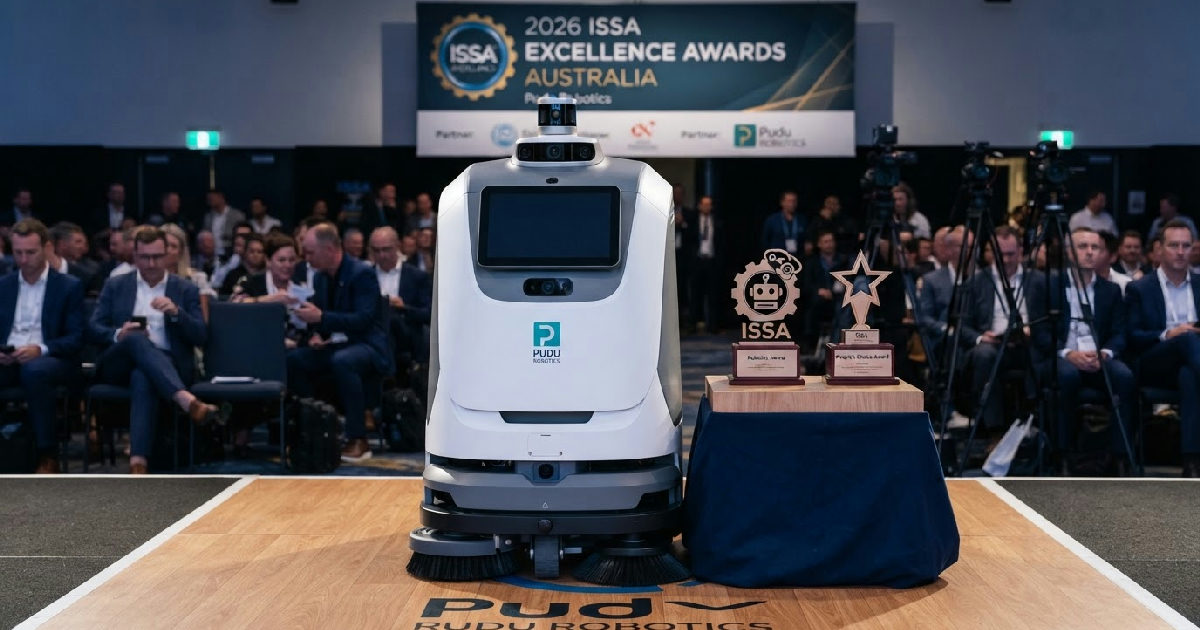
Pudu Robotics’ BG1 Series has won two awards at ISSA industry events in South Korea and Australia. The AI-native cleaning robot received the Robotics Award at ISSA ASIA AWARDS 2026 and the People’s Choice Award at the 2026 ISSA Excellence Awards.
The BG1 Series earned the Robotics Award at the ISSA ASIA AWARDS 2026 in South Korea and the People’s Choice Award at the 2026 ISSA Excellence Awards in Australia. The awards recognise the product through two different award categories, including a People’s Choice Award decided by event attendees.
What the Pudu Robotics BG1 Series awards mean for industrial automation
The awards follow an initial commercial milestone: Pudu Robotics reported more than RMB 100 million in pre-orders during the BG1 Series’ first month on the market.
The awards were presented at ISSA industry events focused on cleaning and hygiene products. The awards add industry recognition to a product designed for large commercial and industrial facilities.
For facility operators, the product’s suitability will depend on its performance in their specific environments, including cleaning requirements, site layout, maintenance needs and operating costs.
Automated cleaning systems may help facilities standardise routine floor-cleaning tasks. In food and beverage or pharmaceutical facilities, however, their suitability must be assessed against the site’s hygiene procedures and regulatory requirements.
Potential benefits include more consistent cleaning routines, more efficient use of resources and improved oversight of scheduled tasks, although these outcomes need to be assessed in actual deployments.
The People’s Choice Award was selected by attendees at the Australian event. The result reflects the product’s reception among those who voted, but does not by itself establish long-term user satisfaction or ease of integration. This user acceptance is often a major hurdle for new technology adoption in established industries.
The awards provide further recognition for Pudu Robotics’ efforts to develop autonomous cleaning equipment for commercial and industrial environments.
Deconstructing the BG1’s AI-native architecture
Pudu Robotics describes the BG1 Series as ‘AI-native’, with navigation and cleaning functions designed to adapt to changing conditions rather than rely solely on fixed routes.
The company says the BG1 Series can interpret its surroundings and adjust its navigation and cleaning behaviour in response to changing conditions. It is intended for large facilities such as warehouses and manufacturing plants.
Beyond fixed routes to dynamic navigation
The navigation system combines multiple sensing technologies. Pudu says the BG1 Series uses 3D visual simultaneous localisation and mapping (VSLAM), LiDAR and other sensors to support positioning and navigation. These technologies help the robot map its surroundings and estimate its position as it navigates.
Navigation that can accommodate changing layouts may be useful in facilities where people, equipment and stored materials move frequently. The company says the robot can adjust its route when conditions change; its effectiveness will depend on the layout and operating conditions of each facility.
The BG1’s approach reflects broader interest in applying AI to physical tasks, including navigation and autonomous equipment operation.
Sensor fusion and adaptive cleaning in practice
The BG1 Series is designed to use sensor data to adapt its cleaning operations. According to Pudu Robotics, the robot analyses sensor data to identify dirt and floor conditions and adjust its cleaning response. The company says these functions allow cleaning parameters to be adjusted in response to detected conditions, rather than relying exclusively on preset routines.
If the system can reliably identify different floor conditions and adjust its cleaning behaviour, it may help reduce unnecessary cleaning or consumable use. These benefits should be quantified through deployment data. For facility managers, the potential benefits include more consistent routine cleaning and more efficient use of consumables, subject to the site’s operating conditions and maintenance requirements.
An integrated workflow for efficiency
The BG1 Series is a large autonomous scrubber-dryer designed for commercial and industrial floor care. The robot is designed to clean large floor areas autonomously. Its effect on cleaning time and labour requirements would need to be established through operating data. The company lists retail complexes, warehouses, industrial plants and transport hubs among the intended applications.
Market traction confirms product demand
The awards follow an early commercial milestone reported by the company. Pudu Robotics launched the BG1 Series in March 2026 and reported more than RMB 100 million in pre-orders during its first month on the market. The company has not provided enough information in this article to establish how those pre-orders translate into completed sales or deployments. The pre-order figure offers an early indication of interest in the product, although longer-term demand remains to be seen.
The BG1 Series joins Pudu Robotics’ other cleaning robots, including the CC1 and MT1. The company positions the range as covering different cleaning requirements across commercial and industrial facilities. Its longer-term commercial performance will depend on customer uptake, service support and the product’s operating costs.
Implications for African industrial operations
For industrial operators in Africa, autonomous cleaning robots may offer another option for managing large facilities. Large factories, food-processing facilities and logistics centres in cities such as Lagos, Johannesburg and Nairobi may face challenges in maintaining consistent cleaning schedules across extensive floor areas. The cost of manual cleaning and the availability of suitable staff will vary by facility.
Automated solutions like the BG1 offer a pathway to improved operational excellence. In food and beverage facilities, automated cleaning equipment may help standardise routine floor-cleaning tasks. However, the ability to record and verify cleaning activities depends on the robot’s software and reporting features, and its use does not replace the facility’s wider sanitation procedures or certification requirements.
New industrial parks and special economic zones could provide opportunities to assess autonomous cleaning systems during facility planning. Adoption would depend on the buildings’ layouts, power and charging arrangements, maintenance support and overall costs.
Where the technology is suitable, cleaning robots could help operators allocate staff to tasks that require human judgement or intervention. Any gains in productivity, safety or hygiene should be assessed against the facility’s actual performance data.
