


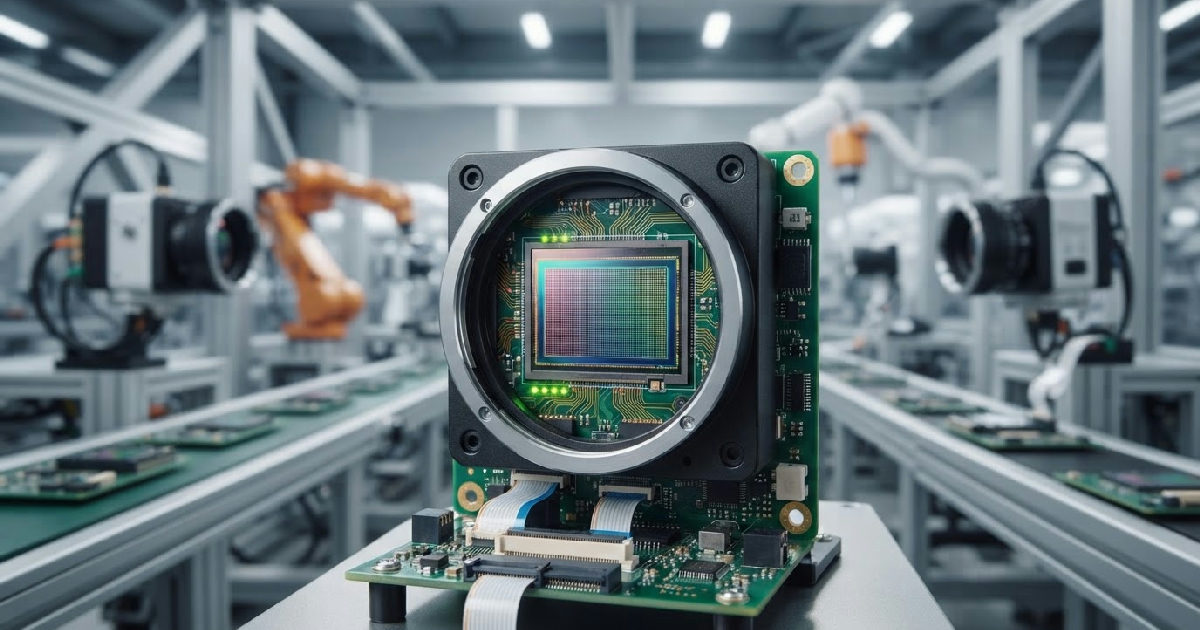
A new 12-megapixel backside illuminated global shutter CMOS image sensor has been introduced for factory automation.
The OG12S10 is designed for applications involving high-speed movement, vibration and continuous motion. It combines 3.45-micron (µm) pixels with an exposure time of 1 microsecond (µs), which the company says helps reduce motion-related distortion during image capture.
OG12S10 combines global shutter technology with high-resolution imaging
The OG12S10 combines specifications intended for demanding industrial imaging applications. The 12MP sensor has a resolution of 4096 × 3072 pixels, enabling detailed image capture for industrial inspection applications. The 12MP sensor has a resolution of 4096 × 3072 pixels, enabling detailed image capture for industrial inspection applications.
The sensor also incorporates PureCel®Plus-S die-stacking technology and on-chip dual conversion gain (DCG™) high dynamic range (HDR), with a specified dynamic range of 74 dB. This is intended to preserve detail in both bright and darker areas of an image.
For low-light and near-infrared applications, Nyxel® technology provides quantum efficiency (QE) of 60% at 850 nm and 40% at 940 nm, according to the manufacturer.
OMNIVISION states that this represents a five-fold increase in QE compared with existing 3.45µm products.
The sensor uses a 12-bit analog-to-digital converter (ADC) to convert captured light information into digital data. This capability can support industrial inspection applications in which variations in colour or material characteristics need to be detected.
The OG12S10 has a full-well capacity of 20,000 electrons (20 ke-) and a read noise of 2.8 electrons (2.8 e-) in DCG™ mode. These specifications support signal capture across a range of lighting conditions.
Global shutter technology supports high-speed imaging
In industrial settings, rapidly moving objects can appear distorted when captured with rolling shutter sensors because pixels are exposed sequentially rather than simultaneously. This can result in skewed lines, geometric distortion or partial exposure, which can affect image-based measurement and inspection.
The OG12S10 uses a global shutter architecture in which pixels are exposed simultaneously, reducing the geometric distortion associated with sequential exposure. This synchronised exposure can help maintain image geometry when capturing fast-moving objects.
Kelly Yan, staff marketing manager at OMNIVISION, highlighted this necessity. “In situations where speed, vibration and motion are constant, maintaining image clarity becomes critical. However, not all image sensors are equipped to deliver the consistency required in these conditions,” Yan stated.
She added that global shutter sensors such as the OG12S10 are designed to reduce motion-related distortion in machine-vision and inspection applications. Such imaging can be used in applications ranging from robotic guidance to high-speed sorting, where motion distortion can affect image-based decisions.
The sensor supports frame rates of up to 75 frames per second (fps), with a 1µs exposure time and a specified shutter efficiency of 106 dB.
These capabilities can support quality-control systems on production lines, where even microscopic defects on rapidly moving parts must be detected accurately. For instance, in automated assembly lines, a clear image without blur or wobble is essential for robotic arms to precisely pick and place components.
Faster and more consistent image acquisition can support automated inspection and quality-control processes.
Applications of global shutter technology
Rolling shutter sensors are widely used in consumer electronics, while global shutter technology is used in applications where simultaneous exposure is important, including machine vision and industrial inspection. Industries like factory automation, intelligent transportation, and scientific imaging demand the absence of motion artefacts that rolling shutters inherently produce.
Simultaneous pixel exposure can provide image data with reduced motion distortion, which is useful for machine-vision and measurement applications. This characteristic can benefit applications involving rapid movement, including robotic guidance, drone navigation and barcode scanning on conveyor systems.
Global shutter sensors can reduce image skew and the rolling-shutter “jello effect”, which can otherwise affect the apparent position or shape of moving objects. As industrial processes become more automated, global shutter sensors may see wider use in applications requiring consistent imaging of moving objects.
The evolution of global shutter technology has been driven by these industrial needs, pushing sensor developers to overcome the inherent complexities of reading all pixels simultaneously without sacrificing performance. OMNIVISION’s PureCel®Plus-S die stacking technology contributes to this, allowing for more advanced functionality within a compact form factor.
These technologies can support higher-resolution imaging and faster frame rates in machine-vision, manufacturing and logistics applications.
OMNIVISION’s market strategy and technological edge
OMNIVISION is headquartered in Santa Clara, California, and develops image sensors for applications including automotive, industrial and consumer markets. According to [source], OMNIVISION held 13.4% of the global image sensor market in 2026, ranking second behind Sony and ahead of Samsung.
The company serves specialised markets including automotive, industrial and security imaging. OMNIVISION was acquired by Will Semiconductor in 2019.
The OG12S10 expands OMNIVISION’s sensor portfolio for industrial imaging applications. The company’s portfolio includes imaging technologies for automotive, security, medical and industrial applications.
OMNIVISION says its Nyxel® technology is designed to improve near-infrared sensitivity for applications requiring imaging beyond the visible spectrum. The OG12S10 is positioned for industrial applications requiring high-resolution, high-speed imaging.
Availability and broader implications
The OG12S10 will be available for sampling in November 2026 and is scheduled to enter mass production in the fourth quarter of 2026. OMNIVISION is also scheduled to showcase the sensor at the VISION show in Stuttgart, Germany, from 6–8 October 2026.
The launch comes as industrial automation systems increasingly use machine-vision and sensor data for inspection, measurement and control. Vision systems capable of capturing fast-moving scenes with limited motion distortion are used in applications across manufacturing, logistics and transportation.
The OG12S10 adds a high-resolution global shutter option for industrial imaging applications, with sampling scheduled to begin in November 2026.
