


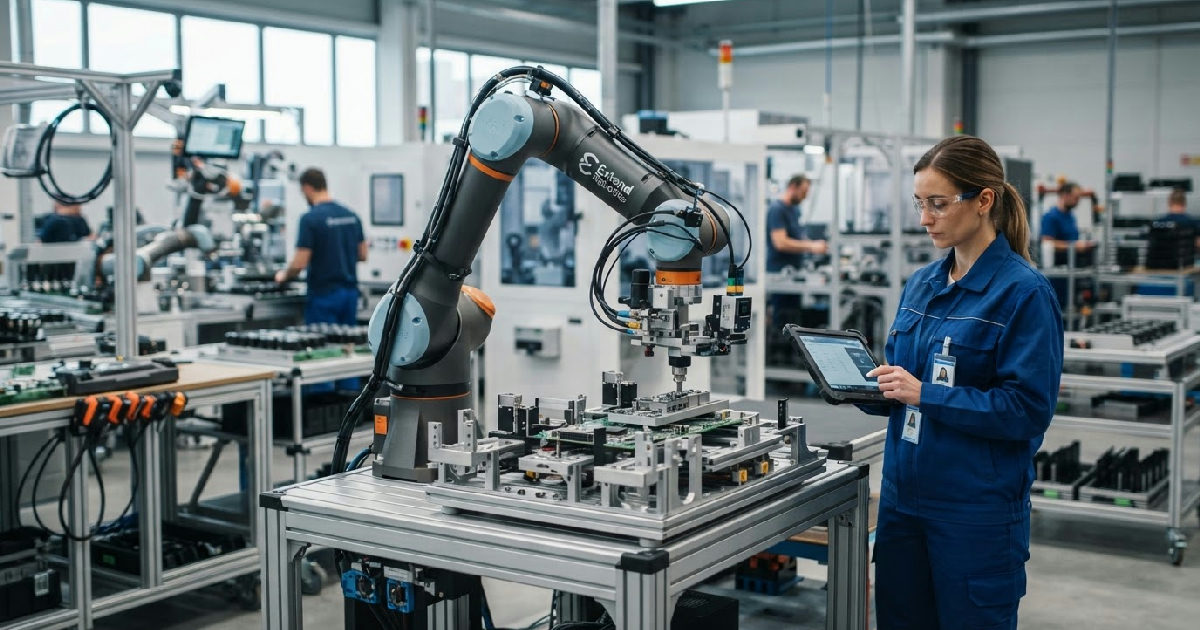
Extend Robotics has secured £2.6 million in an early-stage funding round to support its European expansion. The UK-based embodied-AI startup plans to use the funding to expand its European operations.
The funding will support the expansion of the company’s service model, which charges manufacturers for completed factory output rather than requiring them to purchase robotic hardware. The model aims to reduce the upfront capital commitment of automation by treating robotics as an operating expense.
Extend Robotics expands industrial automation
Extend Robotics operates on a “Result-as-a-Service” model that changes how manufacturers pay for industrial automation. Manufacturers pay for completed work, with pricing linked to production output. The demand-scaled model allows businesses to use robotic systems without the upfront capital expenditure associated with purchasing and deploying the equipment.
Extend Robotics founder and chief executive officer Dr Chang Liu said the model is intended to allow manufacturers to adopt automation without taking on the upfront capital commitment associated with purchasing robotic systems. By taking on more of the deployment and operational responsibility, Extend Robotics says its model can reduce the upfront barriers to adopting robotics.
The model shifts some of the cost of automation from upfront capital expenditure to an operating expense.
The company says the service model could make robotic automation more accessible to small and medium-sized enterprises (SMEs) that face constraints on upfront capital spending. It also provides flexibility, allowing clients to scale robotic capabilities up or down based on their production needs and market fluctuations. The company links payment to completed output rather than the purchase of robotic equipment.
AMAS Platform enables remote robot operations
At the core of Extend Robotics’ offering is its Advanced Mechanical Assistance System (AMAS) platform. The software allows operators, including those without previous robotics experience, to remotely control robotic arms and humanoid robots through a 3D interface. The platform combines human operator input with robotic control.
Artificial intelligence within the AMAS platform handles some routine aspects of tasks, while human operators manage more complex activities and exceptions. The company says this hybrid approach allows human operators to focus on complex tasks and exception handling, while enabling remote operation in hazardous or difficult-to-access environments.
The system is hardware-neutral and compatible with consumer hardware such as VR headsets and hand controllers. It also integrates with third-party robotics frameworks such as ROS and supports various end-effectors.
Dr Chang Liu, who also serves as chief designer, developed the AMAS platform to enable remote interaction with robotic systems. The platform supports gesture-based controls and no-code programming, which the company says can make robotic systems easier for non-specialist operators to use. The platform is designed to support human-robot collaboration in industrial environments.
Addressing European Labour Shortages with Human-Robot Collaboration
European manufacturers face labour shortages in some sectors, including areas involving small-batch production, high-mix manufacturing and hazardous operations. Extend Robotics is targeting some of these applications through its human-robot collaboration platform. The company is deploying the platform in sectors where conventional automation can be difficult to implement.
The company has 35 subscription customers across industries including automotive, aerospace, nuclear, robotics and agriculture. The deployments illustrate the range of applications for the AMAS system across different industries. The model can also allow operators to control robotic systems remotely, potentially reducing the need for some on-site specialist roles.
The company has deployed the technology in several industrial applications. At UK apple grower Adrian Scripps, an Extend Robotics humanoid named Gilbert, integrated with Google Cloud and Gemini, is used for quality control on a live packing line. Leyland Trucks also uses the platform to train robots for high-voltage component installation and custom spray-painting tasks.
Driving Growth: Funding and Financial Performance
The £2.6 million funding round brings new capital to Extend Robotics, which was founded in London in 2019. Skyworks Venture Capital Fund led the pre-Series A round, with participation from Neo Venture (Europe) and Zip Capital. The funding will support the company’s plans to scale its Result-as-a-Service model.
The company reports that its revenue has doubled year on year for three consecutive years. The company attributes the growth to demand for flexible automation solutions that reduce manufacturers’ upfront capital commitments. The latest funding round brings the total capital raised by Extend Robotics to $7.76 million since its inception.
Previous funding included a seed round announced on 18 November 2022 that raised $409,000 from Henley Business Angels and other investors. The company also announced a £345,000 funding round on 21 November 2025, with participation from members of Henley Business Angels. The funding rounds have provided additional capital as the company develops its technology and expands its operations.
Strategic Alliances and Expanding Industrial Reach
Extend Robotics has established partnerships to expand its technology offering and customer reach. The company was named an official integrator for Unitree Robotics in January 2026, broadening its hardware compatibility. The partnership allows Extend Robotics to extend its control platform to additional robotic systems.
NVIDIA selected Extend Robotics for its Robotics Startup Showcase at GTC 2026. The selection gave Extend Robotics an opportunity to present its AMAS platform as part of NVIDIA’s robotics startup programme. The company says the exposure can help support its recruitment and customer-development efforts.
The company aims to enable human-robot collaboration across sectors including manufacturing, energy and agriculture. Extend Robotics targets demanding industries including oil and gas, nuclear decommissioning, mining, general manufacturing, logistics, and agriculture.
The company had 23 employees as of 31 August 2026. Companies like Korea Digitron, which recently secured significant funding, also highlight the ongoing investment in advanced industrial capabilities.
The hardware-neutral design is intended to allow AMAS to integrate with existing industrial systems, potentially reducing the need for extensive hardware changes. This could be relevant to manufacturers operating mixed fleets of legacy and newer equipment.
The company is using its service model and remote-operation capabilities as part of its approach to industrial automation.
The company plans to expand its remote operator network as it scales its Result-as-a-Service model. The network supports the Result-as-a-Service model by providing remote human oversight and intervention where required. Remote access allows human expertise to be provided without requiring operators to be physically present at every deployment site, including potentially hazardous environments.
The company plans to continue developing AI-driven interfaces for remote human-robot interaction as it expands its presence in the robotics market.
