


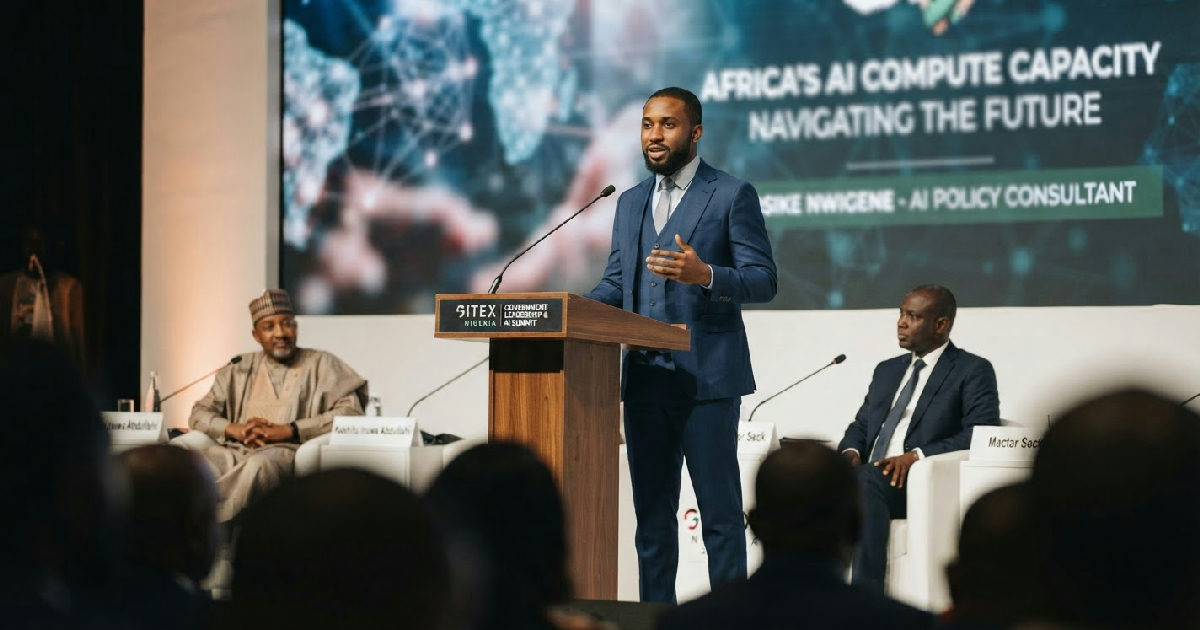
Nosike Nwigene, a strategic communications and external relations consultant, is a key figure in shaping Africa’s artificial intelligence (AI) policy landscape after pivoting from medical studies.
Nwigene, who leads the five-person advisory Nonfictly, recently moderated a pivotal panel at the 2026 GITEX Nigeria Government Leadership & AI Summit. The discussion focused on Africa’s AI compute capacity, bringing together leaders like Kashifu Inuwa Abdullahi, Director-General of the National Information Technology Development Agency, and Dr.
Nosike Nwigene AI policy journey from medical school to industrial chemistry
Mactar Seck of the United Nations Economic Commission for Africa. This role underscores his growing influence in an area critical for industrial development.
Nwigene’s professional trajectory began far from the tech and policy spheres he now inhabits. Growing up in Lagos, the prevailing expectation was for him to follow his father into medicine. This familial pressure led him through multiple attempts to gain admission to medical programmes after completing secondary school at King’s College, Lagos, in 2005.
After missing cut-offs for preferred universities and enduring repeated rejections from institutions like Obafemi Awolowo University and Nnamdi Azikiwe University, he eventually secured a place at the University of Abuja. However, after two years in the medical programme, Nwigene was “booted out” following academic challenges.
This forced pivot led him to study Industrial Chemistry, from which he graduated in 2012. While his formal academic path shifted, Nwigene had already begun cultivating skills in writing, marketing, and event organisation. These talents, initially pursued through freelancing and university event roles, became the bedrock of his eventual career.
Bridging communications and regulatory frameworks
His entry into the technology sector solidified in April 2019 when he joined InsiderPR, a global public relations firm. As a digital engagement specialist, he honed his abilities in brand storytelling, social media management, and ghostwriting for executives, gaining exposure to startups and venture capital firms across emerging markets.
A defining moment arrived when Max.ng, a mobility startup he worked with as a junior account manager, faced a regulatory ban. Instead of simply issuing statements, Nwigene felt compelled to understand the underlying policy issues. This curiosity propelled him beyond traditional communications into active policy advocacy.
He subsequently contributed to the Nigeria Startup Bill, writing advocacy materials and appearing on national television to demystify the proposed legislation. His efforts were crucial in securing state-level adoption for the bill, a contribution he describes as one of his proudest career achievements. Nwigene’s direct involvement with the bill highlights how practical issues for technology companies can drive policy innovation.
Expanding influence: Civic tech and global finance
Nwigene’s expertise broadened beyond tech communications into civic technology and development. In June 2023, he became a fellow at Code for Africa, a pan-African civic technology and data journalism organisation. Here, he worked as a digital strategist, supporting partner civil society organisations on digital engagement and visibility around democratic participation, including work with the African Union.
This role deepened his understanding of how technology, communication, and public institutions intersect, especially in fostering accountability. His ability to distil complex information into accessible narratives proved invaluable. This skill is particularly relevant in the industrial sector, where technical innovation often outpaces regulatory understanding.
In September 2024, Nwigene began consulting with the Climate Investment Funds (CIF) at the World Bank. His work supports communications for climate investment projects, including executive speeches, impact stories, and outreach for events like COP29 in Baku, Azerbaijan.
The CIF, a multilateral climate fund, has secured $12.5 billion in pledges and mobilised $57 billion for climate action across more than 80 countries. This global exposure further refined his capacity to articulate complex issues for diverse audiences, a critical skill for any engineer or operations manager navigating intricate international projects.
Steering Africa’s AI future
Today, Nwigene’s primary focus is on Nonfictly, the advisory he founded, which assists startups, executives, and public sector leaders in making sense of complex ideas and navigating policy landscapes. This work increasingly draws him into artificial intelligence policy and governance, especially its practical implications for African companies. He wants to deepen his engagement in this space over the coming year.
His moderation of the AI compute capacity panel at the 2026 GITEX Nigeria Government Leadership & AI Summit illustrates his standing in this emerging field. The discussion with key figures like Dr. Lourino Chemane of Mozambique’s National Institute of Information and Communication Technologies underscored the continent’s urgent need for robust infrastructure to support AI development and application.
African countries are rapidly adopting AI technology, necessitating swift government action to develop appropriate governance measures. Frameworks like the Malabo Convention, ratified by the African Union in 2023, provide benchmarks, while the African Union Development Agency has drafted policies to guide national AI regulatory regimes.
The AU Continental AI Strategy, released in 2024, also positions AI as a driver for socio-economic growth, aligning with broader continental development goals. Nigeria, notably, launched its National AI Strategy (NAIS) in 2024 and ranked second in Africa for AI firms in the same year, demonstrating regional leadership.
The demand for compute power for industrial AI applications, from predictive maintenance to advanced manufacturing automation, will only grow. Nwigene’s work in highlighting these infrastructure requirements and fostering policy discussions is vital for ensuring Africa can harness AI effectively. It bridges the gap between technological possibility and regulatory reality.
Impact on African industrial development
Nosike Nwigene’s career offers a compelling case study for professionals in Africa’s industrial sectors. His journey from an aspiring doctor to a policy influencer demonstrates that crucial contributions to technology and governance often emerge from non-traditional paths. His ability to translate intricate technical and regulatory issues into clear, actionable insights is invaluable for engineers and operations managers confronting the complexities of modern industrial adoption.
As Africa moves to integrate AI across manufacturing, energy, and infrastructure, the role of clear policy and effective communication becomes paramount. Nwigene’s focus on the intersection of policy development and operational reality helps ensure that emerging regulations are not abstract hurdles but pragmatic frameworks that enable companies to innovate and scale.
His advocacy helps shape an environment where industrial advancements, particularly in AI, can flourish across the continent.
This deliberate engagement with policy means that the industrial sector can expect more coherent and supportive regulatory landscapes.
Organisations like the African Development Bank (AfDB) and UNDP have recognised this potential, launching initiatives like the AI 10 Billion Initiative in February 2026, targeting $10 billion by 2035 to create up to 40 million jobs and boost Africa’s GDP by $1 trillion.
Nwigene’s ongoing work in AI governance aims to facilitate these kinds of continental-scale transformations, ensuring that Africa’s industrial base benefits directly from thoughtful technological policy.
