


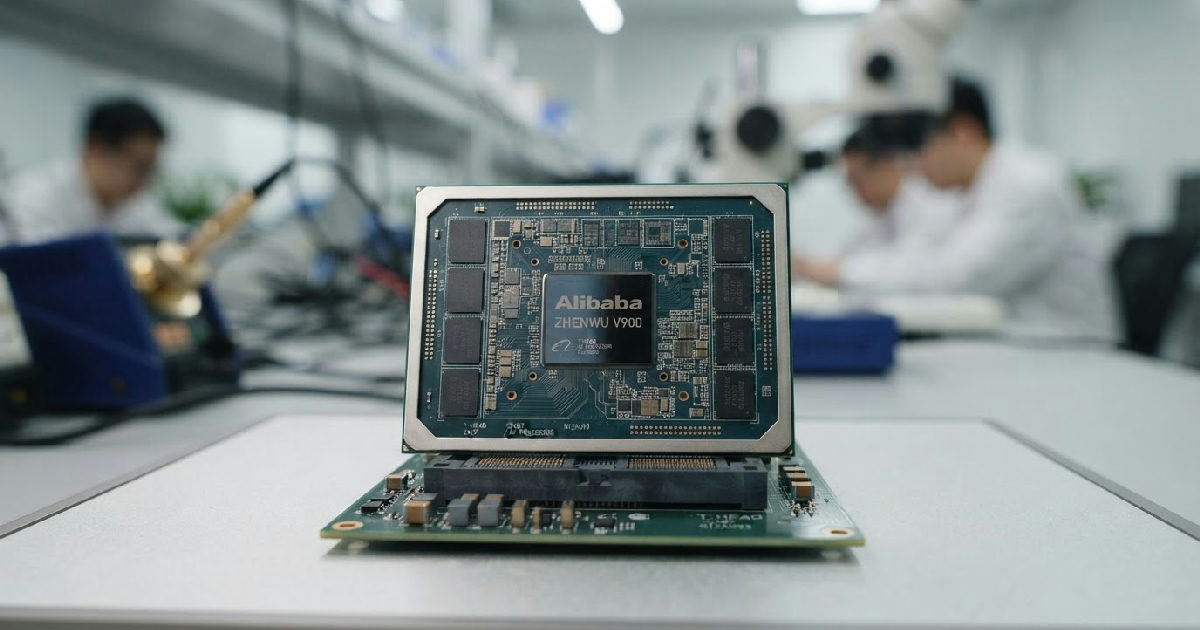
Alibaba has fired a direct shot at NVIDIA’s dominance in the artificial intelligence market, unveiling its powerful new Zhenwu V900 AI chip. The announcement is backed by a colossal plan to construct 20 gigawatts of data centre capacity by 2032, signalling a major engineering and strategic push.
This multi-billion-dollar effort, developed by Alibaba’s semiconductor arm T-Head, aims to build a vertically integrated AI hardware and software stack. It represents one of the most significant domestic hardware initiatives from a Chinese technology giant, driven by soaring AI demand and geopolitical realities.
Alibaba AI chip: The Zhenwu V900 and PPU
The Zhenwu V900 is the centerpiece of Alibaba’s strategy. According to the company, the chip delivers three times the performance of its predecessor, the M890, which was only launched in May 2026. This rapid iteration highlights the aggressive pace of development at T-Head.
Designed for training and running large-scale AI models, the V900 architecture supports clustering up to 500,000 processors to function as a single supercomputer. The enormous power required for such large-scale computing presents its own engineering hurdles, a problem shared across the industry as companies deploy vast NVIDIA AI factories.
Alongside the V900, T-Head also revealed its Parallel Processing Unit (PPU). Benchmarks for the PPU indicate performance on par with NVIDIA’s H20, the most powerful chip the US company is currently permitted to sell in China. With 96 GB of high-bandwidth memory (HBM2e), the PPU is engineered for high-volume AI inference tasks.
Mass production for the Zhenwu V900 is slated for the first quarter of 2027.
A 20-gigawatt infrastructure ambition
A powerful chip is only one part of the equation. To power the next generation of AI, Alibaba Cloud is embarking on one of the most ambitious data centre construction programmes globally. The goal is to build 20 gigawatts of capacity by 2032—an amount of power sufficient to run millions of homes.
Alibaba CEO Eddie Wu noted that demand for AI compute is growing so quickly that it is outpacing the industry’s ability to build capacity. This massive infrastructure investment is a direct response to that reality.
This physical expansion is already underway. China Unicom, a state-owned telecommunications operator, is using the new T-Head PPU as the primary AI chip in its new $390 million data centre project in Xining. T-Head secured the contract to supply 16,384 PPU units, which constitutes around 72% of the facility’s total AI accelerators.
Breaking the software lock-in with SAIL
Alibaba’s challenge to NVIDIA extends beyond silicon to the software that runs on it. For years, NVIDIA has maintained its market lead not just through hardware, but through its proprietary CUDA software platform, which has a deep ecosystem and high switching costs for developers.
To counter this, T-Head open-sourced its “SAIL” software platform in July 2026. SAIL acts as a compiler, translating AI programs into commands the Zhenwu architecture can understand while optimising for performance. This move makes over 260 existing AI training and inference tools freely available for use and modification on Alibaba’s hardware.
By removing a key barrier to adoption, Alibaba hopes to persuade developers to move away from the closed NVIDIA ecosystem. Making the underlying tools open is a critical step in turning raw processing power into tangible results, as the effective use of industrial AI turns factory data into actionable intelligence.
The strategy appears to be working, with Alibaba Cloud reporting it has been able to reduce public cloud inference prices by 50% by leveraging its own PPU.
A journey from internal optimisation to global contender
Alibaba’s foray into chip design is not new. The company unveiled its first AI inference chip, the Hanguang 800, back on September 25, 2019, at its Apsara Computing Conference. Developed by T-Head, it was fabricated on TSMC’s 12nm process and packed 17 billion transistors.
Initially, the Hanguang 800 was deployed internally to accelerate machine learning tasks within Alibaba’s sprawling e-commerce empire. It powered product searches, translations, and recommendations on sites like Taobao. The performance gains were immediate and substantial. A task that took an hour on traditional GPUs—categorising one billion product images—took just five minutes with the Hanguang 800.
By 2021, Alibaba reported that 70% of its cloud division’s AI inference workload was running on its own self-developed chips, having replaced NVIDIA T4 GPUs. This process of proving the hardware at massive scale internally gave the company the confidence and experience to offer its silicon to external customers.
The journey highlights the steep learning curve many manufacturers face data challenges when first adopting AI technologies.
The strategic calculus behind the silicon
Alibaba has committed over US$53 billion to AI development over three years, underscoring its long-term vision. This substantial investment not only fuels its chip design efforts but also supports the ambitious data centre expansion and the development of more sophisticated AI models.
The company’s flagship Qwen model already boasts approximately 2.4 trillion parameters, with plans to build future Qwen AI models reaching up to 10 trillion parameters to handle increasingly complex tasks.
The company also plans to update its AI chip range annually, reflecting a continuous development cycle to keep pace with rapid advancements in AI. With 560,000 processors from the Zhenwu family already deployed by over 400 external customers, T-Head is steadily building its market presence.
This push is set against a backdrop of U.S. export controls, which have constrained Chinese access to advanced American-designed processors. Alibaba’s strategy is to achieve greater control over its AI infrastructure through self-sufficiency. While it still utilises NVIDIA chips for some workloads, the clear trajectory is towards a more integrated, internally developed solution.
This strategic move aims to strengthen China’s domestic technological capabilities and position Alibaba as a key player in the global AI hardware landscape.
