


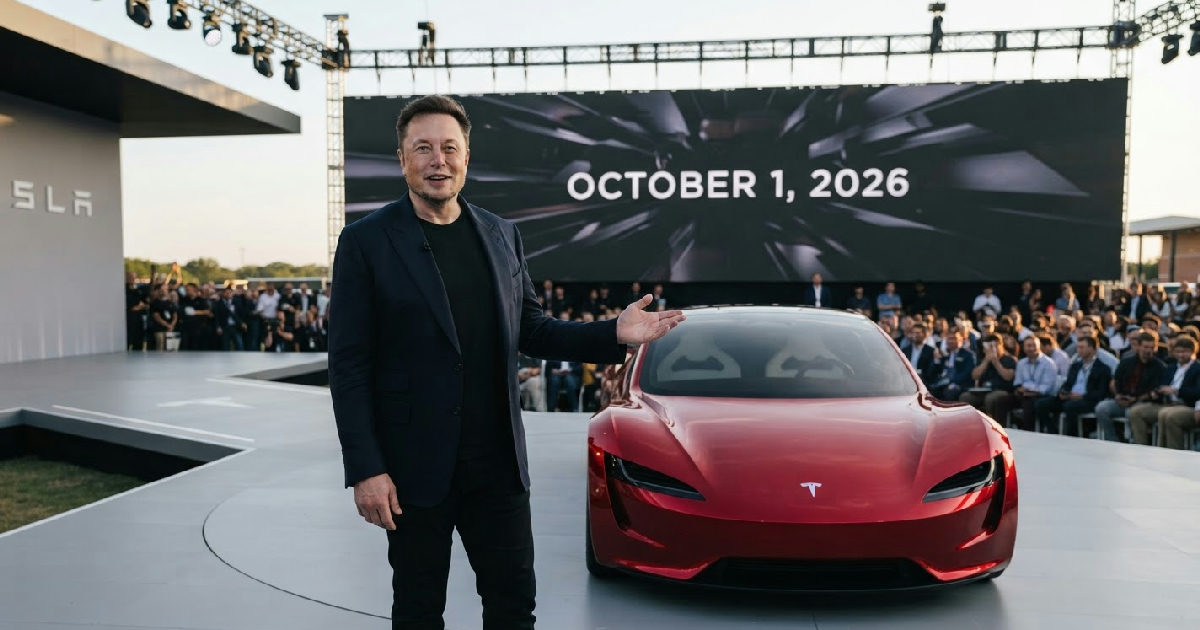
The second-generation Tesla Roadster will be officially unveiled on October 1, 2026. This highly anticipated Tesla Roadster unveiling marks a significant moment for electric vehicle enthusiasts and the automotive industry.
This long-awaited reveal, set for 7:30 PM, represents a significant milestone for Tesla. It signals a readiness to push boundaries in electric vehicle performance and design, integrating advanced technologies from its sister company, SpaceX.
The long wait for the Tesla Roadster unveiling
The second-generation Tesla Roadster first appeared as a concept prototype in November 2017, with initial deliveries optimistically targeted for 2020. However, the project quickly became synonymous with delays, seeing its anticipated arrival repeatedly pushed back over nearly a decade.
Tesla CEO Elon Musk attributed these postponements to a variety of factors, including supply chain disruptions and the prioritisation of other critical models like the Cybertruck and the Semi. The Roadster’s launch goalpost has shifted at least eight times since its original announcement, creating considerable impatience among prospective owners.
Evolution of a hypercar design
Early reports suggested Tesla abandoned an approach based on existing Model S Plaid components for the new Roadster. Instead, the company opted to develop a completely new carbon-fibre hypercar, indicating a fundamental redesign to meet its ambitious performance goals.
This pivot highlights a commitment to radical innovation rather than incremental improvements. Such an extensive re-engineering effort accounts for some of the prolonged development cycle, aiming for a truly distinct vehicle in the high-performance electric segment.
SpaceX collaboration and propulsion technology
Central to the mystique surrounding the new Roadster is its reported integration of SpaceX technology. The teaser image for the Tesla Roadster unveiling itself, with its depiction of “rocket-launch lighting” and “four thruster plumes firing,” heavily suggests a direct collaboration with Elon Musk’s rocket company.
Sources indicate a limited-edition model will feature cold-gas thrusters developed by SpaceX, codenamed A71. This system occupies the rear seating area, using approximately ten thrusters and a high-pressure air tank to enable unprecedented manoeuvres.
Performance claims and track demonstration
These optional thrusters are rumoured to allow the Roadster to perform extraordinary feats, potentially even lifting off the ground. The planned demonstration at SpaceX’s McGregor engine test site in Waco, Texas, will reportedly involve remote operation, with spectators kept several hundred yards away due to noise and force.
Performance claims from the 2017 prototype reveal included a 0 to 60 mph acceleration in 1.9 seconds, a top speed exceeding 250 mph, and a 620-mile range from a 200 kWh battery pack. Musk has since pushed for an acceleration target of under one second, an almost unthinkable figure for a production vehicle.
The event in Waco, Texas
The choice of Waco, Texas, for the official Roadster unveiling is strategically significant. The city sits approximately 1.5 hours north of Tesla’s headquarters in Austin and is a short drive from SpaceX’s McGregor engine test site.
This proximity allows for a seamless demonstration of the thruster technology. The venue offers the necessary space and infrastructure to showcase the vehicle’s more unconventional capabilities, reinforcing the synergy between Tesla and SpaceX.
Logistics for reservation holders
Invitations have already gone out to Roadster reservation holders, who must RSVP by midnight on September 16, 2026. Access to the event is limited to guests aged 21 and older, and all invitations are non-transferable, indicating an exclusive gathering.
This controlled environment ensures a premium experience for those who committed early to the project. It also maintains an element of exclusivity for the highly anticipated reveal of this advanced electric vehicle.
Long wait for reservation holders
The prolonged development has tested the patience of many early adopters who placed significant deposits. Standard car reservations required $50,000, while the Founders Series demanded $250,000, tying up considerable capital for years.
Some prominent reservation holders, including OpenAI CEO Sam Altman, have reportedly cancelled their orders due to the extended wait. This situation highlights the challenges of pre-ordering disruptive technology with lengthy, unpredictable development cycles.
Musk’s vision versus reality
The delays have often sparked public debate, including a social media exchange between Elon Musk and Sam Altman last year regarding refunds and the timeline. Musk has consistently maintained that the extensive development was necessary to achieve radically increased design goals.
While the vision is ambitious, the practicalities of bringing such a complex vehicle to market have proven challenging. Even after this unveiling, Musk has indicated that production will not start for another 12 to 18 months, pushing initial deliveries to 2027 or 2028.
Broader EV market context
The Roadster’s launch comes at a dynamic time for the electric vehicle market. Tesla’s U.S. EV market share stood at 52% in the first eight months of 2026, an increase from 43% in the same period of 2025.
This growth occurred despite a 16% year-over-year decline in Tesla’s U.S. sales, against a backdrop where overall U.S. EV sales fell approximately 30%. Traditional automakers like Ford, General Motors, and Honda have scaled back or cancelled their own EV plans due to shifting market conditions.
Tesla’s production track record
Tesla’s history is dotted with ambitious product announcements followed by significant production delays. The Cybertruck, unveiled in November 2019, only began customer deliveries in November 2023.
Similarly, the Semi truck, after a protracted development, only began volume production in April 2026. The Roadster’s journey fits this pattern, underscoring the complexities inherent in bringing novel automotive technology to mass production.
Legacy of the first Roadster
The original Tesla Roadster, produced between 2008 and 2012, holds a significant place in EV history. Based on a Lotus Elise chassis, it was the first highway-legal, serial production, all-electric car to use lithium-ion battery cells.
With a range exceeding 200 miles per charge, it paved the way for mainstream electric vehicles. Approximately 2,450 units were sold across more than 30 countries, establishing Tesla’s early reputation for electric performance.
Outlook for high-performance EVs
The second-generation Roadster represents more than just a new model for Tesla; it’s a statement about the extreme potential of electric propulsion. Its advanced design and potential thruster technology could redefine what’s possible in hypercar performance, setting new benchmarks for the industry.
This unveiling reinforces Tesla’s position as a leader in automotive innovation, particularly in areas challenging conventional engineering. It’ll be a significant moment for both the company and the broader electric vehicle landscape.
