


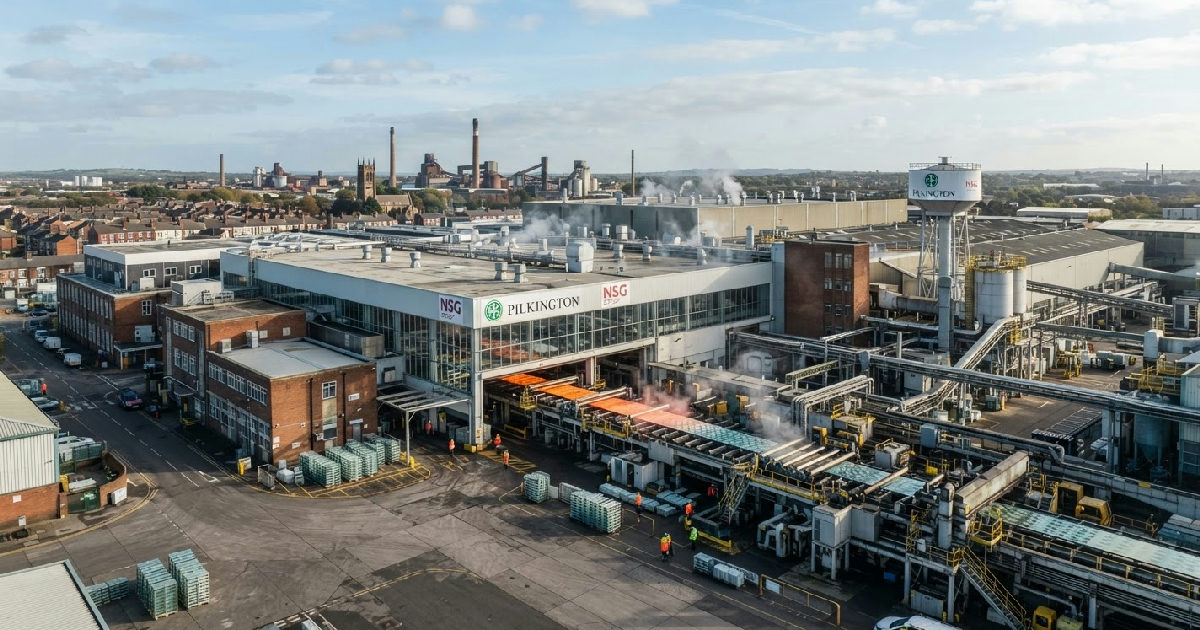
Pilkington United Kingdom Limited has confirmed a 15,000-tonne reduction in carbon emissions (CO2e) during the first year of its new rolled glass production line at Greengate Works, St Helens.
The emissions saving, equivalent to removing 8,000 to 8,800 cars from the road annually, marks a crucial step in the company’s broader decarbonisation strategy. This achievement, reported on September 3, 2026, stems from a multi-million-pound investment aimed at modernising production and safeguarding the future of rolled texture glass manufacturing in the UK.
Achieving Pilkington UK Carbon Reduction Goals
The core of Pilkington UK’s substantial carbon reduction lies in an intricate engineering project: the consolidation of both rolled and float glass manufacturing into a single furnace at its Greengate Works. This innovative approach eliminated the need for two separate, energy-intensive furnaces, marking a strategic shift in operational efficiency.
This consolidation followed the closure of the historic Watson Street Works in St Helens, which had operated for two centuries. The move allowed Pilkington UK to streamline its entire glassmaking process, focusing resources and technology on the more efficient Greengate facility. It highlights a pragmatic approach to industrial transformation.
An Engineering Feat: Breaking into a Live Furnace
The implementation of the new production line involved an exceptional engineering challenge. Teams had to successfully break into the side of a live glass furnace to construct a canal. This new channel now directs molten glass from the existing float line to the new rolled glass line in a separate building.
Neil Syder, Managing Director of Pilkington UK, described it as an “incredible feat of engineering.” This complex construction ensures all glass production now originates from one optimised furnace, directly enabling the 15,000-tonne annual CO2e reduction. Such projects demonstrate leadership in the UK manufacturing landscape and its drive towards efficiency.
The project received crucial financial backing, including £3.7 million in funding from the UK government’s Industrial Energy Transformation Fund (IETF). This fund is specifically designed to support high-energy industrial businesses in their efforts to reduce both energy consumption and carbon emissions, accelerating the transition to a greener economy.
Safeguarding UK Rolled Glass Manufacturing
The investment at Greengate Works extends beyond carbon reduction; it also secures the future of rolled texture glass manufacturing in the United Kingdom. Pilkington UK produces its “Texture by Pilkington” glass range at the facility. This range features 20 original designs across Any Room, Eternal, and Icon collections, providing privacy and aesthetic style in interior design.
The heritage of this product line is deep, with Texture by Pilkington glass having been manufactured in St Helens since 1852. The recent modernisation ensures this long-standing tradition continues with enhanced efficiency and reduced environmental impact. It represents a commitment to both local industry and product innovation.
The closure of the Watson Street Works in February 2024, a site historically significant as the birthplace of Sir Alastair Pilkington’s modern float glass process, marked a strategic shift. All jobs from the older facility were successfully transferred to the modern Greengate site, ensuring the continuity of a skilled workforce and preserving local employment opportunities.
Pilkington UK is also actively supporting St Helens Borough Council with plans to redevelop the former Watson Street site. This collaboration aims to create new opportunities for the area, transitioning from its industrial past to a revitalised future. It reflects a responsible approach to industrial legacy.
Broader Sustainability Ambitions and Hydrogen Pioneers
The 15,000-tonne Pilkington UK carbon reduction is a significant step within the company’s broader sustainability framework. Pilkington UK, as part of the NSG Group, has committed to a 30% reduction in greenhouse gas emissions by 2030, benchmarked against 2018 levels. The ultimate goal is achieving net-zero emissions by 2050.
The Greengate Works site itself has been a pioneer in industrial decarbonisation, achieving several global firsts in hydrogen-fired glass production. These milestones are critical for demonstrating the viability of alternative, low-carbon fuels in energy-intensive industries. The facility serves as a testing ground for future glassmaking technologies.
Looking ahead, Pilkington UK plans to open a new hydrogen plant at its Greengate Works site. This facility aims to eliminate an additional 15,000 tonnes of carbon from direct emissions annually. It will provide up to seven tonnes of zero-emission hydrogen daily to the site’s furnace, with construction expected to begin in 2025 and operation by 2027.
Such forward-looking investments place Pilkington UK at the forefront of the global glass industry’s efforts to decarbonise. The company’s commitment to hydrogen technology aligns with wider industry trends towards more sustainable energy sources. It offers a blueprint for other manufacturers aiming for net-zero manufacturing facilities.
Government Support and Industrial Energy Transformation
The £3.7 million funding from the Industrial Energy Transformation Fund highlights the UK government’s commitment to supporting industrial decarbonisation. The IETF, which has made £500 million available across three phases up to 2028, provides crucial grants for energy efficiency and low-carbon technology deployment.
This fund is vital for businesses in high-energy sectors like manufacturing, helping them to invest in technologies that reduce both operational costs and environmental impact. Such governmental support is essential for accelerating the transition to a low-carbon economy. It de-risks significant capital investments for companies.
The UK glass industry as a whole is actively exploring alternative fuels, including hydrogen, biofuels, and electrification, to reduce its reliance on natural gas. Pilkington UK’s pioneering work at Greengate, alongside collaborations with organisations like Glass Futures, demonstrates this collective drive. Their efforts contribute to a broader industrial energy transformation.
A Blueprint for Sustainable Manufacturing
Pilkington UK’s achievement of its 15,000-tonne Pilkington UK carbon reduction target in the first year of its new rolled glass line at Greengate Works serves as a compelling case study. It demonstrates that significant environmental gains can be achieved through strategic investment and advanced engineering. The project successfully safeguarded manufacturing capacity while substantially reducing the carbon footprint.
The success at Greengate provides a practical example for other manufacturers grappling with decarbonisation challenges. By consolidating operations, investing in new technology, and leveraging government support, industries can meet ambitious sustainability goals. The combination of engineering innovation and clear environmental targets sets a high standard for the sector.
This commitment to industrial efficiency and sustainability is vital for the long-term viability of manufacturing in the UK and globally. As industries continue to seek pathways to net-zero, Pilkington UK’s experience offers valuable lessons in planning, execution, and the integration of advanced technologies. It underscores the profound impact of dedicated engineering effort on industrial energy transformation.
