


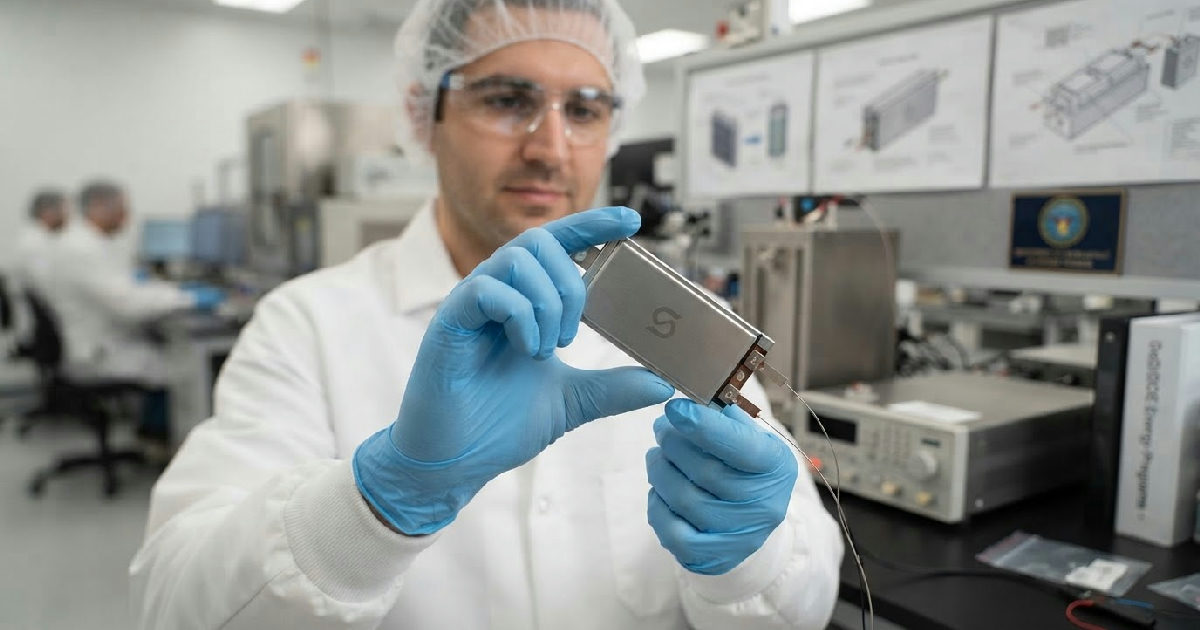
America’s battery startup sector has found a critical new lifeline in the US defense industry.
This strategic pivot reflects national security imperatives, aiming to onshore vital supply chains and diminish reliance on foreign sources, particularly China, for essential components. Key players like Sila Nanotechnologies and Forge Nano are among those securing substantial investments, signalling a significant reorientation of the nation’s industrial strategy.
Defense funding boosts US battery startups
The U.S. Department of Defense is channelling over £1.6 billion ($2 billion) into domestic companies working on batteries and critical minerals. This extensive financial backing, encompassing conditional loan commitments and equity investments, aims squarely at reducing the nation’s dependence on Chinese suppliers across the board.
In parallel, the Department of Energy recently announced £400 million ($500 million) in grants for next-generation battery technologies, including solid-state and lithium-sulfur chemistries. Much of this money has directly supported US battery startups, providing them with crucial capital to scale their operations.
These initiatives share a common goal: to fortify domestic supply chains, challenge China’s significant dominance in battery manufacturing, and create American jobs. The military needs robust, high-energy batteries for a vast array of applications, from drones and weapon systems to infantry radios and advanced fighter jets.
The strategic shift underscores a broader push within Washington to link industrial policy with national security. Even as the Trump administration has expressed skepticism about electric vehicles, it acknowledges the indispensable role batteries play in modern life, leaning heavily on defense as the primary justification for these large-scale investments.
DOE grants bolster materials and recycling innovation
Several startups have already secured significant portions of the DOE’s grant funding to advance specific areas of the battery supply chain. Coreshell, a battery materials startup, received £40 million ($50 million) to expand manufacturing for its metallurgical silicon anode material.
A spokesperson for Coreshell told TechCrunch that defense applications for lithium-ion batteries are “absolutely playing out in discussions.” The company recently brought on ADS Ventures as an investor, whose parent, ADS, is a defense supplier. This connection highlights the intertwining interests of commercial innovation and military readiness.
Another major recipient, Lilac Solutions, landed £80 million ($100 million) to establish a processing facility on Utah’s Great Salt Lake. This plant aims to produce 5,000 metric tons of lithium carbonate annually by 2028, a critical precursor in battery production. Digital overhauls like this are vital for industrial scale-up.
Nth Cycle also secured £80 million ($100 million) from the DOE. The funding will go towards building a facility designed to refine black mass from recycled lithium-ion batteries. This process extracts lithium and nickel compounds for reuse in new battery manufacturing, strengthening a circular economy approach.
Sila Nanotechnologies secures major DoD loan
One of the most substantial commitments came on 10 August 2026, when Sila Nanotechnologies received a £1.12 billion ($1.4 billion) conditional loan from the U.S. Department of Defense’s Office of Strategic Capital. This funding marks a significant milestone for the company and its advanced silicon anode technology.
Sila plans to scale up production of its Titan Silicon, a silicon-carbon anode material, at its Moses Lake, Washington factory. Titan Silicon promises to store 20% to 40% more electricity than traditional graphite anodes, offering substantial performance improvements for various applications.
The investment will also help fund a new lithium-ion battery cell manufacturing facility, further solidifying domestic production capabilities. The expansion at Moses Lake is set to quintuple its output, with the capacity to support over 100,000 electric vehicles annually.
Crucially, this enhanced production will also support specialty uses, including industrial, agricultural, and military drones. This direct intervention by the DoD addresses the ongoing challenge for U.S. battery manufacturers to source materials outside of China, which currently controls over 90% of anode processing globally.
Forge Nano builds America’s Battery Gigafactory
In a bold move to expand domestic lithium-ion battery manufacturing, Forge Nano broke ground on a major expansion of its facility in Morrisville, North Carolina, on 21 August 2026. This ambitious project has been dubbed “America’s Battery Gigafactory” and represents a significant step towards energy independence.
The expansion benefits from up to £80 million ($100 million) in non-dilutive funding from the U.S. Department of Energy. This complements Forge Nano’s own investment of between £240 million ($300 million) and £264 million ($330 million). This blended funding model underscores the government’s commitment alongside private sector ambition.
The project also secured a critical partnership on 25 June 2026, with Samsung SDI Co. Samsung agreed to provide £16 million ($20 million) in combined Series D financing and strategic investment, along with crucial engineering support. This collaboration brings international expertise to the domestic manufacturing effort.
Once complete, the expansion will transform the existing 100,000-square-foot operation into a sprawling manufacturing campus approaching 315,000 square feet. This scale is designed to establish approximately 3 gigawatt-hours (GWh) of annual battery cell manufacturing capacity at full production, equivalent to about 150 million battery cells each year.
Strategic alignment with defense requirements
The Morrisville facility is poised to create over 250 new jobs in North Carolina, spanning advanced manufacturing, engineering, operations, and technical roles. It will supply advanced lithium-ion batteries for a diverse range of customers, including defense, aerospace, and commercial entities.
At full capacity, the gigafactory could produce enough batteries for 10-20 million drones, 34,000 electric military vehicles, or 6 million BB-2590 radio batteries annually. It could also support 900 6T (Type 2) batteries or approximately 275 energy storage system containers each year, demonstrating its versatility and strategic importance. Automated defense manufacturing attracts significant investment.
Paul Lichty, CEO of Forge Nano, highlighted the significance during the groundbreaking ceremony: “Today’s groundbreaking marks an important step toward building a battery supply chain in America. America’s Battery Gigafactory will give defense, aerospace and commercial customers access to advanced battery cells manufactured here at home, at the scale needed to compete globally.”
The timing of this expansion aligns strategically with new National Defense Authorization Act (NDAA) battery sourcing requirements set to take effect in 2028. Assistant Secretary of Energy Audrey Robertson added, “These batteries will not only serve commercial markets, but also the defense and aerospace applications on which our military depends.”
Congresswoman Deborah Ross underscored the multifaceted benefits, stating: “Expanding domestic battery production will drive economic growth, create jobs, support our clean energy transition, and strengthen America’s technology supply chain.” This project embodies a national push for self-sufficiency in critical industrial components.
Diversifying critical materials for national security
Beyond lithium-ion batteries, the DoD’s Office of Strategic Capital is investing in a broader range of critical materials essential for defense. On 10 August 2026, Sunrise Energy Metals received a £320 million ($400 million) conditional loan commitment.
This funding will support the development of a domestic scandium supply chain, including the world’s first primary scandium mine. Scandium is vital for high-heat aluminium alloys used in fighter jets and spacecraft, highlighting the need for specialized material production.
Also on that date, Niron Magnetics was awarded £120 million ($150 million) to bolster its production capabilities as a rare earth magnet maker. Rare earth magnets are crucial for numerous high-tech applications, including advanced motors and sensors used in military hardware.
These investments collectively demonstrate a comprehensive strategy to secure the entire industrial base for advanced materials. It’s not just about energy storage, but about the fundamental building blocks of modern military and industrial technology, ensuring resilience against geopolitical risks.
Shifting market dynamics: automotive versus defense
The current landscape for U.S. battery manufacturers reflects a complex interplay between commercial and defense demands. While the automotive industry is still projected to spend nearly £14.4 billion ($18 billion) on battery manufacturing in the U.S. this year, its trajectory has faced recent headwinds.
The “One Big Beautiful Bill,” which eliminated battery and EV incentives, dealt a significant blow to future demand in the automotive sector. This legislative change forced many startups to re-evaluate their primary markets and seek alternative funding avenues.
Defense, by contrast, offers a more immediate and consistent demand driver, albeit a smaller one in pure volume terms. The U.S. Defense Logistics Agency, for example, purchased £160 million ($200 million) worth of batteries in 2021 alone. While dwarfed by the automotive market, defense procurement prioritises security of supply and performance over cost in many instances.
Megan O’Connor, co-founder and CEO of Nth Cycle, acknowledged this dynamic, noting strong demand from the defense sector while recognising the long-term potential of the automotive space. This dual demand allows battery companies to diversify their revenue streams and mitigate risks associated with fluctuating commercial markets. Domestic battery solutions are gaining traction.
Broader implications for industrial autonomy
The substantial government and defense-backed investments in US battery startups and critical materials underscore a renewed focus on industrial autonomy. It’s a clear signal that securing domestic production capabilities for strategic technologies is now a national priority, moving beyond purely economic considerations.
These initiatives aim to correct vulnerabilities exposed by global supply chain disruptions and geopolitical tensions. By funding companies like Sila Nanotechnologies and Forge Nano, the U.S. is actively building resilience into its industrial infrastructure, reducing dependence on external, potentially unreliable, sources.
For operations professionals and engineers, this means a growing pool of domestically produced, advanced battery components and materials will become available. This shift not only ensures supply stability but also fosters an environment for continuous innovation within the U.S. manufacturing sector.
While the immediate trigger for some of this funding was a perceived overcorrection in EV incentives, the underlying drive for national security and domestic industrial capability remains firm. It represents a long-term commitment to ensuring that critical technologies can be manufactured at home, serving both military and commercial needs.
This also provides an interesting parallel for African nations looking to industrialise and control their own resource processing, leveraging mineral wealth for local manufacturing growth rather than simply exporting raw materials.
