


Precision manufacturing operations, particularly those relying on computer numerical control (CNC) machining, now have a powerful tool against the persistent threat of thermal deformation: real-time AI temperature offset technology.
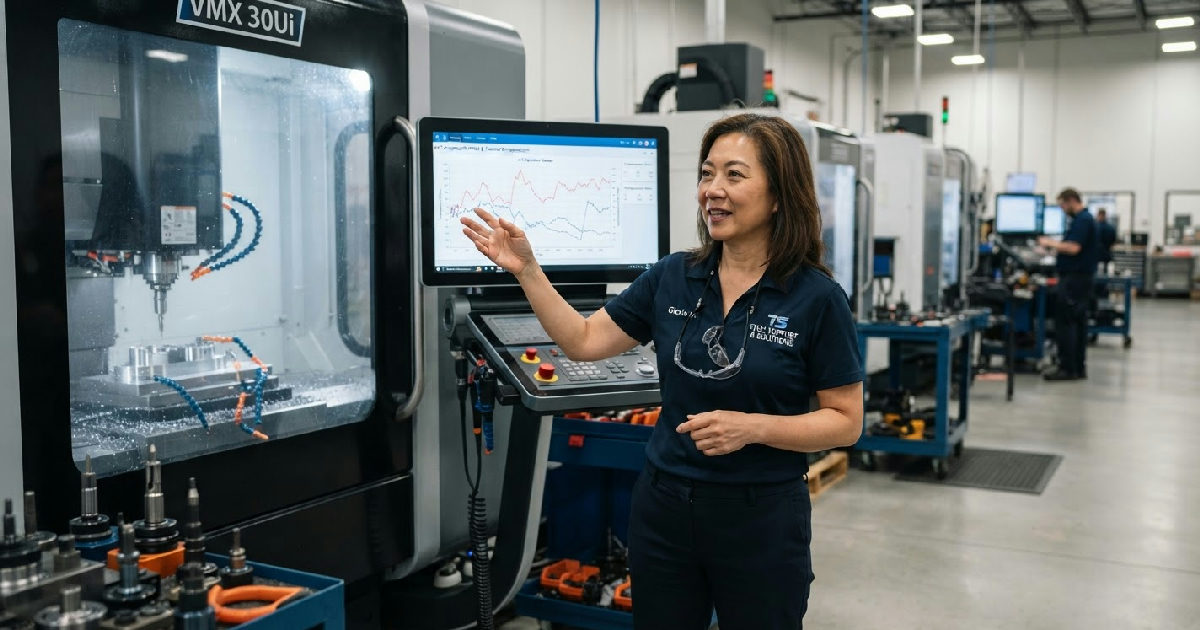
Gloria Wu, Director of Technical Support & Solutions, highlighted this shift, explaining that while damaged tooling and CAM programming issues are often blamed for quality problems, the true culprit is frequently thermal deformation. This invisible physical phenomenon causes even the most meticulously set-up machines to produce out-of-tolerance parts as operating temperatures fluctuate throughout the day.
Understanding thermal deformation in CNC machining
Thermal deformation isn’t a single issue but a complex interplay of thermodynamic variables within the machining environment. It’s a problem every experienced machinist has encountered: a machine produces perfect parts at the start of a shift, but after hours of continuous operation and rising ambient temperatures, dimensions begin to drift. This persistent challenge directly impacts manufacturing quality and efficiency.
The heat sources are varied and pervasive. High-speed spindles, often operating at speeds that push temperatures beyond 55°C, become significant heat sources. This localised heat causes axial expansion, predominantly affecting the machine tool’s Z-axis and leading to subtle but critical dimensional inaccuracies in the workpiece.
How heat affects precision components
Beyond the spindle, friction in components like ball screws and guides contributes substantially to the overall thermal load. Continuous rapid positioning can warm ball screws by 3°C to 8°C. This seemingly minor increase can subtly shift the X and Y home positions during multi-axis toolpaths, causing errors to accumulate over extended runs.
Coolant systems, designed to manage heat, also introduce another variable. As coolant absorbs heat generated by cutting operations throughout the day, its temperature can fluctuate by as much as 10°C. These variations directly influence the expansion of the workpiece itself, impacting the precision of the cut.
Even the ambient shop-floor temperature contributes: an uncontrolled rise of just 5°C can cause a standard 1-metre steel machine bed to expand by more than 55 micrometres (μm).
Consider the material properties: aluminium expands by approximately 23 μm per metre per degree Celsius, while steel expands by approximately 12 μm per metre per degree Celsius. In setups demanding precision within ±0.005 mm (or ±5 μm), a mere 2°C thermal shift is enough to breach strict engineering specifications. This illustrates the tight margins at play and the difficulty of maintaining consistent quality without advanced intervention.
From manual checks to automated precision
Historically, manufacturers relied on manual methods to counter thermal drift. Operators would halt production every couple of hours to measure parts using coordinate measuring machines (CMMs) or micro-calipers. They then manually updated tool wear offsets in the CNC control system. This method was labour-intensive and inherently inefficient.
The cost of manual intervention
This trial-and-error approach had significant drawbacks. It typically led to a 15% to 20% loss in overall equipment effectiveness (OEE). Furthermore, the long intervals between manual checks created a high risk of undetected scrap, as parts could drift out of tolerance for extended periods before the issue was identified. The process was reactive, not proactive, and introduced significant variability.
Many modern precision manufacturing facilities are now moving beyond these inefficiencies. They are integrating dynamic predictive algorithms directly into their CNC machining services. This represents a fundamental shift in how accuracy is maintained on the factory floor. The core of this new approach lies in real-time monitoring and adaptive control, driven by artificial intelligence.
AI-driven dynamic compensation
The new methodology involves high-precision thermal sensors that constantly feed multi-point temperature metrics into an AI algorithm. These sensors continuously gather readings from critical heat sources such as spindle bearings, machine castings, ball screw nuts, and the surrounding air.
This comprehensive data collection provides a detailed thermal map of the machine and its environment.
An integrated predictive model then processes these live thermal inputs.It compares these readings against trained material expansion curves and finite element analysis (FEA) data. This allows the AI to calculate micro-level physical displacement across the X, Y, and Z axes in real time.
The intelligence of the system lies in its ability to understand and predict how temperature changes will affect specific machine components and the workpiece.
Finally, the CNC controller automatically applies micro-adjustments to the machine coordinate system. This dynamic coordinate compensation ensures that any structural expansion is counteracted as machining begins. This continuous, adaptive feedback loop means the machine is constantly correcting itself, maintaining tight tolerances without human intervention.
Tangible gains for high-tolerance production
Implementing real-time AI temperature compensation brings tangible performance improvements to the production of critical components. This is especially true in industries with stringent quality demands, such as aerospace, medical device manufacturing, and automotive manufacturing, where even microscopic errors can have severe consequences. The technology addresses long-standing issues that have hampered efficiency and quality.
Reducing scrap and boosting quality
One of the most significant benefits is a reduction of more than 85% in thermal scrap. Part rejections that were once common due to shop-floor warming in the afternoon or thermal spikes during extended cutting operations are now virtually eliminated. This not only saves material costs but also reduces wasted production time and the labour associated with rework or scrap disposal.
The system also leads to a higher process capability index (Cpk), which remains well above 1.33, even during extended, unsupervised overnight runs. This means tight statistical process control is maintained consistently, helping ensure that parts meet specifications with minimal variation. The automated nature of the solution ensures that quality doesn’t degrade when human oversight is reduced or absent.
Sustained repeatability and process control
Moreover, this technology ensures remarkable batch-to-batch repeatability. It helps ensure that the first part produced and the one-thousandth part produced remain within the same defined tolerance limits. This consistency is achieved without requiring operators to make manual zero-setting adjustments or take the system offline to address thermal issues, streamlining the entire production cycle.
This level of sustained accuracy and repeatability simplifies quality assurance processes and builds greater trust in automated production lines. It removes a major source of variability that has traditionally been difficult to control, paving the way for more predictable and efficient manufacturing workflows. The implications for long-term production contracts and reliable supply chains are substantial.
Broader implications for industrial strategy
This integration of AI and advanced sensing capabilities provides manufacturing facilities with a clear competitive edge. The development extends beyond merely mitigating thermal drift, representing a broader trend towards fully digitalised and self-optimising production environments. Access to such automated thermal controls, alongside complementary operations such as custom sheet metal fabrication, offers engineering teams comprehensive manufacturing capabilities for tight-tolerance applications under a single roof.
As industrial automation continues its evolution, the application of real-time AI temperature offset technology points to a future where machines do not just execute commands but intelligently adapt to their physical environment. This technology helps manufacturers overcome common production challenges, reduce waste, and deliver precision components with consistent accuracy. This strengthens manufacturers’ position in complex global supply chains.
