


Hedge fund Situational Awareness has committed an additional $400 million to Source Foundry, a startup specialising in advanced chip manufacturing.
Co-founded by Abdulmalik Obaid and Joe Burg, Source Foundry aims to revolutionise semiconductor lithography to produce AI chips faster and more affordably. The capital infusion comes at a critical juncture for both firms, signalling a strategic push in the competitive AI hardware landscape.
A high-stakes pivot for Situational Awareness
The latest investment by Situational Awareness marks a notable pivot for the AI-focused hedge fund, which recently experienced significant financial turbulence. Just weeks prior, the fund faced steep losses amounting to $35 billion in July 2026, primarily from its positions in public AI infrastructure stocks.
Its assets under management (AUM) reportedly contracted sharply, from a peak of $45 billion in July 2026 to an estimated $10 billion. This dramatic downturn forced the fund to re-evaluate its investment strategy and public market exposure.
Aschenbrenner’s turbulent journey
Leopold Aschenbrenner, a former OpenAI researcher, founded Situational Awareness in September 2024. The fund initially delivered strong returns, drawing considerable attention to the young manager.
However, the recent market correction in AI equities exposed the vulnerabilities of a heavily leveraged public-stock portfolio. The fund’s rapid growth and subsequent losses highlight the volatile nature of the AI investment sector.
The public portfolio divestment
To stabilise its operations, Situational Awareness sold the majority of its public holdings to Ken Griffin’s Citadel Advisors in late July 2026. This extensive sell-off marked a significant development in the financial markets.
Crucially, the fund opted to retain its shares in Anthropic, a move that suggests selective confidence in specific, perhaps more foundational, AI companies. This strategic divestment cleared the path for focusing on private, deep-tech opportunities like Source Foundry.
Source Foundry’s quest for faster chip production
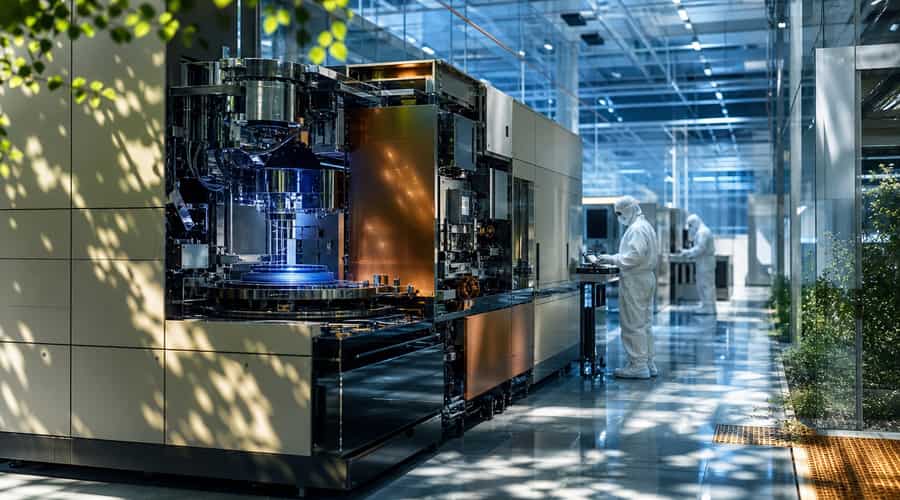
Source Foundry, established in San Francisco in 2025 by Stanford researchers Abdulmalik Obaid and Joe Burg, is at the forefront of tackling persistent bottlenecks in chip manufacturing. The startup’s core mission involves developing advanced tools and processes to make semiconductor production both faster and more cost-effective.
he company’s technology specifically targets current limitations in lithography, aiming to introduce a new paradigm for creating AI chips. Existing methods, particularly those relying on extreme ultraviolet (EUV) lithography from companies like ASML, are highly complex and expensive.
Challenging lithography bottlenecks
The company’s approach focuses on simpler, lower-cost, and more efficient methods for semiconductor lithography and manufacturing. This directly challenges the established, capital-intensive processes currently dominating the industry.
Stephanie Zhan, a partner at Sequoia, an early backer of Source Foundry, underscored the importance of the startup’s work. “If you trace the AI supply chain upstream, from models to chips to the machines that manufacture them, each layer becomes increasingly critical and constrained. Source Foundry tackles the tightest bottleneck: tooling for semiconductor manufacturing, starting in lithography,” Zhan explained.
Founders and early backing
The vision for Source Foundry was conceived by Abdulmalik Obaid, a materials scientist from Stanford, alongside co-founder Joe Burg. Their expertise underpins the technical ambition of the company.
Before the latest infusion from Situational Awareness, Source Foundry had already garnered significant support, including backing from Sequoia Capital. This prior endorsement from a prominent venture capital firm signals the perceived potential of its innovations.
Broader implications for AI manufacturing
The investment in Source Foundry reflects a growing recognition within the tech sector that the rapid expansion of AI compute demand is outpacing the current capabilities of semiconductor manufacturing. Building advanced chips quickly and affordably has become a strategic imperative for global technology leadership.
Source Foundry’s success could ease this critical supply constraint, allowing for quicker development and deployment of next-generation AI models. This deep-tech investment shows that institutional capital is increasingly focused on the foundational infrastructure of AI, rather than just its applications.
Addressing the supply-demand imbalance
The demand for specialised materials and efficient processes in the evolving AI landscape continues to surge. Current chip production capacity struggles to keep pace with the exponential growth in AI computing needs, creating a significant bottleneck.
Companies like Source Foundry are seen as vital for bridging this gap, offering solutions that could help scale traditional chip production more efficiently. Such advancements are essential for the continued progress of AI, addressing the fundamental challenges of scaling up physical infrastructure for advanced computing.
The evolving investment landscape in deep tech
Situational Awareness’s move highlights a broader trend in which investors, even after significant market setbacks, are committing substantial capital to deep-tech ventures. These startups often address fundamental challenges in sectors like semiconductor manufacturing, energy, and advanced materials.
This commitment is distinct from the more speculative bets sometimes seen in application-layer software. The estimated valuation for Source Foundry stands at around $5 billion, according to industry reports. This figure underscores the high confidence placed in companies capable of delivering tangible improvements to industrial processes.
Investments into areas such as AI materials foundries, automotive chip development and physical AI data infrastructure suggest a broader industrial push.
Outlook for advanced manufacturing
This investment reinforces the global push for greater efficiency and innovation in semiconductor fabrication. As geopolitical tensions highlight supply chain vulnerabilities, the drive for domestic chip production capabilities is gaining momentum across various regions.
Source Foundry’s efforts contribute to this larger objective by developing technologies that could democratise access to advanced manufacturing. Making chip production faster and cheaper has far-reaching implications beyond AI, affecting industries ranging from automotive to consumer electronics.
Africa’s industrial prospects in a new chip era
While Source Foundry operates out of San Francisco, its advances in manufacturing efficiency could eventually have broader implications for industrial development in emerging markets, including Africa. The continent’s nascent but growing technology sector and ambitions for industrialisation could benefit from more accessible and affordable chip production.
Lowering the cost and complexity of semiconductor manufacturing could empower African nations to develop more localised electronics assembly and, eventually, fabrication capabilities. This could reduce reliance on external supply chains, fostering greater technological self-reliance and supporting diverse industrial sectors across the continent.
