


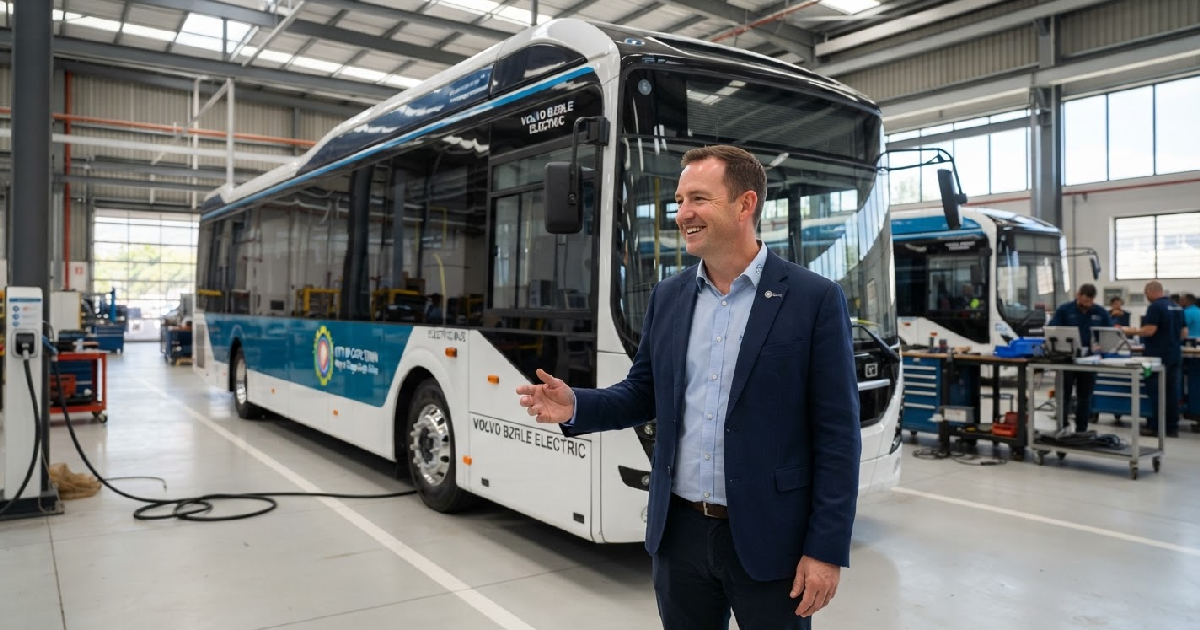
Cape Town will manufacture 38 additional electric buses for its MyCiTi public transport network, with Executive Mayor Geordin Hill-Lewis giving the go-ahead on July 25, 2026.
This initiative represents a strategic shift for the City of Cape Town towards modernising its transit systems and reducing reliance on fossil fuels. It also bolsters resilience against volatile diesel prices, providing a more stable operational foundation for public transport. The programme is a notable step in South Africa’s urban mobility evolution.
engineering the new electric bus fleet
The Volvo BZRLE electric buses, each measuring 12 metres long, symbolise a significant engineering advancement for the region. Their frames undergo assembly locally in Johannesburg, marking a crucial development in South Africa’s capacity for electric vehicle manufacturing. This allows for production specifically tailored for local road conditions.
This local production component is crucial for fostering economic growth and creating jobs within the country. It also underscores a commitment to developing indigenous capabilities in advanced transport technology, moving beyond mere importation towards active domestic production.
rigorous testing ensures operational readiness
Before full deployment, Cape Town is conducting a comprehensive 12-month pilot programme in partnership with the University of Cape Town (UCT). This research aims to meticulously study battery durability, charging times, and the buses’ performance under varied passenger loads. The impact of diverse route conditions and local weather on energy consumption will also form a critical part of the study.
Prototype e-buses underwent extensive trials this July across diverse test routes. These routes included Hospital Bend, the N2 highway, Camps Bay, Polkadraai Road, and Jip de Jager Drive. This thorough testing regimen ensures robust operational insights before the wider rollout.
powering the fleet with sustainable infrastructure
The decision to manufacture bus bodies in Johannesburg is a cornerstone of this electrification strategy. It allows Cape Town to not only adopt green technology but also to cultivate a local supply chain and expertise in electric vehicle production. This approach builds an industrial ecosystem capable of supporting and sustaining electric public transport into the future.
A crucial aspect of this transition involves establishing reliable charging infrastructure. The 38 new electric buses will charge at the MyCiTi depot, which is equipped with a solar photovoltaic system. This integration of renewable energy sources further enhances the environmental credentials and energy independence of the project.
operational benefits and emission reduction
The shift to electric buses offers substantial operational cost reductions. Some countries report savings of up to 70% due to lower fuel expenses and reduced maintenance requirements inherent in electric powertrains compared to traditional diesel engines. This efficiency directly benefits public transport budgets.
Moreover, deploying electric buses directly addresses air pollution in urban areas. This leads to cleaner air and improved public health outcomes, supporting Cape Town’s broader environmental goals. The transition contributes significantly to a healthier city for its residents.
navigating funding for a sustainable future
The MyCiTi Phase 2A expansion will extend the bus network to more than 30 communities, significantly improving connectivity and access to public transport for thousands. However, securing consistent funding remains a critical challenge for this growth. The National Treasury is phasing out the Public Transport Network Grant, which has historically financed Bus Rapid Transit (BRT) systems.
Cuts totalling R8.4 billion ($500.9 million) are expected over three years. Executive Mayor Geordin Hill-Lewis has warned that the continued expansion of the MyCiTi network hinges on sustained national funding. Cape Town already accounts for a significant 42% of all BRT passenger trips across South Africa.
lessons from early adopters and long-term vision
Cape Town isn’t entirely new to electric bus technology. Golden Arrow Bus Services (GABS), a local operator, began piloting electric buses in 2020. GABS received 20 electric buses from BYD in China in March 2025 and an additional 100 over the course of 2025. This shows growing confidence in electric bus technology within South Africa’s transport sector.
This parallel development offers valuable insights into real-world performance, operational costs, and maintenance requirements. The City of Cape Town’s project, supported by a €90,000 grant from the eBRT2030 Consortium (Urban Electric Mobility Initiative), is poised to deliver cleaner, more efficient, and more resilient urban transport.
timeline for cape town’s electric bus deployment
- July 2026: The first electric MyCiTi bus, “Evie,” completes performance tests. Prototype e-buses are piloted, and road tests for the first fully electric bus begin.
- July 24, 2026: The City of Cape Town reveals its first all-electric MyCiTi fleet bus, “Evie.”
- July 25, 2026: Mayor Geordin Hill-Lewis approves manufacturing for 38 more e-buses.
- August 2026: The first electric bus is expected for the MyCiTi network.
- October to December 2026: 12 low-floor e-buses are scheduled to arrive, with the first batch of 38 battery-electric vehicles expected before year-end.
- December 2026: The research project with UCT runs until at least this month, with a possible extension to June 2027.
- June 2027: The full first batch of 30 electric buses is due by this month.
- July 1, 2027: The first electric buses are expected to begin carrying passengers.
- 2027/2028: Planned roll-out of electric buses on routes serving the metro-south east corridor.
