


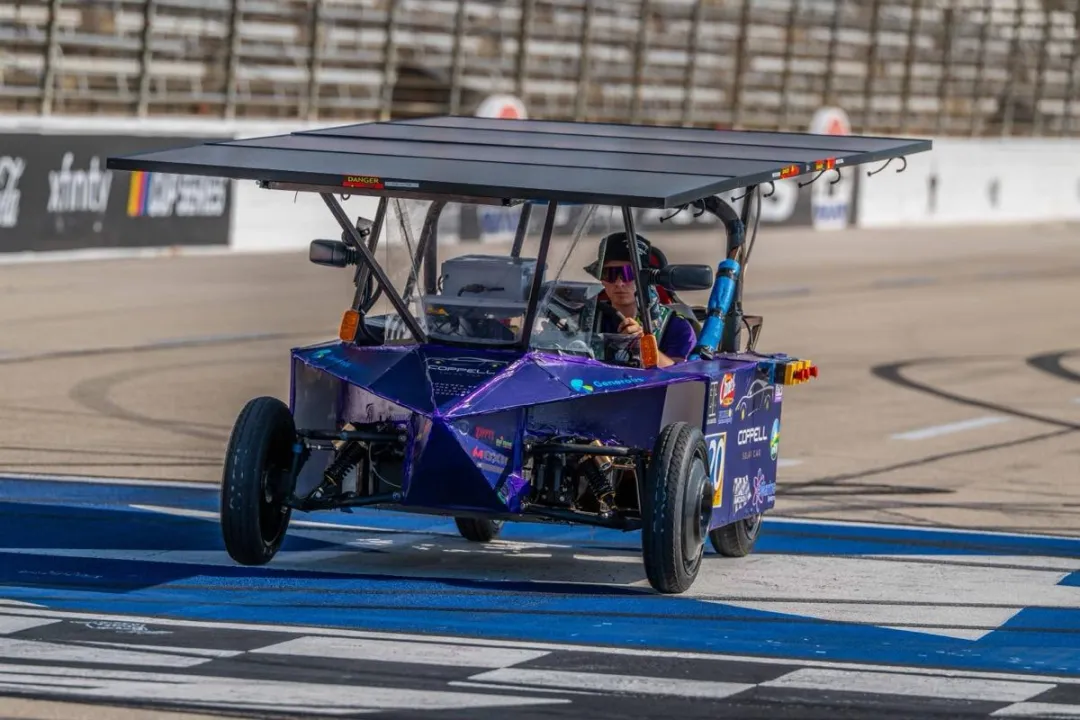
Dozens of high school student teams began a five-day, 630-mile solar car challenge on July 19, traversing Texas from Fort Worth to Fort Stockton.
This unique competition, founded by Dr. Lehman Marks, a Texas educator, highlights the practical application of renewable energy technology. It pushes young engineers to confront real-world design constraints and manufacturing processes, culminating in a road race that demands both technical precision and strategic thinking.
30 years of inspiring solar engineering talent
The Solar Car Challenge marks its 30th anniversary this year, celebrating three decades of fostering engineering talent among high school students. Since its inception, the programme has engaged over 85,000 students across 39 US states and several international countries, including Canada, Mexico, Costa Rica, Spain, and Singapore.
Currently, more than 260 active high school solar projects operate globally, building on the challenge’s educational framework. These initiatives cultivate crucial skills such as project management, budgeting, fundraising, and complex engineering disciplines, preparing students for future careers in technology and manufacturing.
From textbook frustration to hands-on creation
Dr. Lehman Marks established the Solar Car Challenge in response to what he observed as disengagement in traditional STEM education during the late 1980s and early 1990s. He sought a more dynamic approach to ignite student interest beyond conventional textbooks.
His inspiration came after students were captivated by a collegiate solar car project at the University of North Texas. Realising high school teams couldn’t compete equally against universities due to resource disparities, Marks initiated a dedicated challenge for younger students. The educational programme officially launched in 1993, with the first national competition following in 1995.
This foundational shift aimed to provide practical experience, moving beyond theoretical learning to tangible output. It created an environment where complex problems required innovative solutions, much like those faced daily in industrial engineering sectors.
Innovating solar vehicle design
The competition typically features categories such as Classic, Advanced, and Electric-Solar Power, allowing teams to compete based on their experience and technical approach. However, this year introduces a significant new category: Cruiser.
The Cruiser division challenges teams to build four-seater vehicles with solar arrays integrated directly into the car’s body. This design mandates space for four passengers, four doors, and a boot, pushing students to consider practical passenger vehicle requirements.
Building real-world solar cars
This new division addresses a long-standing critique that many solar cars barely resemble road-worthy vehicles, often appearing more like futuristic spacecraft or high-tech go-karts. Dr. Marks noted that the aim is to bridge the gap between experimental designs and consumer expectations.
Marks believes the Cruiser category demonstrates the practical applications of solar-powered transportation, helping the public visualise future solar-assisted passenger vehicles. It pushes students to blend aerodynamic efficiency with functional design, a key consideration for automotive engineering and manufacturing.
“People would say, ‘Oh, this is really neat, but it’s not reality,'” Marks explained. “Now we can show them what it could be. And I think that’s a step up.” This focus on integrated design reflects broader industry efforts to make renewable energy solutions more appealing and viable for mass adoption.
Student teams tackle complex manufacturing
Participating in the Solar Car Challenge demands comprehensive planning and execution, essentially requiring student teams to run a small-scale engineering and manufacturing operation. Each team manages everything from design and material sourcing to construction, safety testing, and finance.
The cars themselves are built using a combination of off-the-shelf parts and 3D printed materials, showcasing modern manufacturing techniques. Before hitting the road, vehicles must be road-legal, undergo extensive crash testing, and pass days of rigorous scrutineering by organisers to ensure safety and compliance.
Old Rip Racing’s year-long development
Blake Wood, a 17-year-old rising senior and captain of the Old Rip Racing team from Fort Worth Country Day high school, illustrates the depth of commitment required. His 14-member team, composed of students from three different schools, began planning approximately a year before the competition.
Their process started with paper sketches, followed by analysing successful designs from previous Classic Division races. This research informed their initial concepts, which then evolved into digital engineering models using computer-aided design (CAD) software. Learning these advanced design tools became an integral part of their educational journey.
Wood highlighted the iterative nature of their work. “We don’t really get to see it that often all put together,” he said, describing the continuous cycle of fixing, making, and reassembling components. This hands-on, problem-solving approach mirrors the realities faced by professional engineers and manufacturers daily.
The rigorous test of the open road
The 630-mile journey across Texas is not merely a symbolic finish line; it is a critical testbed for the student-built vehicles. The five-day trek starts in Fort Worth and travels through towns like Palestine, Round Rock, Fredericksburg, and San Angelo, before concluding in Fort Stockton.
This cross-country format, last used in 2018, exposes the cars to diverse terrains, from the wooded areas of East Texas to the rolling hills of central Texas and the flatlands of West Texas. Such varied conditions push the limits of vehicle reliability, battery management, and solar efficiency.
Dr. Marks emphasises the importance of extensive pre-race testing, urging teams to put 500 miles on their cars before the event. “You need to know, will it break?” he stated, advocating for failures to occur in a controlled environment where students can diagnose and implement fixes.
This practical training in reliability engineering is invaluable for anyone entering the manufacturing sector. It underscores the principle that rigorous testing and iterative improvement are fundamental to producing dependable industrial products.
Cultivating a future workforce for industrial technology
While solar-powered vehicles remain largely experimental compared to mainstream battery-electric vehicles, the Solar Car Challenge plays a vital role in nurturing future talent. Several startups pursuing solar cars have either pivoted to other technologies or faced bankruptcy, yet the underlying educational value of the challenge persists.
Blake Wood, despite the commercial challenges, remains optimistic about the long-term potential of solar vehicles. He believes that sustained educational competitions like this are crucial for exposing students to renewable energy technologies early, fostering the innovation needed for commercial viability.
Dr. Lehman Marks concurs, though he clarifies the core mission. “People say, ‘Well, are you trying to build a better solar car?'” he remarked. “Between you and me, I’m not.
I’m trying to build a student who is capable, who learns about commitment, dedication to a project, to learn about teamwork, to learn about engineering and battery technology. I’m trying to build a workforce and trying to build engineers.”
This outlook directly addresses the demand for skilled professionals in various industrial sectors, including sustainable energy, advanced manufacturing, and automotive design. The challenge acts as a critical pipeline, feeding dedicated and experienced young people into industries hungry for innovation.
The wider view of solar vehicle development
The distinction between the educational goals of the Solar Car Challenge and the commercial ambitions of solar vehicle startups is important. While companies like Sono Motors and Lightyear have faced significant hurdles, some, such as Aptera, continue to pursue mass-market solar car development.
The difficulties faced by commercial ventures underscore the complex engineering and economic barriers to widespread solar vehicle adoption. These include efficiency limitations, cost, and the integration of robust, aesthetically pleasing solar arrays that meet consumer demands.
The challenge for students, therefore, isn’t just to build a working prototype, but to grapple with these real-world constraints on a smaller scale. Their learning experiences contribute to a broader understanding of where the limits of current solar technology lie and where future breakthroughs are needed.
Ultimately, the Solar Car Challenge serves as a foundational platform for industrial progress. It doesn’t just showcase innovative student vehicles; it showcases the development of future engineers and manufacturers who will drive the next generation of sustainable technology and production processes.
