


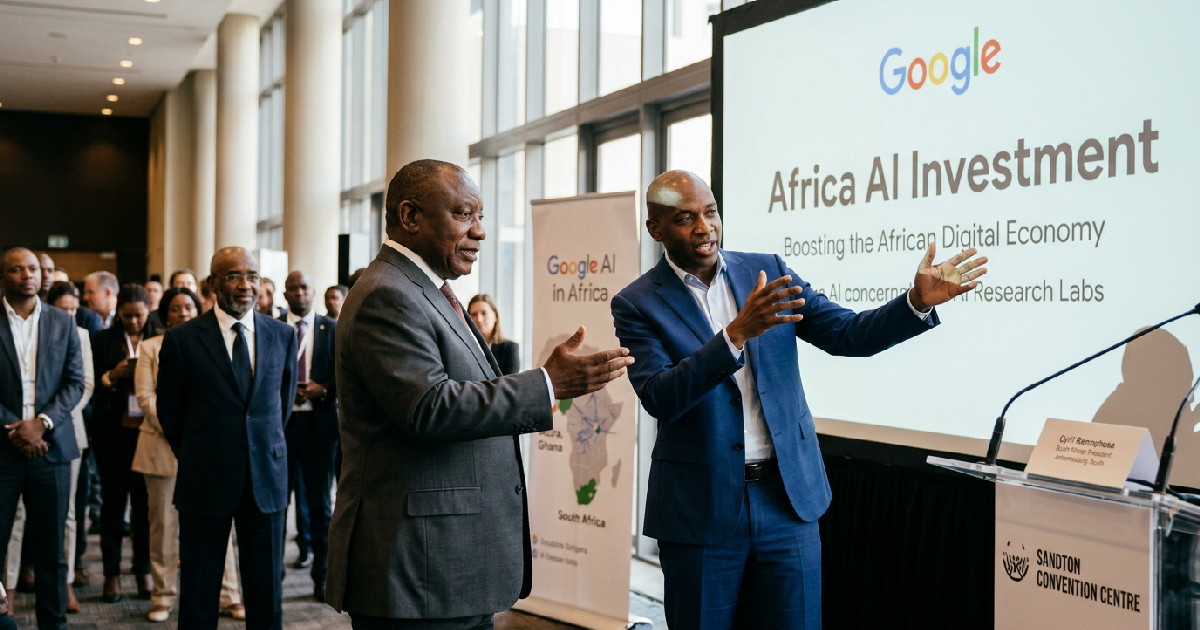
South African President Cyril Ramaphosa and Google executives used the inaugural Google Cloud Summit in Johannesburg on Wednesday, 1 July 2026, to outline a major pivot in the continent’s digital industrialisation. The event, held at the Sandton Convention Centre, brought together Google Senior Vice President James Manyika, Econet founder Strive Masiyiwa, and British actor Idris Elba to detail new investments in infrastructure and educational programmes designed to transition Africa from a technology consumer to a primary producer of artificial intelligence (AI).
James Manyika confirmed that Google has already exceeded its $1 billion investment commitment to Africa’s digital transformation. The company is now shifting its focus across the entire AI value chain, from subsea cables and computing power to workforce development. This move leverages South Africa’s existing position as a digital leader; the country currently hosts 70% of Africa’s hyperscale data centres, a factor that makes it a natural launchpad for the regional AI economy.
President Cyril Ramaphosa positioned the summit as a moment for Africa to take the “driving seat” of its own growth. While the president focused on the continent’s potential to produce globally competitive businesses, market data suggests the local impact will be substantial. The AI market in South Africa is currently valued at R50 billion and is projected to triple by 2030.
Infrastructure and the Digital Exchange Point in the Eastern Cape
To support this growth, Google announced the establishment of a South African Digital Exchange point in the Eastern Cape. This hub connects local networks to the Umoja subsea cable, creating the high-capacity links required for advanced AI applications. Such industrial connectivity and IoT infrastructure are essential for reducing latency and ensuring that African developers have the same high-speed access as their international counterparts.
The physical backbone of this strategy also includes the Johannesburg Cloud Region, which launched in 2025. 6 billion) to South Africa’s gross economic output by 2030. com/manufacturing-execution-system-strategic-lever-engineering-shift/”>Manufacturing Execution Systems to be deployed in regional factories without the lag associated with international routing.
Connectivity and subsea engineering
The Umoja cable represents a critical piece of subsea engineering, providing redundancy and reliable data flow for the continent. By establishing the Eastern Cape exchange point, Google is improving the reliability of digital public infrastructure. This is not merely about internet speed; it is about providing the stability required for agentic AI and automated industrial processes that cannot afford downtime.
The broader economic impact of these digital investments is already tangible. In 2023, Google’s impact on the South African digital economy was estimated at R118 billion. This includes productivity boosts from skills development, which contributed R5 billion in the same year. By building these pipes locally, the initiative seeks to lower costs for startups and large-scale industrial operators alike.
Funding AI research and educational institutions
Google.org has earmarked $2.85 million (~R49 million) for AI skills, education, and cybersecurity in South Africa for 2026. This funding is strategically distributed across several organisations to build a pipeline of technical talent. The allocation includes $1.5 million to the FATE Foundation and the African Institute for Mathematical Sciences (AIMS) to embed Google DeepMind’s AI Research Foundations Curriculum in South African universities.
Separately, Google is providing $1 million research grants each to the African Institute of Data Science and Artificial Intelligence and the Wits Machine Intelligence and Neural Discovery (MIND) Institute. These grants are specifically designed to foster high-level academic research. These investments ensure that the use of AI for coding and science is grounded in local contexts.
Applied AI and linguistic engineering
While South Africa serves as the hub for this summit, Google remains active across the continent. Africa’s first applied AI lab, the Google Africa Applied AI Lab, is located in Accra, Ghana. This lab focuses on practical software solutions that can be scaled across different markets. To solve the problem of linguistic exclusion, Google is also providing $3 million to Masakhane to develop AI tools for more than 40 African languages, ensuring that the software produced is functionally competent for the continent’s diverse population.
Additional funding for 2026 includes:
- $500,000 to Junior Achievement Africa for digital entrepreneurship training.
- $500,000 to the CyberSafe Foundation for cybersecurity education.
- $350,000 for the African Technology Forum AI Challenge.
- R9.5 million to Nelson Mandela University for cybersecurity seminars.
Creative partnerships and digital innovation centres
The summit highlighted the role of AI in the creative economy through a partnership with the Akuna Group, founded by British actor Idris Elba. Backed by more than $1 million (R17 million) in Google.org funding, the initiative will train creators across sub-Saharan Africa in AI storytelling tools. Elba noted that while the continent is full of talent, a lack of access to technical tools has historically been a barrier. AI aims to bridge that gap by automating production tasks.
On the local development front, Google is investing R3 million in a digital innovation centre in Soweto. Partnered with WeThinkCode, the centre is located at the George Tabor Campus of South West Gauteng TVET College. This facility focuses on bringing technical training to young adults in industrial townships, building on the 300,000 South Africans who reportedly developed new digital skills through Google platforms in 2023.
By positioning AI as an enabling technology rather than a standalone product, the announcements at the Sandton Convention Centre suggest a more integrated approach to industrial growth. The focus now shifts to how these investments in South African infrastructure and continental education will translate into homegrown intellectual property and competitive industrial exports. Africa is no longer just waiting for the future; it is building the infrastructure to run it.
