


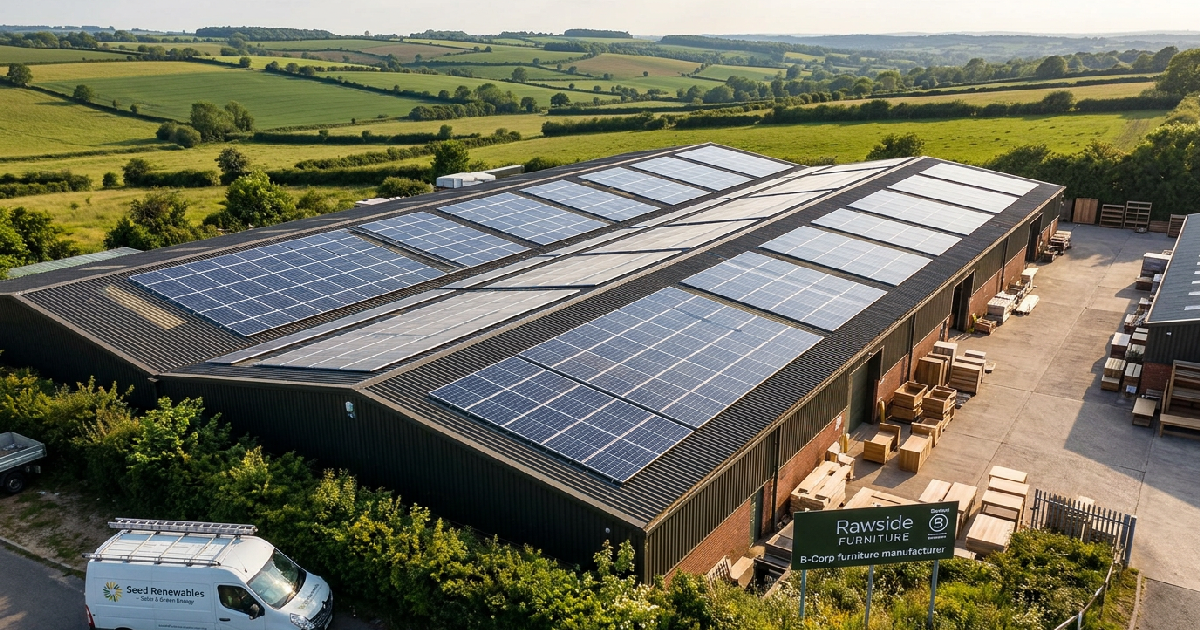
Rawside Furniture has completed the installation of a 191-panel rooftop solar PV system at its Hampshire manufacturing facility near Winchester to decarbonise its production of commercial furniture.
The project, designed and delivered by turnkey renewable energy specialist Seed Renewables, is expected to generate nearly 100,000kWh of electricity annually, providing enough clean power to offset approximately 32.5 tonnes of carbon emissions every year.
Engineering energy resilience at the Winchester production hub
This investment serves as a major operational upgrade for the certified B-Corp company as it seeks to insulate itself from volatile grid pricing while maintaining its commitment to sustainable manufacturing.
The new solar array is integrated directly into the day-to-day operations of the Sylcombe Farm site in Ropley, where the company transitioned its fulfillment and workshop operations following the purchase of the warehouse in February 2020.
Since completing additional warehouse construction in March 2022, Rawside Furniture has worked to transform the facility into a model of circular production. The solar installation represents the latest phase of this effort, aligning the facility’s high daytime energy demand with the peak generation periods of the photovoltaic panels to maximise self-consumption.
For Richard Gann and Liz Close, the co-founders of Rawside Furniture, the project is a strategic response to the dual pressures of environmental responsibility and industrial energy resilience.
By generating power on-site, the manufacturer reduces its reliance on the national grid, a move that is becoming increasingly common among UK makers facing high industrial electricity costs.
The Winchester facility, which houses a team of more than 60 people, now functions with a significantly lower carbon footprint, supporting the company’s broader mission to produce workplace and hospitality furniture with minimal ecological impact.
The technical deployment of 191 solar panels across the Ropley facility required a bespoke approach to ensure the system met the specific load requirements of heavy woodworking machinery. Seed Renewables tailored the rooftop solar PV system to sync with the operational hours of the factory, where energy consumption peaks during daylight hours.
Key details
This alignment is critical for manufacturers because it allows them to consume the majority of their generated power in real-time, avoiding the inefficiencies of battery storage or the lower financial returns of exporting excess energy back to the grid.
Lee Heath, CEO of Seed Renewables, noted that manufacturing businesses are uniquely positioned to benefit from rooftop solar because their production cycles typically mirror the sun’s trajectory. By utilising existing roof space, Rawside Furniture has essentially turned an idle asset into a power plant.
The system is designed to provide a stable, predictable cost for a portion of the factory’s electricity, sheltering the business from the price spikes that have plagued the UK energy market in recent years.
This engineering shift reflects a wider trend where companies are viewing manufacturing execution system as strategic lever for plant efficiency and operational stability. In Rawside’s case, the physical infrastructure of the solar array acts as a foundation for their wider sustainability goals, allowing the engineering team to plan production runs with a clearer understanding of their energy overheads and carbon output per unit produced.
Technical specifications and carbon mitigation targets
The output of 100,000kWh annually is not merely a symbolic figure; it represents a substantial percentage of the facility’s total energy requirement. In an industry where kiln drying and CNC machining consume significant amounts of power, displacing grid electricity with solar energy significantly lowers the “embedded carbon” of each piece of furniture.
The 32.5 tonnes of carbon saved annually is equivalent to the sequestration capacity of hundreds of mature trees, providing a measurable metric for the company’s annual B-Corp impact reports.
Detailed building work at the Ropley site, which began in November 2021, provided the structural basis for this solar integration. The facility was designed to handle the weight and electrical requirements of a large-scale renewable system, ensuring that the 191 panels could be installed safely and efficiently.
This forward-thinking approach to facility design is a hallmark of modern industrial engineering, where the physical structure of a factory is treated as an active participant in the production process rather than just a shell.
Sustainability as a core furniture manufacturing philosophy
Rawside Furniture, which achieved its B-Corp certification on July 18, 2023, after a rigorous three-year assessment, has long operated on the principle that industrial output must not come at a net loss to the environment. The company’s Hampshire factory already employs several circular manufacturing techniques.
For instance, the workshop maintains a zero-wood-waste policy; offcuts are either repurposed for smaller products, used in a log burner to heat the factory, or processed through an on-site briquetter to create heating fuel for the local community.
The company also prioritises local sourcing to reduce Scope 3 emissions. By sourcing sheet materials from nearby providers in Belgium and keeping other supply chains within the UK, the team minimises the logistics-related footprint of their raw materials.
Key details
This focus on ethical procurement and waste reduction recently extended to packaging, where the company introduced a CNC cardboard cutting machine to produce bespoke, recycled packaging that eliminates the need for plastic fillers and makes end-user recycling easier.
As the African IoT sector expands through industrial connectivity to track supply chain metrics, UK manufacturers like Rawside are using physical hardware—like solar panels and log burners—to achieve similar transparency in their energy cycles.
The integration of a log burner and solar panels creates a multi-layered energy strategy: solar provides the power for the machines, while wood waste provides the thermal energy for the building, effectively closing the loop on two major operational costs.
Strategic implications for the British furniture sector
The investment by Richard Gann and Liz Close comes at a time when the British furniture industry is facing intense competition from low-cost imports. By leaning into the “Maker” identity and highlighting their B-Corp status, Rawside is differentiating its products through the values of durability and responsibility.
The Shoreditch showroom in London serves as the public face of this engineering effort, linking high-end commercial design with the gritty reality of sustainable production in Hampshire.
Future iterations of the facility are expected to include rainwater harvesting, further reducing the site’s environmental impact. This holistic approach to factory management suggests that for Rawside, the solar project is not an isolated green initiative but part of a continuous engineering evolution.
Key details
The company’s ability to score 88 points on its initial B-Impact Assessment—surpassing the 80-point threshold—was largely due to these integrated practices that treat manufacturing as an ecosystem rather than a linear assembly line.
For individual engineers and makers looking to follow this path, the primary lesson from the Winchester facility is the importance of site-specific energy planning. Rawside did not simply buy off-the-shelf panels; they commissioned Seed Renewables to design a system that “integrated seamlessly” into day-to-day operations.
This meant ensuring that peak solar periods aligned with the heaviest machine usage, a calculation that requires a deep understanding of electrical loads and production schedules.
Future outlook for renewable-led manufacturing facilities
As we look toward the end of the decade, the success of projects like Rawside’s Winchester facility will likely encourage more SMEs to invest in their own energy infrastructure.
The financial case for solar in manufacturing is becoming undeniable, especially as industrial and engineering stocks rally on the back of improved operational efficiency and green credentials.
For Rawside, the focus now shifts to demonstrating the long-term resilience that Liz Close highlighted, showing that a furniture maker can remain competitive while strictly adhering to carbon-neutral goals.
Key details
The next phase for the company involves expanding their London presence while continuing to refine the engineering processes in Hampshire. With building work completed and the solar array active, the facility is now at full operational capacity, capable of meeting the growing demand for sustainable workplace furniture.
By anchoring their brand in the reality of their Hampshire workshop, Rawside provides a clear example of how traditional manufacturing can be modernised through targeted technological and renewable investments.
The project serves as a practical blueprint for other UK manufacturers. It demonstrates that decarbonisation is not just about meeting regulatory targets, but about building a more resilient, cost-effective, and independent business model. As Rawside Furniture moves toward its next B-Corp recertification, the 100,000kWh of clean energy generated annually will stand as the strongest evidence of its commitment to making things better—not just more.
