


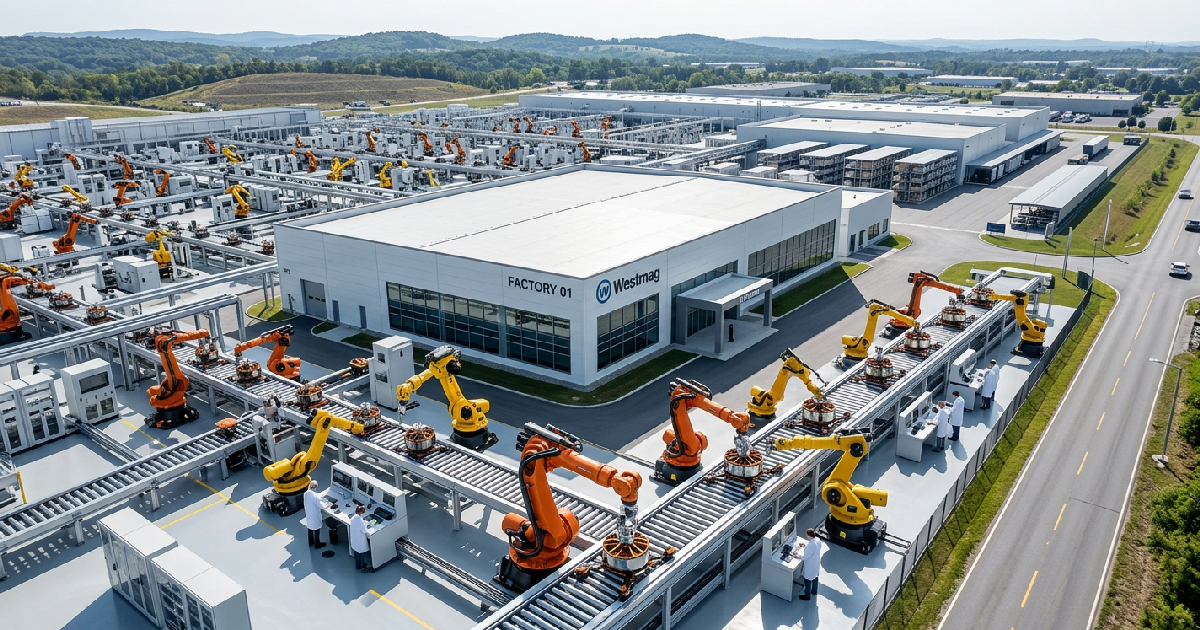
Westmag, a California-based propulsion hardware startup, emerged from stealth on 2 June 2026, following a $11 million seed funding round led by Andreessen Horowitz. The capital injection is earmarked to rebuild America’s industrial base for robotics by establishing high-volume domestic manufacturing for drone motors and robot actuators. The company aims to address a decades-old dependency on foreign manufacturing, primarily from China, for these critical components.
The company, also known as Western Magnetics Company, is scaling its headquarters and manufacturing facility, “Factory 01,” located in South San Francisco. Westmag has set an ambitious target to reach over 30 million units in annual production capacity before 2030. This expansion follows regulatory shifts, including the December 2025 FCC ban on the sale of new models of foreign-made drones and critical components, which has intensified the need for secure, domestic supply chains.
Westmag’s strategy focuses on vertical integration to ensure national security and economic resilience. This approach mirrors wider efforts to stabilise industrial output, similar to how stable electricity for Nigerians remains a priority for regional industrial growth. For engineers, the move signifies a shift toward controlled, traceable hardware that satisfies both commercial logistics requirements and government procurement mandates.
Engineering domestic solutions for rare earth obstacles
Westmag was founded in 2023 by aerospace engineers and materials scientists to bypass the supply chain risks associated with neodymium permanent magnets. Currently, these magnets are almost entirely centralised outside the West, leaving domestic drone makers vulnerable to supply volatility. CEO David Hansen noted that most hardware bringing motion to physical AI has historically been built outside the U.S., but he maintains that this does not have to be the case.
Technical innovation at Westmag centres on a proprietary electromagnetic framework and superior stator and coil designs. Through a redesign of motor geometry and flux paths, the startup has built electric propulsion systems that outperform typical UAV power-to-weight ratios while minimising the use of rare earth minerals. This engineering focus allows the firm to produce high-performance hardware that remains cost-effective compared to international commodity motors.
The market for these components is expanding rapidly. The global drone motor market, valued at nearly $2.4 billion in 2024, is projected to exceed $5.7 billion by 2029. Additionally, the robot actuator market is expected to double to nearly $4 billion by 2030. In humanoid robots, actuators represent 40% to 60% of production costs, making Westmag’s domestic supply critical for the 20+ actuators required per robot.
Transitioning to high-rate automated production
The $11 million investment serves as a pivot point for Westmag to move from low-rate prototyping to high-volume assembly. At the San Diego facility, the company is implementing advanced robotics and automated winding machinery to increase production throughput by an estimated 500% over the next year. Every unit produced on these integrated lines at Factory 01 is validated and documented with a fully traceable digital twin.
To control the bill of materials and improve cost structures, Westmag is investing upstream in subcomponent production. This includes in-house or allied finishing for rare earth magnets and electromagnet stator steel stamping involving partners in the U.S. and Japan. This rigorous quality control is as vital to hardware as addressing AI infrastructure faults is to software security and compliance.
Initial production efforts are focused on fulfilling committed orders for tens of thousands of units. The company has prioritised initial product development by partnering directly with select high-volume customers through supply offtake agreements. These partnerships involve tier-one defence contractors and logistics operators who have already subjected the hardware to rigorous field testing.
Closing the 30 million unit manufacturing gap
The scale of international competition is stark; China currently builds more than 30 million more drone motors and robot actuators annually than the United States. Westmag intends to close this gap by leveraging flexible automation and replicable production modules. These common building blocks allow the factory to scale for a wide variety of customer applications, from multirotor motors to heavy-lift systems for cargo drones.
The company’s growth is supported by a broad group of institutional investors, including Founders Fund, Lux Capital, NFDG, Menlo Ventures, and Shield Capital. These investors are increasingly backing dual-use technologies that serve both commercial enterprise and national security functions. By focusing on materials science and automated assembly, Westmag is positioning itself to be a primary domestic source for the heart of autonomous platforms.
Westmag’s emergence reflects a broader industrial movement toward hardware security. By aggregating rising demand, the company intends to become a trusted supplier of high-performance motors and actuators for the global market. The focus remains on ensuring that the hardware driving the next generation of robotics is both resilient and manufactured within a secure industrial base.
