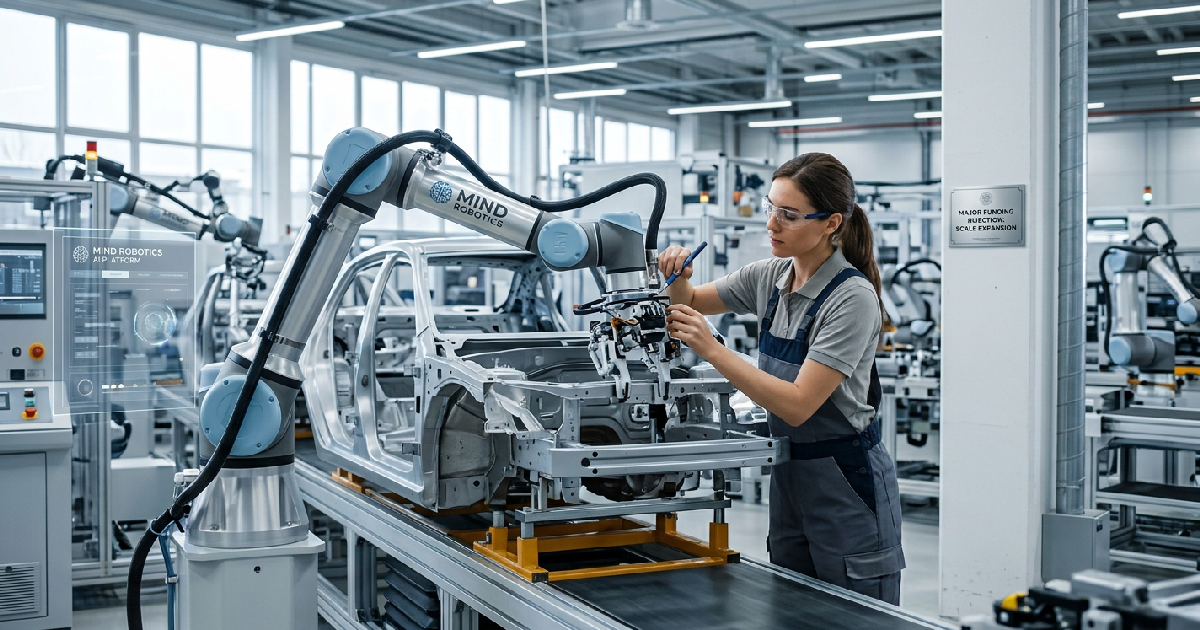
Building on its foundations in the electric vehicle sector, Mind Robotics has secured a significant capital injection led by Kleiner Perkins to scale its artificial intelligence-driven industrial robotics platform. The funding round reportedly includes several prominent Silicon Valley venture capital firms, marking a major commitment to the integration of advanced software with heavy industrial hardware. The company, which emerged from the engineering ecosystem of electric vehicle manufacturer Rivian, intends to deploy this capital to expand its engineering teams and accelerate the roll-out of machines capable of handling complex manufacturing tasks.
This latest move reinforces a trend where investment is flowing toward the
industrial and engineering sectors as manufacturers seek to mitigate labour shortages through automation. By developing a full-stack platform, Mind Robotics aims to address the flexibility gap in traditional factory automation, where machines often struggle to adapt to changing floor conditions or varied assembly requirements.
Engineering AI for Physical Manufacturing Environments
Mind Robotics distinguishes itself by managing the entire technical lifecycle of its products, from the underlying AI foundation models to the physical sensors and actuators. In most modern factories, robotic arms operate on fixed scripts, performing repetitive tasks like welding or palletising. The systems developed by Mind Robotics are engineered for roles that demand finer motor control and situational awareness, such as intricate part inspection and multi-stage assembly.
The engineering challenge lies in creating a unified system where software and hardware are designed in tandem. Traditional methods of layering third-party AI onto legacy robotic frames often result in latency issues or mechanical limitations. By controlling the hardware blueprints, the company ensures its machines can execute the high-speed “reasoning” provided by its software without the physical bottlenecks common in retrofitted industrial systems.
This technical synergy is increasingly vital as the
expansion of industrial connectivity allows for a constant stream of data between factory floors and central processing units. The robots currently active on production lines act as data nodes, processing real-world manufacturing inputs to refine their movement patterns and error-detection capabilities over time.
Scaling Beyond Automotive Production Lines
While the company has deep roots in automotive manufacturing, the new funding provides the resources to move into broader industrial verticals. Engineering teams are reportedly targeting electronics assembly and aerospace components—sectors where high-volume production requires constant adjustment and a high degree of precision. The objective is to transition from “set-and-forget” automation to autonomous systems that can troubleshoot errors on a production line without manual intervention.
The company’s technical roadmap involves the introduction of robotic units with improved mechanical tolerances. These units are expected to take on quality control roles previously reserved for human eyes and hands. As these systems become more prevalent, the
infrastructure reliability of a facility’s digital backbone becomes a critical factor in performance, ensuring that high-bandwidth data from robotic sensors flows to training models without interruption.
Market Trajectory and the Shift to Physical AI
The participation of major investors like Meritech Capital and Redpoint Ventures suggests a growing consensus that the next frontier for artificial intelligence is the physical world. For years, AI was largely confined to digital environments, but the convergence of high-performance computing and advanced mechanical engineering has made physical deployment more feasible.
Mind Robotics enters a competitive field occupied by both established industrial giants and a new cohort of well-funded startups. However, its access to live factory data through its operational history with Rivian provides a significant advantage in training its models. The company now plans an aggressive hiring phase for its operations and engineering departments to manage an increased production load and fulfill new manufacturing partnerships expected in the coming months.
As the global manufacturing industry pivots toward smarter, more adaptable machines, the focus is shifting away from simple cost-cutting. The goal now is to build resilient production systems that can operate with high autonomy in an increasingly complex global supply chain.