


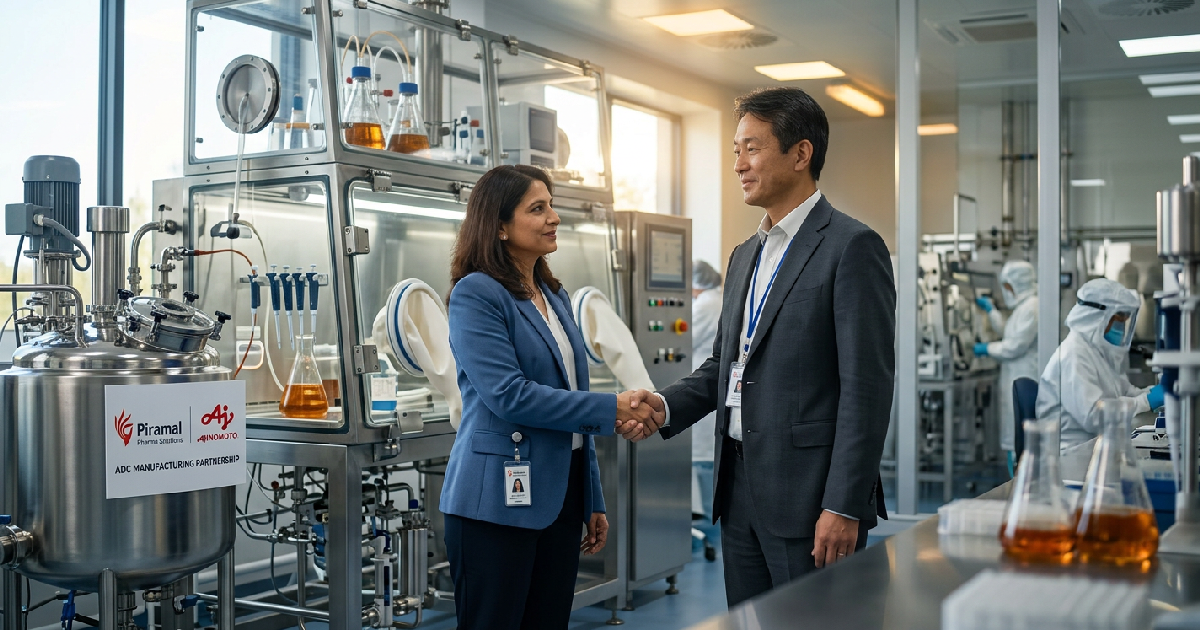
Manufacturing specialized cancer treatments requires a level of precision that few individual companies can manage entirely in-house. This reality is driving a new collaboration between Piramal Pharma Solutions and Ajinomoto Bio-Pharma Services, as both firms look to consolidate their standing in the antibody-drug conjugate (ADC) market. By aligning their respective strengths, the two companies aim to simplify the supply chain for pharmaceutical developers working on these complex therapies.
ADCs are often described as “guided missiles” for cancer. They work by linking a potent cell-killing agent to an antibody that specifically targets cancer cells, sparing healthy tissue from the damage typically associated with traditional chemotherapy. But producing them is a logistical headache. It requires expertise in biologics, high-potency chemical synthesis, and the delicate process of conjugation—joining the two components together. The new partnership between Piramal and Ajinomoto is designed to offer a more unified path through this technical maze.
Consolidating the ADC supply chain
The primary hurdle in ADC production has long been the fragmented nature of the industry. Typically, a drug developer might have to contract one facility to produce the antibody, another to manufacture the toxic payload, and a third to handle the conjugation and final fill-finish work. Each handoff introduces risk, adds time, and complicates regulatory compliance.
Through this agreement, the two players are looking to provide a “one-stop-shop” experience. Piramal brings its extensive experience in handling high-potency active pharmaceutical ingredients (HPAPIs) and its established facilities for ADC development. Ajinomoto contributes its proprietary protein expression technologies and specialized knowledge in site-specific conjugation. Together, they believe they can reduce the lead times that often stall therapeutic candidates in the middle of clinical trials.
Geographic and technical synergy
The partnership isn’t just about sharing lab space; it’s about matching specific technical capabilities. Ajinomoto has spent years refining its AJICAP technology, which allows for more controlled conjugation. This is a critical factor in ensuring that the drug is stable and that each dose has a consistent amount of the therapeutic payload attached to the antibody. If the ratio is off, the drug could be either ineffective or dangerously toxic.
Piramal, meanwhile, has invested heavily in its global manufacturing footprint. The company has recently expanded its capacity to handle the increasingly large volumes required as more ADC candidates move out of early-stage research and into late-phase trials. By pairing these manufacturing hubs with Ajinomoto’s technical platforms, the duo is positioning itself to capture a larger share of the outsourcing market from biotech firms that lack their own manufacturing infrastructure.
The rising demand for targeted oncology
The timing of the deal reflects a broader shift in the oncology landscape. After a decade of incremental progress, the ADC sector has exploded with new approvals and massive licensing deals. But as the science matures, the bottleneck has shifted from R&D to production capacity. There is a looming shortage of facilities capable of handling the highly toxic materials involved in ADC synthesis while maintaining the sterile conditions required for biologics.
And because these drugs are becoming more personalized, the batches are often smaller and more frequent. This requires a flexible manufacturing approach that large, rigid facilities struggle to provide. The Piramal-Ajinomoto alliance is a bet on the idea that specialized, nimble partnerships will be the dominant model for the next generation of cancer drug development.
Navigating regulatory and safety requirements
Safety remains the invisible thread running through this partnership. Handling payloads that are designed to kill cells requires specialized containment systems and rigorous worker protection protocols. Piramal has built a reputation on its ability to manage these high-risk substances, which is a significant barrier to entry for many CDMOs (Contract Development and Manufacturing Organizations).
As regulatory agencies like the FDA and EMA tighten their scrutiny of ADC manufacturing, having a streamlined process under a single collaborative umbrella becomes a competitive advantage. It simplifies the audit process and ensures that data integrity is maintained from the initial chemical synthesis through to the final vial. For drug developers, this reduced regulatory friction is often as valuable as the technical expertise itself.
A collaborative future for biopharma manufacturing
This move suggests that the era of the “do-it-all” mega-corporation may be giving way to strategic alliances between specialists. Neither Piramal nor Ajinomoto is attempting to absorb the other; instead, they are creating a shared ecosystem that plays to their individual strengths. It is a pragmatic response to a market where the science is moving faster than the physical infrastructure to support it.
While the immediate focus is on existing ADC technologies, the partnership likely has one eye on the future. New iterations of these drugs, including those using different linkers or double payloads, will require even more precise manufacturing. By locking in this collaboration now, Piramal and Ajinomoto are ensuring they remain at the center of the conversation as oncology moves toward even more sophisticated targeted treatments.
